. 2021 Nov 26;11(11):186.
doi: 10.1038/s41408-021-00569-2.

Assessing the prognostic utility of smoldering multiple myeloma risk stratification scores applied serially post diagnosis

Affiliations

Assessing the prognostic utility of smoldering multiple myeloma risk stratification scores applied serially post diagnosis

Alissa Visram et al. Blood Cancer J. .

Abstract

The Mayo-2018 smoldering multiple myeloma (SMM) risk score is used routinely in the clinical setting but has only been validated at diagnosis. In SMM patients, the progression risk decreases over time. However, the utility of applying risk stratification models after diagnosis is unknown. We retrospectively studied 704 SMM patients and applied the Mayo 2018 and IMWG-2020 risk stratification models at annual landmark timepoints up to 5 years post diagnosis. The Mayo-2018 and IMWG-2020 models reliably stratified patients based on progression risk when applied post diagnosis. The respective 2-year progression risk in Mayo-2018 high risk patients versus IMWG-2020 intermediate-high risk patients was 51% versus 62% at the 1-year landmark and 47% versus 45% at the 4-year landmark. We showed that patients categorized at Mayo-2018 high-risk at follow-up had a similar risk of progression if the baseline risk assessment was low-intermediate versus high-risk (HR 1.04, 95% CI 0.46-2.36, p = 0.931 at 5-year landmark). Patients migrating to a higher risk category during follow up had a higher progression risk compared to patients with stable/decreased risk categorization. Our findings support the use of these risk scores post-diagnosis and suggest that patients evolving to a high-risk category may benefit from early intervention therapeutic approaches.


Conflict of interest statement

The authors declare no competing interests.

Figures

Fig. 1
Fig. 1. Time to progression (TTP) stratified by the Mayo 2018 risk score.
SMM patients were stratified by the Mayo 2018 score based on the MCP, FLCr, and BMPC at diagnosis (dashed lines) or the updated values at the post-diagnosis timepoint (solid lines). The TTP is at baseline (A), and post-diagnosis landmarks of 2 years (B), 3 years (C), and 4 years (D). At each timepoint there was a significant difference in the TTP based on risk categorization is based on baseline or follow up risk factors (log rank p < 0.001).
Fig. 2
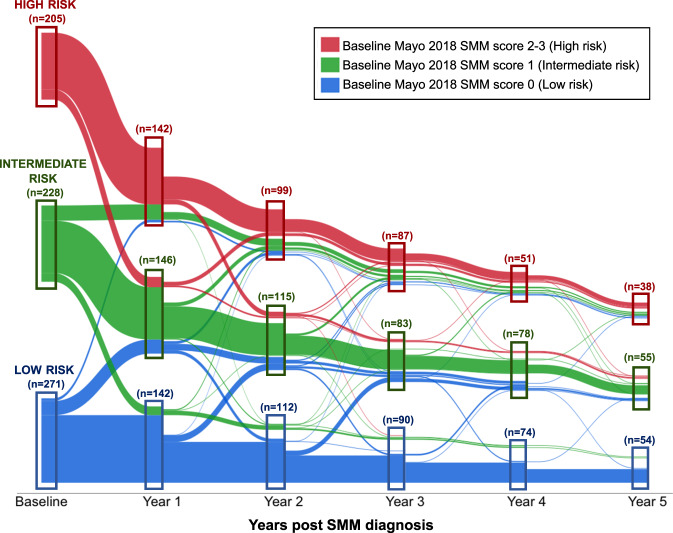
Fig. 2. Parallel plot demonstrating the change in the Mayo 2018 SMM risk score over time.
The colored lines represent patients based on their baseline SMM risk stratification, as shown in the legend. The line thickness is proportional to the number of patients within each SMM score stratum. At each annual time point post SMM diagnosis, the boxes represent the composition of patients re-categorized at high risk (red box), intermediate risk (green box), or low risk (blue box). This plot demonstrates that in some SMM patients, the risk categorization is dynamic over time.
Fig. 3
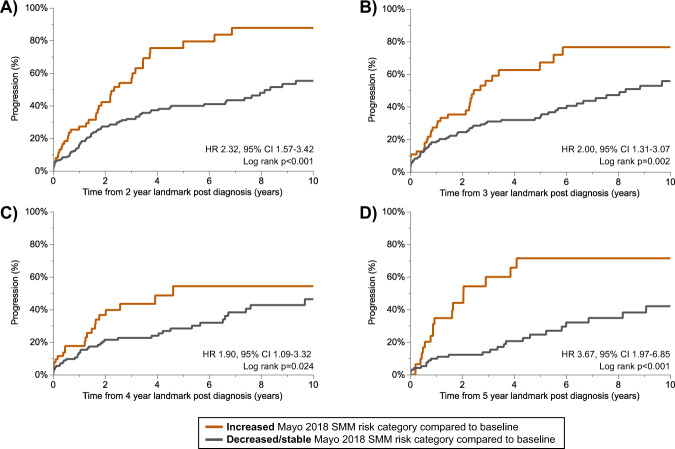
Fig. 3. The time to progression, stratified by migration of SMM Mayo 2018 risk category during follow up.
Patients were grouped based on whether the Mayo 2018 category at follow up was increased or stable/decreased compared to baseline. The stage migration of SMM patients without progression at 2 years (A), 3 years (B), 4 years (C), and 5 years (D) post SMM diagnosis is shown. The percentage of patients evolving to a higher risk category was 20% at the 2-year landmark, 23% at the 3-year landmark, 29% at the 4-year landmark, and 24% at the 5-year landmark.
Fig. 4
Fig. 4. The TTP over time based on the IMWG 2020 risk stratification.
The TTP is presented stratified by the SMM risk score at baseline (A), and post-diagnosis landmarks of 1 year (B), 2 years (C), and 3 years (D). The risk score was re-assessed based on updated data at each time point.
Fig. 5
Fig. 5. The time to progression, stratified by migration of SMM IMWG 2020 risk category during follow up.
Patients were grouped based on whether the IMWG 2020 category at follow up was increased or stable/decreased compared to baseline. The stage migration of SMM patients without progression at 1 year (A), 2 years (B), 3 years (C), and 4 years (D) post SMM diagnosis is shown. The percentage of patients evolving to a higher risk category was 20% at the 1-year landmark, 26% at the 2-year landmark, 30% at the 3-year landmark, and 36% at the 5-year landmark.

References

    1. Rajkumar SV, Dimopoulos MA, Palumbo A, Blade J, Merlini G, Mateos MV, et al. International Myeloma Working Group updated criteria for the diagnosis of multiple myeloma. Lancet Oncol. 2014;15:e538–48. doi: 10.1016/S1470-2045(14)70442-5. - DOI - PubMed
    1. Mateos MV, Hernández MT, Giraldo P, de la Rubia J, de Arriba F, Corral LL, et al. Lenalidomide plus dexamethasone versus observation in patients with high-risk smouldering multiple myeloma (QuiRedex): long-term follow-up of a randomised, controlled, phase 3 trial. Lancet Oncol. 2016;17:1127–36.. doi: 10.1016/S1470-2045(16)30124-3. - DOI - PubMed
    1. Mateos M-V, Hernández M-T, Giraldo P, De La Rubia J, De Arriba F, Corral LL, et al. Lenalidomide plus Dexamethasone for High-Risk Smoldering Multiple Myeloma. New Engl J Med. 2013;369:438–47. doi: 10.1056/NEJMoa1300439. - DOI - PubMed
    1. Lonial S, Jacobus S, Fonseca R, Weiss M, Kumar S, Orlowski RZ, et al. Randomized trial of lenalidomide versus observation in smoldering multiple myeloma. J Clin Oncol. 2020;38:1126–37.. doi: 10.1200/JCO.19.01740. - DOI - PMC - PubMed
    1. Lakshman A, Rajkumar SV, Buadi FK, Binder M, Gertz MA, Lacy MQ, et al. Risk stratification of smoldering multiple myeloma incorporating revised IMWG diagnostic criteria. Blood Cancer J. 2018;8:59. doi: 10.1038/s41408-018-0077-4. - DOI - PMC - PubMed