. 2021 Nov 26;11(1):23008.
doi: 10.1038/s41598-021-02338-4.

The reserve of joint torque determines movement coordination

Affiliations

The reserve of joint torque determines movement coordination

Germain Faity et al. Sci Rep. .

Abstract

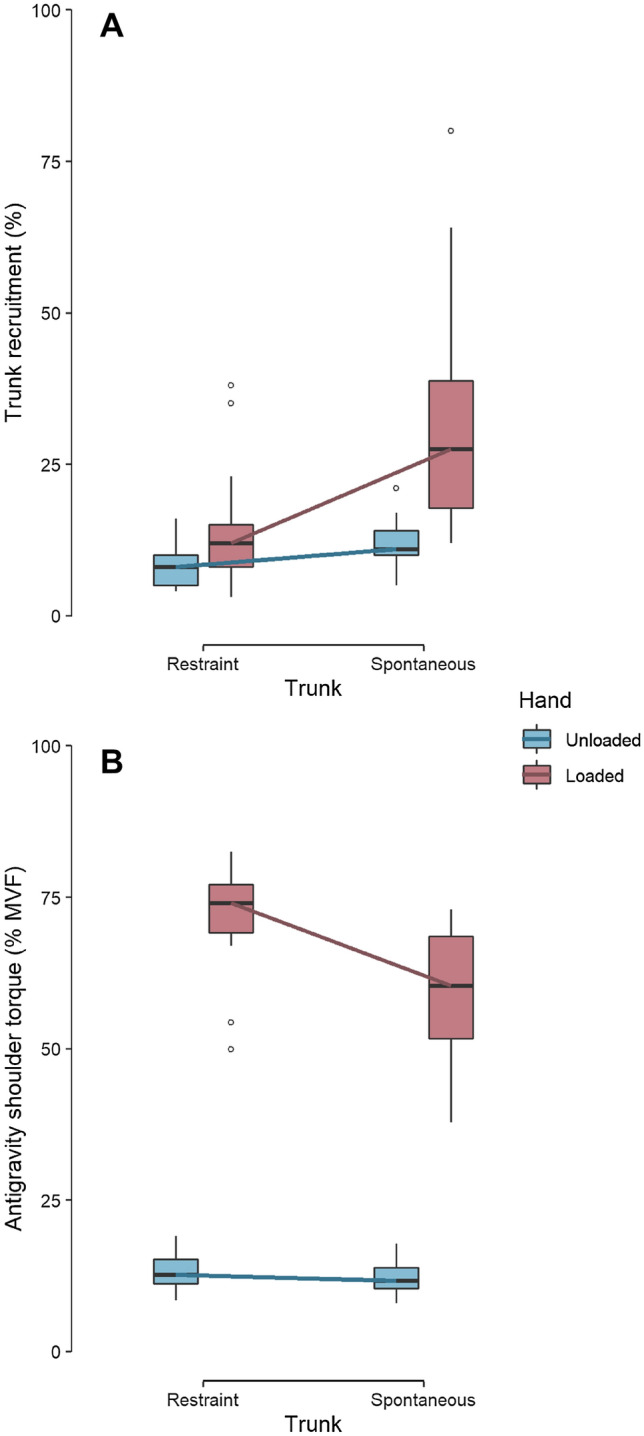
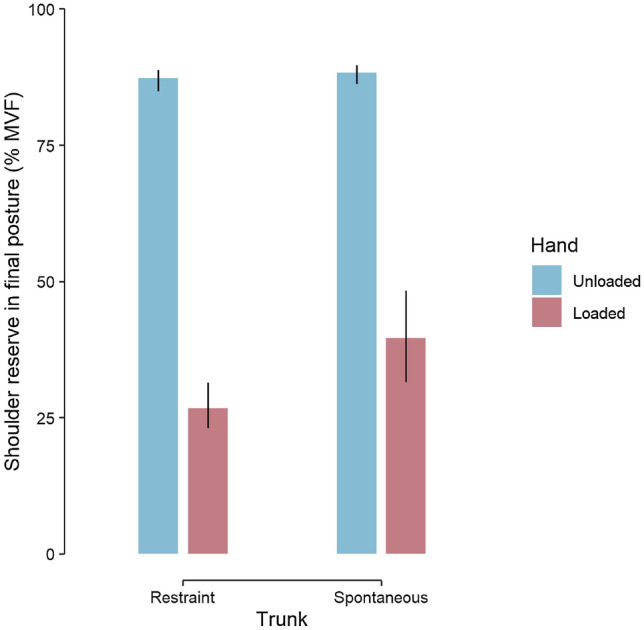
Humans coordinate biomechanical degrees of freedom to perform tasks at minimum cost. When reaching a target from a seated position, the trunk-arm-forearm coordination moves the hand to the well-defined spatial goal, while typically minimising hand jerk and trunk motion. However, due to fatigue or stroke, people visibly move the trunk more, and it is unclear what cost can account for this. Here we show that people recruit their trunk when the torque at the shoulder is too close to the maximum. We asked 26 healthy participants to reach a target while seated and we found that the trunk contribution to hand displacement increases from 11 to 27% when an additional load is handled. By flexing and rotating the trunk, participants spontaneously increase the reserve of anti-gravitational torque at the shoulder from 25 to 40% of maximal voluntary torque. Our findings provide hints on how to include the reserve of torque in the cost function of optimal control models of human coordination in healthy fatigued persons or in stroke victims.


Conflict of interest statement

The authors declare no competing interests.

Figures
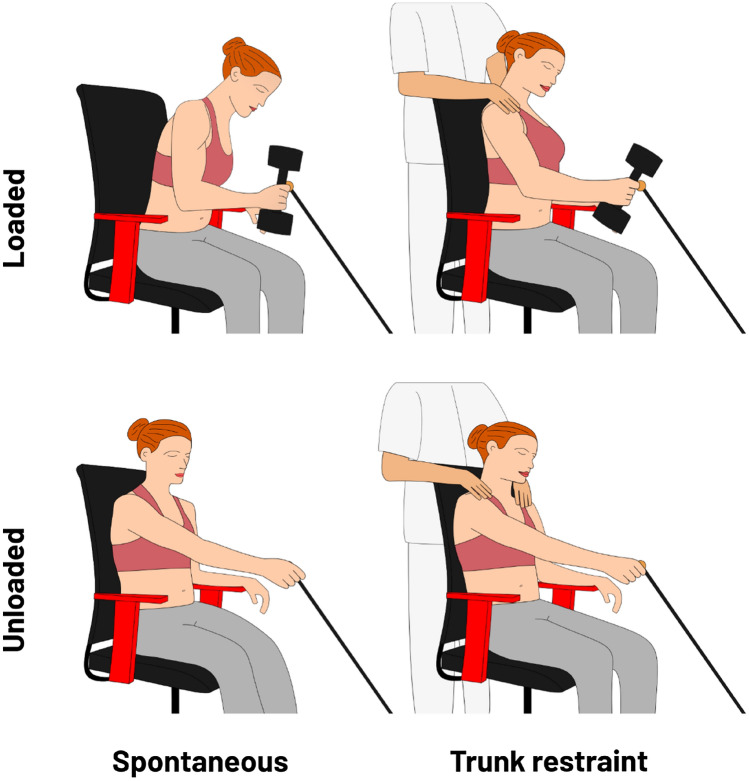
Figure 1
Figure 1
Schema of the four experimental conditions. In the loaded conditions (upper row), participants held a dumbbell which mass corresponded to 75% of their maximal voluntary shoulder force (MVF). In the unloaded conditions (lower row), participants had to reach the target without the dumbbell. In the spontaneous conditions (left column), participants had to reach the target in a natural way. In the trunk restraint conditions (right column), participants had to reach the target while minimising trunk movement.
Figure 2
Figure 2
Trunk recruitment (Panel A) and antigravity shoulder torque (Panel B) as a function of trunk restraint and hand load. Trunk recruitment is in percentage of reach length. Antigravity shoulder torque at the final posture is in percentage of maximal voluntary shoulder torque. In each boxplot, the internal horizontal bar represents the median, boxes extend from first to third quartile, whiskers extend from minimal to maximal values excluding outliers and white circles represent outliers. All comparisons are statistically significant. The figure shows that trunk recruitment stays low in the unloaded conditions. When the hand is loaded, trunk recruitment is doubled, and antigravity shoulder torque is decreased by 18% in the spontaneous condition.
Figure 3
Figure 3
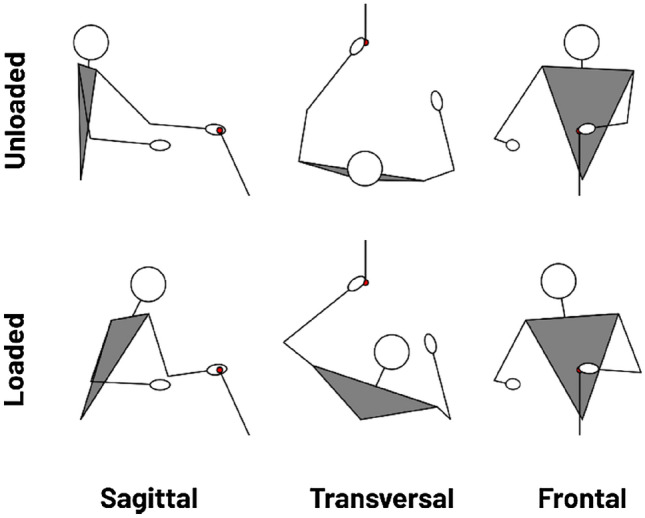
Final posture of a typical participant in the spontaneous condition as a function of load (Unloaded: top row, Loaded: bottom row). Diagrams are viewed from the side (sagittal plane, left column), viewed from above (transverse plane, middle column) and viewed from the front (frontal plane, right column). The red circle represents the target. When the hand is loaded, the participant has less elbow extension, less shoulder flexion and shoulder abduction at the expense of greater trunk flexion and rotation. The figure shows that the greater recruitment of the trunk brings the shoulder closer to the target, resulting in less gravitational torque at the shoulder, as can be inferred by comparing the sagittal views.
Figure 4
Figure 4
Shoulder reserve in final posture as a function of trunk restraint and hand load. Shoulder reserve is in percentage of maximal antigravity shoulder torque. In each barplot, the top of the bar represents the median, error bar extends from the first to the third quartile. All comparisons are statistically significant. The figure shows that shoulder reserve stays high in the unloaded conditions. When the hand is loaded and the trunk is restrained, shoulder reserve is considerably reduced.

References

    1. Bernstein. The Co-ordination and Regulation of Movements. (Pergamon Press, 1967).
    1. Jeannerod, M. Intersegmental coodination during reaching at natural visual objects. Attent. Perform.IX, 153–169 (1981).
    1. Todorov E, Jordan MI. Optimal feedback control as a theory of motor coordination. Nat. Neurosci. 2002;5:1226–1235. doi: 10.1038/nn963. - DOI - PubMed
    1. Rigoux, L. & Guigon, E. A model of reward- and effort-based optimal decision making and motor control. PLOS Computat. Biol.8, e1002716 (2012). - PMC - PubMed
    1. Diedrichsen J, Shadmehr R, Ivry RB. The coordination of movement: optimal feedback control and beyond. Trends Cogn. Sci. 2010;14:31–39. doi: 10.1016/j.tics.2009.11.004. - DOI - PMC - PubMed

Publication types