


Nodulating white lupins take advantage of the reciprocal interplay between N and P nutritional responses
- PMID: 34837246
- PMCID: PMC9303408
- DOI: 10.1111/ppl.13607
Nodulating white lupins take advantage of the reciprocal interplay between N and P nutritional responses
Abstract
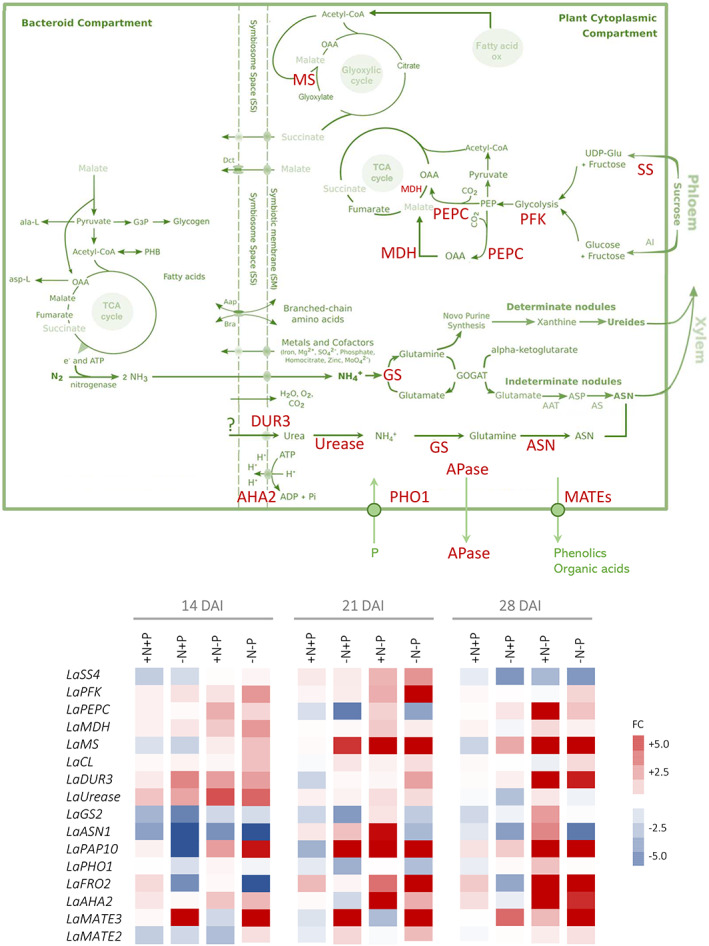
The low bioavailability of nutrients, especially nitrogen (N) and phosphorus (P), is one of the most limiting factors for crop production. In this study, under N- and P-free nutrient solution (-N-P), nodulating white lupin plants developed some nodules and analogous cluster root structures characterized by different morphological, physiological, and molecular responses than those observed upon single nutrient deficiency (strong acidification of external media, a better nutritional status than -N+P and +N-P plants). The multi-elemental analysis highlighted that the concentrations of nutrients in white lupin plants were mainly affected by P availability. Gene-expression analyses provided evidence of interconnections between N and P nutritional pathways that are active to promote N and P balance in plants. The root exudome was mainly characterized by N availability in nutrient solution, and, in particular, the absence of N and P in the nutrient solution triggered a high release of phenolic compounds, nucleosides monophosphate and saponines by roots. These morphological, physiological, and molecular responses result from a close interplay between N and P nutritional pathways. They contribute to the good development of nodulating white lupin plants when grown on N- and P-free media. This study provides evidence that limited N and P availability in the nutrient solution can promote white lupin-Bradyrhizobium symbiosis, which is favourable for the sustainability of legume production.
© 2021 The Authors. Physiologia Plantarum published by John Wiley & Sons Ltd on behalf of Scandinavian Plant Physiology Society.
Conflict of interest statement
The authors declare no conflict of interest.
Figures




References
-
- Al‐Niemi, T.S. , Kahn, M.L. & McDermott, T.R. (1998) Phosphorus uptake by bean nodules. Plant and Soil, 198, 71–78.
-
- Arunothayanan, H. , Nomura, M. , Hamaguchi, R. , Itakura, M. , Minamisawa, K. & Tajima, S. (2010) Copper metallochaperones are required for the assembly of bacteroid cytochrome c oxidase which is functioning for nitrogen fixation in soybean nodules. Plant and Cell Physiology, 51, 1242–1246. - PubMed
-
- Barsch, A. , Tellstrom, V. , Patschkowski, T. , Kuster, H. & Niehaus, K. (2006) Metabolite profiles of nodulated alfalfa plants indicate that distinct stages of nodule organogenesis are accompanied by global physiological adaptations. Molecular Plant‐Microbe Interactions, 19, 998–1013. - PubMed
-
- Biala‐Leonhard, W. , Zanin, L. , Gottardi, S. , de Brito Francisco, R. , Venuti, S. , Valentinuzzi, F. et al. (2021) Identification of an isoflavonoid transporter required for the nodule establishment of the Rhizobium‐Fabaceae symbiotic interaction. Frontiers in Plant Science, 12, 758213. 10.3389/fpls.2021.758213 - DOI - PMC - PubMed
MeSH terms
Substances
LinkOut - more resources
Full Text Sources
Miscellaneous
