


High anticholinergic burden at admission associated with in-hospital mortality in older patients: A comparison of 19 different anticholinergic burden scales
- PMID: 34837340
- PMCID: PMC9299782
- DOI: 10.1111/bcpt.13692
High anticholinergic burden at admission associated with in-hospital mortality in older patients: A comparison of 19 different anticholinergic burden scales
Abstract
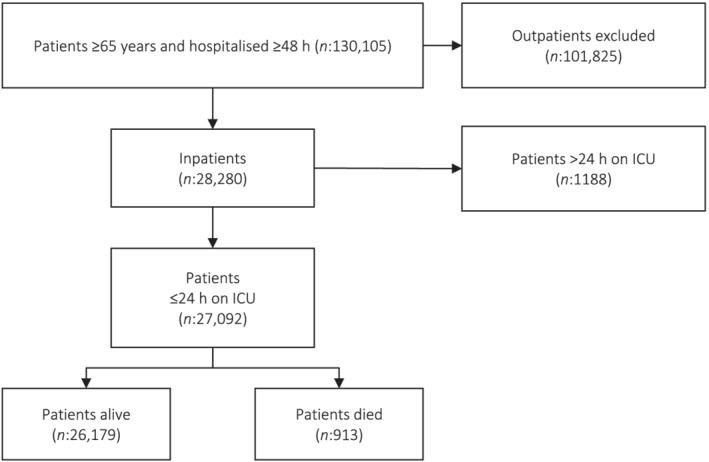
Although no gold standard exists to assess a patient's anticholinergic burden, a review identified 19 anticholinergic burden scales (ABSs). No study has yet evaluated whether a high anticholinergic burden measured with all 19 ABSs is associated with in-hospital mortality and length of stay (LOS). We conducted a cohort study at a Swiss tertiary teaching hospital using patients' electronic health record data from 2015-2018. Included were patients aged ≥65 years, hospitalised ≥48 h without stays and >24 h in intensive care. Patients' cumulative anticholinergic burden score was classified using a binary (<3: low, ≥3: high) and categorical approach (0: no, 0.5-3: low, ≥3: high). In-hospital mortality and LOS were analysed using multivariable logistic and linear regression, respectively. We included 27,092 patients (mean age 78.0 ± 7.5 years, median LOS 6 days). Of them, 913 died. Depending on the evaluated ABS, 1370 to 17,035 patients were exposed to anticholinergics. Patients with a high burden measured by all 19 ABSs were associated with a 1.32- to 3.03-fold increase in in-hospital mortality compared with those with no/low burden. We obtained similar results for LOS. To conclude, discontinuing drugs with anticholinergic properties (score ≥3) at admission might be a targeted intervention to decrease in-hospital mortality and LOS.
Keywords: anticholinergic burden; in-hospital mortality; length of stay; older patients.
© 2021 The Authors. Basic & Clinical Pharmacology & Toxicology published by John Wiley & Sons Ltd on behalf of Nordic Association for the Publication of BCPT (former Nordic Pharmacological Society).
Conflict of interest statement
The authors declare that they have no conflict of interest. Presentation of work: GSASA Congress 2020 (25.1‐26.11.2020), poster and oral presentation.
Figures
References
-
- Kersten H, Wyller TB. Anticholinergic drug burden in older people's brain—How well is it measured? Basic Clin Pharmacol Toxicol. 2014;114(2):151‐159. - PubMed
-
- Rudd KM, Raehl CL, Bond CA, Abbruscato TJ, Stenhouse AC. Methods for assessing drug‐related anticholinergic activity. Pharmacotherapy. 2005;25(11):1592‐1601. - PubMed
Publication types
MeSH terms
Substances
LinkOut - more resources
Full Text Sources
