


Association of polygenic risk scores, traumatic life events and coping strategies with war-related PTSD diagnosis and symptom severity in the South Eastern Europe (SEE)-PTSD cohort
- PMID: 34837533
- PMCID: PMC9188618
- DOI: 10.1007/s00702-021-02446-5
Association of polygenic risk scores, traumatic life events and coping strategies with war-related PTSD diagnosis and symptom severity in the South Eastern Europe (SEE)-PTSD cohort
Abstract
Objectives: Posttraumatic stress disorder (PTSD) is triggered by extremely stressful environmental events and characterized by high emotional distress, re-experiencing of trauma, avoidance and hypervigilance. The present study uses polygenic risk scores (PRS) derived from the UK Biobank (UKBB) mega-cohort analysis as part of the PGC PTSD GWAS effort to determine the heritable basis of PTSD in the South Eastern Europe (SEE)-PTSD cohort. We further analyzed the relation between PRS and additional disease-related variables, such as number and intensity of life events, coping, sex and age at war on PTSD and CAPS as outcome variables.
Methods: Association of PRS, number and intensity of life events, coping, sex and age on PTSD were calculated using logistic regression in a total of 321 subjects with current and remitted PTSD and 337 controls previously subjected to traumatic events but not having PTSD. In addition, PRS and other disease-related variables were tested for association with PTSD symptom severity, measured by the Clinician Administrated PTSD Scale (CAPS) by liner regression. To assess the relationship between the main outcomes PTSD diagnosis and symptom severity, each of the examined variables was adjusted for all other PTSD related variables.
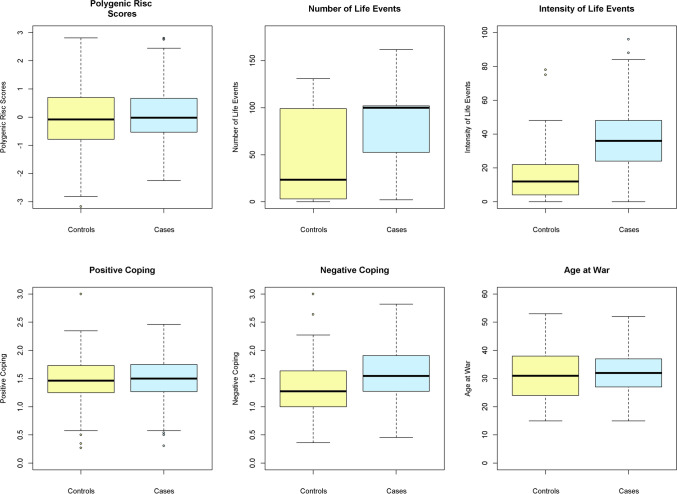
Results: The categorical analysis showed significant polygenic risk in patients with remitted PTSD and the total sample, whereas no effects were found on symptom severity. Intensity of life events as well as the individual coping style were significantly associated with PTSD diagnosis in both current and remitted cases. The dimensional analyses showed as association of war-related frequency of trauma with symptom severity, whereas the intensity of trauma yielded significant results independently of trauma timing in current PTSD.
Conclusions: The present PRS application in the SEE-PTSD cohort confirms modest but significant polygenic risk for PTSD diagnosis. Environmental factors, mainly the intensity of traumatic life events and negative coping strategies, yielded associations with PTSD both categorically and dimensionally with more significant p-values. This suggests that, at least in the present cohort of war-related trauma, the association of environmental factors and current individual coping strategies with PTSD psychopathology was stronger than the polygenic risk.
Keywords: CAPS; Coping style; Life events; PTSD; Polygenic risk score.
© 2021. The Author(s).
Conflict of interest statement
The authors declare not conflicts of interest.
Figures
References
-
- American Psychiatric Association (2013) Diagnostic and statistical manual of mental disorders, 5th edn
-
- Arcel L, Folnegoviü-Smalc V, Tocilj-Simunkoviü G, Kozariü-Kovaþiü D, Ljubotina D (1995) Psychosocial help to war victims: women refugees and their families. Assesment of psycho-social status and treatment of refugee women and their families. Nakladništ. Zagreb
Publication types
MeSH terms
Grants and funding
LinkOut - more resources
Full Text Sources
Medical
Miscellaneous
