


The impact of working from home on modal commuting choice response during COVID-19: Implications for two metropolitan areas in Australia
- PMID: 34840440
- PMCID: PMC8608599
- DOI: 10.1016/j.tra.2021.11.011
The impact of working from home on modal commuting choice response during COVID-19: Implications for two metropolitan areas in Australia
Abstract
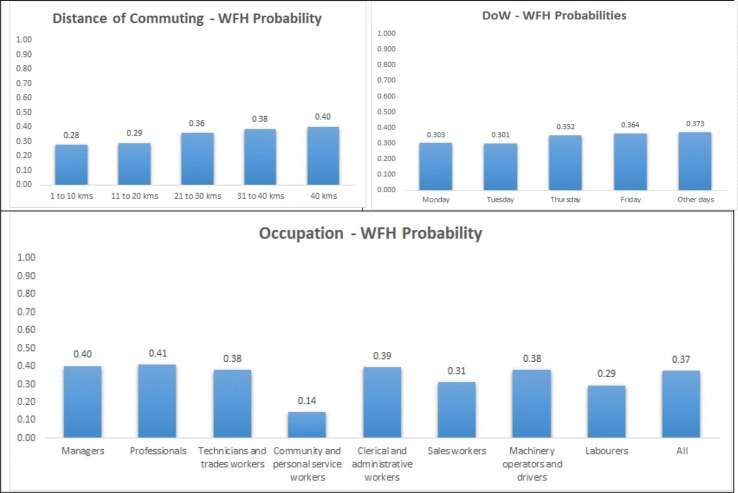
The need to recognise and account for the influence of working from home on commuting activity has never been so real as a result of the COVID-19 pandemic. Not only does this change the performance of the transport network, it also means that the way in which transport modellers and planners use models estimated on a typical weekday of travel and expand it up to the week and the year must be questioned and appropriately revised to adjust for the quantum of working from home. Although teleworking is not a new phenomenon, what is new is the ferocity by which it has been imposed on individuals throughout the world, and the expectation that working from home is no longer a temporary phenomenon but one that is likely to continue to some non-marginal extent given its acceptance and revealed preferences from both many employees and employ where working from home makes good sense. This paper formalises the relationship between working from home and commuting by day of the week and time of day for two large metropolitan areas in Australia, Brisbane and Sydney, using a mixed logit choice model, identifying the influences on such choices together with a mapping model between the probability of working from home and socioeconomic and other contextual influences that are commonly used in strategic transport models to predict demand for various modes by location. The findings, based on Wave 3 (approximately 6 months from the initial outbreak of the pandemic) of an ongoing data collection exercise, provide the first formal evidence for Australia in enabling transport planners to adjust their predicted modal shares and overall modal travel activity for the presence of working from home.
Keywords: Australian experience; COVID-19; Commuter mode choice; Elasticities; Mixed logit model; Segment mapping for WFH propensity; Value of time; Working from home.
© 2021 Elsevier Ltd. All rights reserved.
Conflict of interest statement
The authors declare that they have no known competing financial interests or personal relationships that could have appeared to influence the work reported in this paper.
Figures




References
-
- Anders, G. (2020) Workforce Confidence Index: Introducing a biweekly pulse on the mood of workers, Linkedin Workforce Insights, https://www.linkedin.com/pulse/workforce-confidence-index-introducing-bi..., accessed 13/08/20.
-
- Balbontin, C., Hensher, D.A., Beck, M.J., Giesen, R., Basnak, P., Vallejo-Borda, J.A., Venter, C. Impact of COVID-19 on the number of days working from home and commuting travel: A cross-cultural comparison between Australia, South America and South Africa, submitted to J. Transp. Geography, 10 May 2021. - PMC - PubMed
-
- Barrero,J.M., Bloom, N., Davis, S.J. (2021) Why working from home will stick, National Bureau of Economic Research Working Paper 2873, April http://www.nber.org/papers/w28731.
-
- Beck M., Hensher D.A. Insights into the Impact of Covid-19 on Household Travel, Work, Activities and Shopping in Australia – the early days under restrictions, Paper #1. Transp. Policy. 2020;96:76–93. doi: 10.1016/j.tranpol.2020.07.001. (one of top most downloaded papers in the journal since published) - DOI - PMC - PubMed
LinkOut - more resources
Full Text Sources