


Impact of Empirical Antibiotic Regimens on Mortality in Neutropenic Patients with Bloodstream Infection Presenting with Septic Shock
- PMID: 34843387
- PMCID: PMC8846468
- DOI: 10.1128/AAC.01744-21
Impact of Empirical Antibiotic Regimens on Mortality in Neutropenic Patients with Bloodstream Infection Presenting with Septic Shock
Abstract
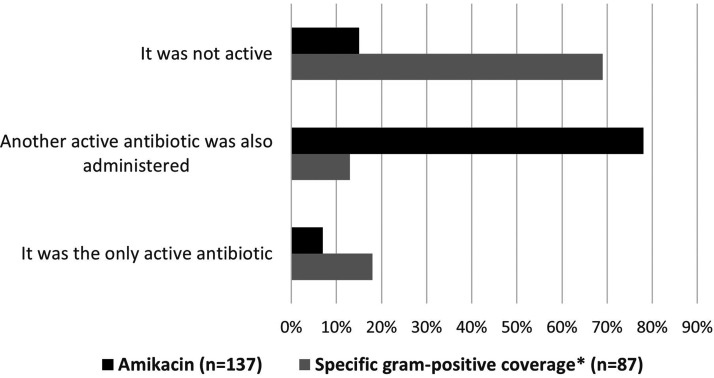
We analyzed risk factors for mortality in febrile neutropenic patients with bloodstream infections (BSI) presenting with septic shock and assessed the impact of empirical antibiotic regimens. A multicenter retrospective study (2010 to 2019) of two prospective cohorts compared BSI episodes in patients with or without septic shock. Multivariate analysis was performed to identify independent risk factors for mortality in episodes with septic shock. Of 1,563 patients with BSI, 257 (16%) presented with septic shock. Those patients with septic shock had higher mortality than those without septic shock (55% versus 15%, P < 0.001). Gram-negative bacilli caused 81% of episodes with septic shock, Gram-positive cocci caused 22%, and Candida species caused 5%. Inappropriate empirical antibiotic treatment (IEAT) was administered in 17.5% of septic shock episodes. Empirical β-lactam combined with other active antibiotics was associated with the lowest mortality observed. When amikacin was the only active antibiotic, mortality was 90%. Addition of empirical specific Gram-positive coverage had no impact on mortality. Mortality was higher when IEAT was administered (76% versus 51%, P = 0.002). Age of >70 years (odds ratio [OR], 2.3; 95% confidence interval [CI], 1.2 to 4.7), IEAT for Candida spp. or Gram-negative bacilli (OR, 3.8; 95% CI, 1.3 to 11.1), acute kidney injury (OR, 2.6; 95% CI, 1.4 to 4.9), and amikacin as the only active antibiotic (OR, 15.2; 95% CI, 1.7 to 134.5) were independent risk factors for mortality, while the combination of β-lactam and amikacin was protective (OR, 0.32; 95% CI, 0.18 to 0.57). Septic shock in febrile neutropenic patients with BSI is associated with extremely high mortality, especially when IEAT is administered. Combination therapy including an active β-lactam and amikacin results in the best outcomes.
Keywords: bacteremia; empirical treatment; mortality; neutropenia; shock.
Conflict of interest statement
The authors declare a conflict of interest. Carolina Garcia-Vidal has received honoraria for talks on behalf of Gilead Science, MSD, Novartis, Pfizer, Janssen, Lilly as well as a grant from Gilead Science and MSD. Alex Soriano has received honoraria for talks on behalf of Merck Sharp and Dohme, Pfizer, Novartis, Angellini, as well as grant support from Pfizer. Pedro Castro has received honoraria for talks on behalf of Merck Sharp and Dohme, Pfizer, Gilead and Alexion. Josep Mensa has received honoraria for talks on behalf of Merck Sharp and Dohme, Pfizer, Novartis and Angellini.
The authors declare a conflict of interest. Carolina Garcia-Vidal has received honoraria for talks on behalf of Gilead Science, MSD, Novartis, Pfizer, Janssen, Lilly as well as a grant from Gilead Science and MSD. <br>Alex Soriano has received honoraria for talks on behalf of Merck Sharp and Dohme, Pfizer, Novartis, Angellini, as well as grant support from Pfizer.<br>Pedro Castro has received honoraria for talks on behalf of Merck Sharp and Dohme, Pfizer, Gilead and Alexion. <br>Josep Mensa has received honoraria for talks on behalf of Merck Sharp and Dohme, Pfizer, Novartis and Angellini.
Figures
References
-
- Soares M, Caruso P, Silva E, Teles JMM, Lobo SMA, Friedman G, Dal Pizzol F, Mello PVC, Bozza FA, Silva UVA, Torelly AP, Knibel MF, Rezende E, Netto JJ, Piras C, Castro A, Ferreira BS, Réa-Neto Á, Olmedo PB, Salluh JIF, Brazilian Research in Intensive Care Network (BRICNet). 2010. Characteristics and outcomes of patients with cancer requiring admission to intensive care units: a prospective multicenter study. Crit Care Med 38:9–15. doi: 10.1097/CCM.0b013e3181c0349e. - DOI - PubMed
Publication types
MeSH terms
Substances
LinkOut - more resources
Full Text Sources
Medical
Miscellaneous
