


The coronavirus disease 2019 (COVID-19) vaccination psychological antecedent assessment using the Arabic 5c validated tool: An online survey in 13 Arab countries
- PMID: 34843545
- PMCID: PMC8629271
- DOI: 10.1371/journal.pone.0260321
The coronavirus disease 2019 (COVID-19) vaccination psychological antecedent assessment using the Arabic 5c validated tool: An online survey in 13 Arab countries
Abstract
Background: Following the emergency approval of the coronavirus disease 2019 (COVID-19) vaccines, research into its vaccination hesitancy saw a substantial increase. However, the psychological behaviors associated with this hesitancy are still not completely understood. This study assessed the psychological antecedents associated with COVID-19 vaccination in the Arab population.
Methodology: The validated Arabic version of the 5C questionnaire was distributed online across various social media platforms in Arabic-speaking countries. The questionnaire had three sections, namely, socio-demographics, COVID-19 related infection and vaccination, and the 5C scale of vaccine psychological antecedents of confidence, complacency, constraints, calculation, and collective responsibility.
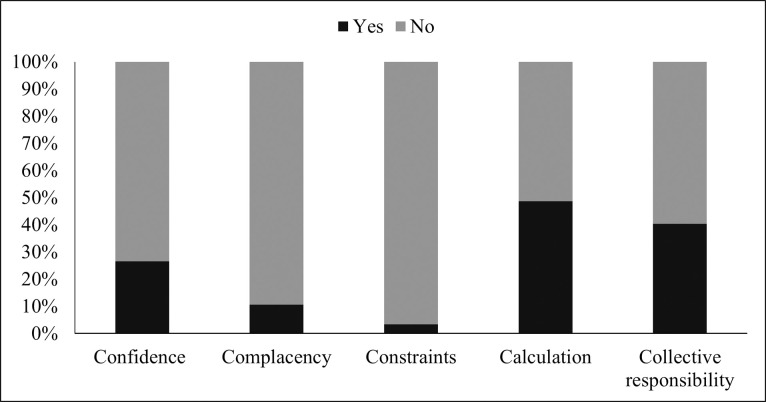
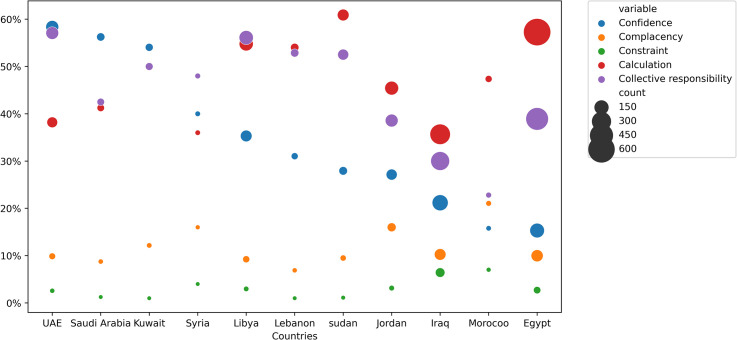
Results: In total, 4,474 participants with a mean age of 32.48 ± 10.76 from 13 Arab countries made up the final sample, 40.8% of whom were male. Around 26.7% of the participants were found to be confident about the COVID-19 vaccination, 10.7% indicated complacency, 96.5% indicated they had no constraints, 48.8% had a preference for calculation and 40.4% indicated they had collective responsibility. The 5C antecedents varied across the studied countries with the confidence and collective responsibility being the highest in the United Arab Emirates (59.0% and 58.0%, respectively), complacency and constraints in Morocco (21.0% and 7.0%, respectively) and calculation in Sudan (60.0%). The regression analyses revealed that sex, age, educational degrees, being a health care professional, history of COVID-19 infection and having a relative infected or died from COVID-19 significantly predicted the 5C psychological antecedents by different degrees.
Conclusion: There are wide psychological antecedent variations between Arab countries, and different determinants can have a profound effect on the COVID-19 vaccine's psychological antecedents.
Conflict of interest statement
The authors have declared that no competing interests exist.
Figures
References
-
- Worldometers. COVID-19 Coronavirus pandemic 2021. [cited 2021 31–1]. Available from: https://www.worldometers.info/coronavirus/.
-
- World Health Organization [WHO]. Five million COVID-19 cases reported in WHO’s Eastern Mediterranean Region. 2021. [cited 2021 31–1]. Available from: http://www.emro.who.int/media/news/five-million-covid-19-cases-reported-....
Publication types
MeSH terms
LinkOut - more resources
Full Text Sources
Medical
