. 2021 Dec 7;118(49):e2003405118.
doi: 10.1073/pnas.2003405118.

Functional recovery of secondary tropical forests

Lourens Poorter  1 Danaë M A Rozendaal  2   3   4 Frans Bongers  2 de Jarcilene S Almeida  5 Francisco S Álvarez  6 José Luís Andrade  7 Luis Felipe Arreola Villa  8 Justin M Becknell  9 Radika Bhaskar  8   10 Vanessa Boukili  11 Pedro H S Brancalion  12 Ricardo G César  12 Jerome Chave  13 Robin L Chazdon  14   15   16 Gabriel Dalla Colletta  17 Dylan Craven  18 Ben H J de Jong  19 Julie S Denslow  20 Daisy H Dent  21   22 Saara J DeWalt  23 Elisa Díaz García  12 Juan Manuel Dupuy  7 Sandra M Durán  24 Mário M Espírito Santo  25 Geraldo Wilson Fernandes  26 Bryan Finegan  6 Vanessa Granda Moser  6 Jefferson S Hall  27 José Luis Hernández-Stefanoni  7 Catarina C Jakovac  2   28 Deborah Kennard  29 Edwin Lebrija-Trejos  30 Susan G Letcher  31 Madelon Lohbeck  2   32 Omar R Lopez  21   33 Erika Marín-Spiotta  34 Miguel Martínez-Ramos  8 Jorge A Meave  35 Francisco Mora  8 Vanessa de Souza Moreno  12 Sandra C Müller  36 Rodrigo Muñoz  2   35 Robert Muscarella  37 Yule R F Nunes  25 Susana Ochoa-Gaona  19 Rafael S Oliveira  38 Horacio Paz  8 Arturo Sanchez-Azofeifa  39 Lucía Sanaphre-Villanueva  7   40 Marisol Toledo  41 Maria Uriarte  42 Luis P Utrera  6 Michiel van Breugel  27   43   44 Masha T van der Sande  2   45   46 Maria D M Veloso  25 S Joseph Wright  21 Kátia J Zanini  36 Jess K Zimmerman  47 Mark Westoby  48
Affiliations

Functional recovery of secondary tropical forests

Lourens Poorter et al. Proc Natl Acad Sci U S A. .

Abstract

One-third of all Neotropical forests are secondary forests that regrow naturally after agricultural use through secondary succession. We need to understand better how and why succession varies across environmental gradients and broad geographic scales. Here, we analyze functional recovery using community data on seven plant characteristics (traits) of 1,016 forest plots from 30 chronosequence sites across the Neotropics. By analyzing communities in terms of their traits, we enhance understanding of the mechanisms of succession, assess ecosystem recovery, and use these insights to propose successful forest restoration strategies. Wet and dry forests diverged markedly for several traits that increase growth rate in wet forests but come at the expense of reduced drought tolerance, delay, or avoidance, which is important in seasonally dry forests. Dry and wet forests showed different successional pathways for several traits. In dry forests, species turnover is driven by drought tolerance traits that are important early in succession and in wet forests by shade tolerance traits that are important later in succession. In both forests, deciduous and compound-leaved trees decreased with forest age, probably because microclimatic conditions became less hot and dry. Our results suggest that climatic water availability drives functional recovery by influencing the start and trajectory of succession, resulting in a convergence of community trait values with forest age when vegetation cover builds up. Within plots, the range in functional trait values increased with age. Based on the observed successional trait changes, we indicate the consequences for carbon and nutrient cycling and propose an ecologically sound strategy to improve forest restoration success.

Keywords: community assembly; functional traits; rainfall; secondary succession; tropical forest.


Conflict of interest statement

The authors declare no competing interest.

Figures
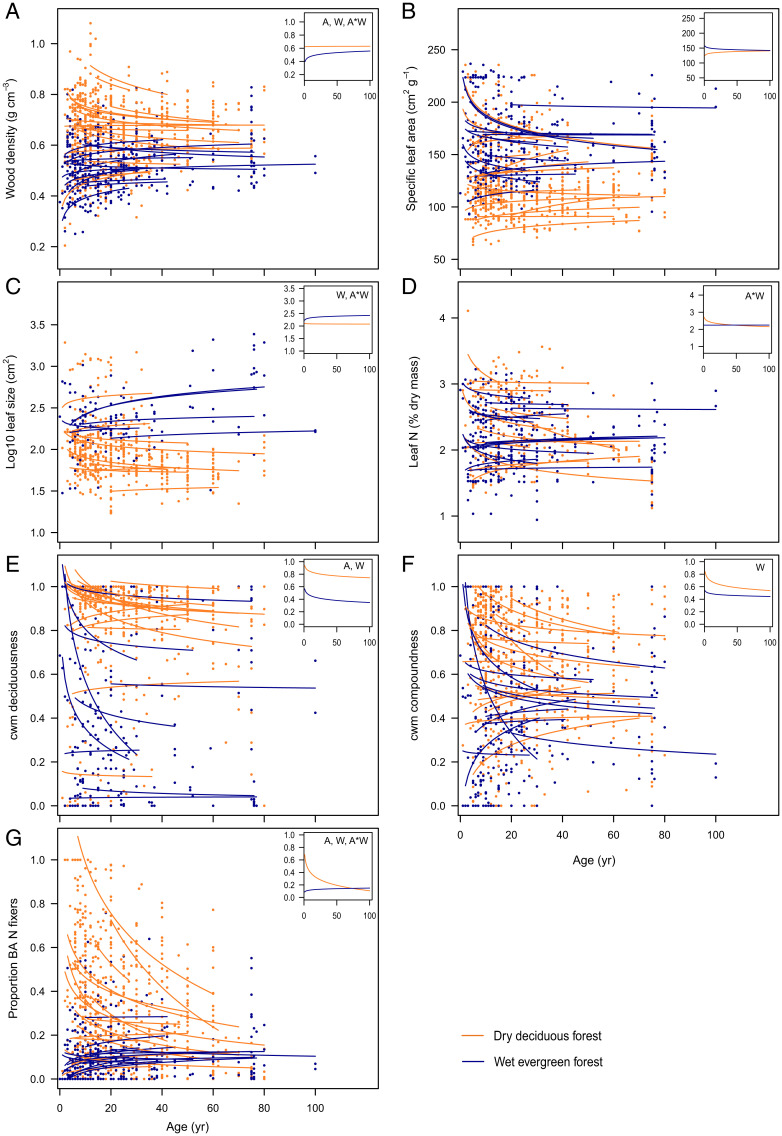
Fig. 1.
Fig. 1.
Recovery of CWM functional trait values with time since abandonment. CWM trait values were calculated by weighting by basal area. (A) WD, (B) SLA, (C) LS, (D) LNC, (E) deciduousness, (F) compoundness, and (G) proportion NF trees. Each line represents the model prediction for a different chronosequence. Other predictors were kept constant at the mean. Lines and dots are color-coded according to the forest type as dry deciduous forest (orange) and wet evergreen forest (blue). Dots indicate individual plots. (Insets) Model predictions of an “average” dry deciduous forest CWA = −700 mm/y) and an “average” wet evergreen forest (CWA = −250 mm/y) based on the fixed effects only. Letters in Inset charts indicate whether forest age since abandonment (A), CWA (W), and their interaction (A*W) are significant.
Fig. 2.
Fig. 2.
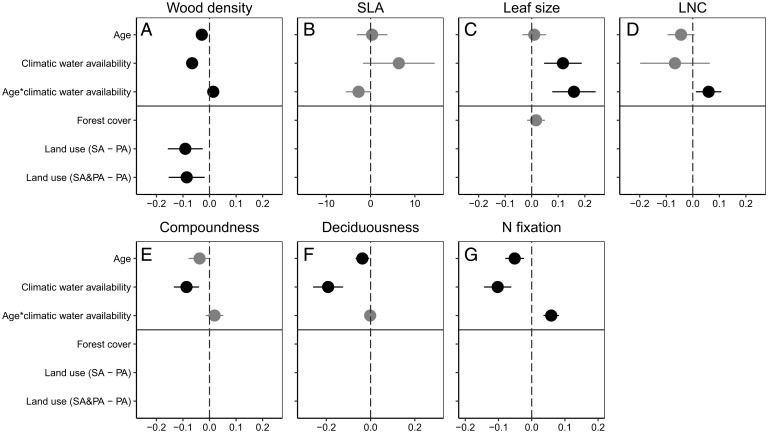
Effects of a core model (forest age, CWA, the interaction between CWA and forest age) and the potential effects of forest cover, previous land use type, CEC, and their interactions with forest age on CWM trait recovery in Neotropical secondary forests. (A) WD, (B) SLA, (C) LS, (D) LNC, (E) compoundness, (F) deciduousness, and (G) proportion NF trees (N fixation). Forest cover, previous land use type, and CEC are only included and shown when they are part of the best model. Standardized coefficients with 95% CIs are shown. Note that predictor variables were standardized but the response variables not, which explains why, for example, for SLA effect, sizes are larger. Black symbols indicate significant responses, and gray symbols indicate nonsignificant responses. Negative coefficients indicate a negative effect, and positive coefficients indicate a positive effect. Effect sizes of land use type comparisons are not directly comparable with those of the other predictors because they are dummy variables. We used PA as a reference. SC, shifting cultivation; SC and PA, some plots shifting cultivation and some plots PA. CEC was not included in any of the best models and therefore not shown.
Fig. 3.
Fig. 3.
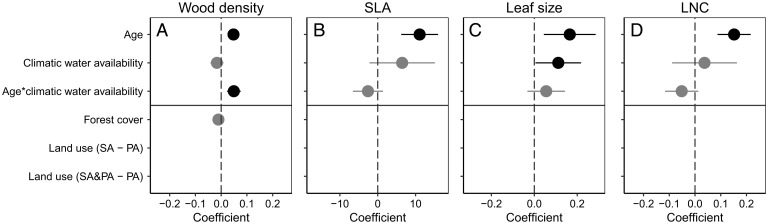
Effects of a core model (stand age, CWA, and the interaction between CWA and stand age) and the potential effects of forest cover, previous land use and CEC on recovery of within-plot trait range in Neotropical secondary forests. (A) WD, (B) SLA, (C) LS, and (D) LNC. The range is calculated per plot as the trait value of the 90th percentile minus the trait value of the 10th percentile of basal area–weighted trait values in a plot. For further explanations, refer to the legend of Fig. 2.
Fig. 4.
Fig. 4.
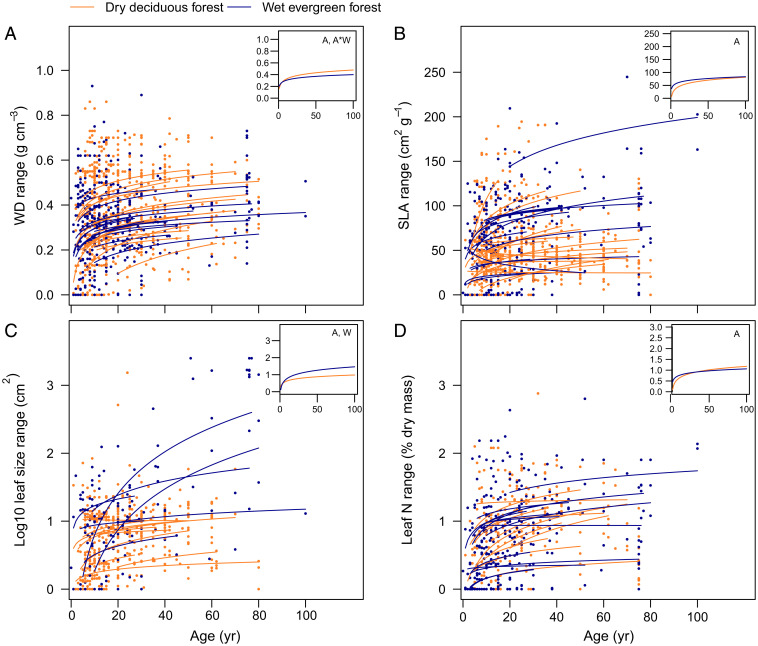
Range of trait values observed within communities versus time since abandonment. (A) WD, (B) SLA, (C) LS, and (D) LNC. The range is calculated per plot as the trait value of the 90th percentile minus the trait value of the 10th percentile of basal area–weighted trait values in a plot. Each line represents the model prediction for a different chronosequence. Lines and dots are color-coded according to the forest type as dry deciduous forest (orange) and wet evergreen forest (blue). Dots indicate individual plots. (Insets) The model prediction line for an “average” dry deciduous forest (CWA = −700 mm/y) and an “average” wet evergreen forest (CWA = −250 mm/y). Letters in Inset charts indicate whether forest age since abandonment (A), CWA (W), and their interaction (A*W) are significant.

References

    1. Chazdon R. L., et al. , Carbon sequestration potential of second-growth forest regeneration in the Latin American tropics. Sci. Adv. 2, e1501639 (2016). - PMC - PubMed
    1. Chazdon R. L., Beyond deforestation: Restoring forests and ecosystem services on degraded lands. Science 320, 1458–1460 (2008). - PubMed
    1. Holl K. D., Restoring tropical forests from the bottom up. Science 355, 455–456 (2017). - PubMed
    1. Brancalion P. H. S., et al. , Global restoration opportunities in tropical rainforest landscapes. Sci. Adv. 5, eaav3223 (2019). - PMC - PubMed
    1. Clements F. E., Plant Succession: An Analysis of the Development of Vegetation (Carnegie Institution of Washington, 1916).

Publication types

LinkOut - more resources