. 2021 Nov 29;11(1):23083.
doi: 10.1038/s41598-021-02167-5.

Revealing the efficacy-toxicity relationship of Fuzi in treating rheumatoid arthritis by systems pharmacology

Affiliations

Revealing the efficacy-toxicity relationship of Fuzi in treating rheumatoid arthritis by systems pharmacology

Wuwen Feng et al. Sci Rep. .

Abstract

In recent decades, herbal medicines have played more and more important roles in the healthcare system in the world because of the good efficacy. However, with the increasing use of herbal medicines, the toxicity induced by herbal medicines has become a global issue. Therefore, it is needed to investigate the mechanism behind the efficacy and toxicity of herbal medicines. In this study, using Aconiti Lateralis Radix Praeparata (Fuzi) as an example, we adopted a systems pharmacology approach to investigate the mechanism of Fuzi in treating rheumatoid arthritis and in inducing cardiac toxicity and neurotoxicity. The results showed that Fuzi has 25 bioactive compounds that act holistically on 61 targets and 27 pathways to treat rheumatoid arthritis, and modulation of inflammation state is one of the main mechanisms of Fuzi. In addition, the toxicity of Fuzi is linked to 32 compounds that act on 187 targets and 4 pathways, and the targets and pathways can directly modulate the flow of Na+, Ca2+, and K+. We also found out that non-toxic compounds such as myristic acid can act on targets of toxic compounds and therefore may influence the toxicity. The results not only reveal the efficacy and toxicity mechanism of Fuzi, but also add new concept for understanding the toxicity of herbal medicines, i.e., the compounds that are not directly toxic may influence the toxicity as well.


Conflict of interest statement

The authors declare no competing interests.

Figures
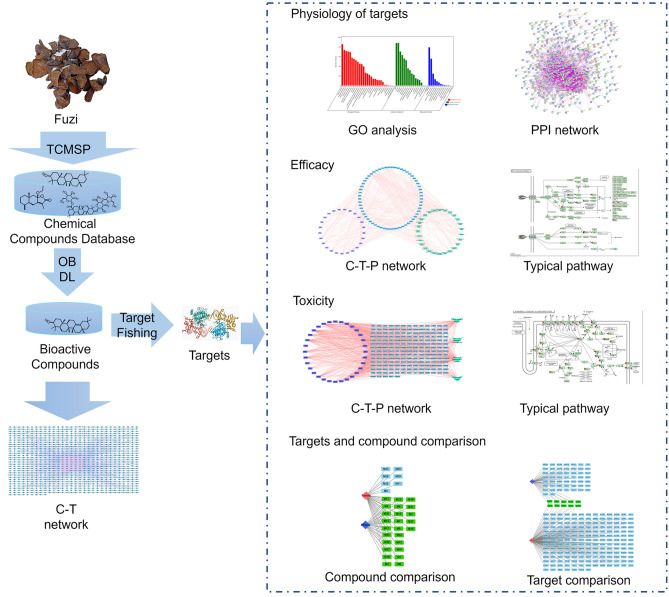
Figure 1
Figure 1
Schematic diagram of the systems pharmacology to comparatively investigate the efficacy and toxicity mechanisms of Fuzi. C-T compound-target, C-T-P compound-target-pathway, DL drug-likeness, Fuzi Aconiti Lateralis Radix Praeparata, GO gene ontology, OB oral bioavailability, PPI protein–protein interaction, TCMSP Traditional Chinese Medicine Systems Pharmacology Database and Analysis Platform.
Figure 2
Figure 2
Molecular docking simulation for bioactive ingredients and target proteins. (A) Coryneine and ADRA2A, (B) denudatine and BCHE, (C) norcoclaurine and CHRM2, (D) songorine and KCNH2.
Figure 3
Figure 3
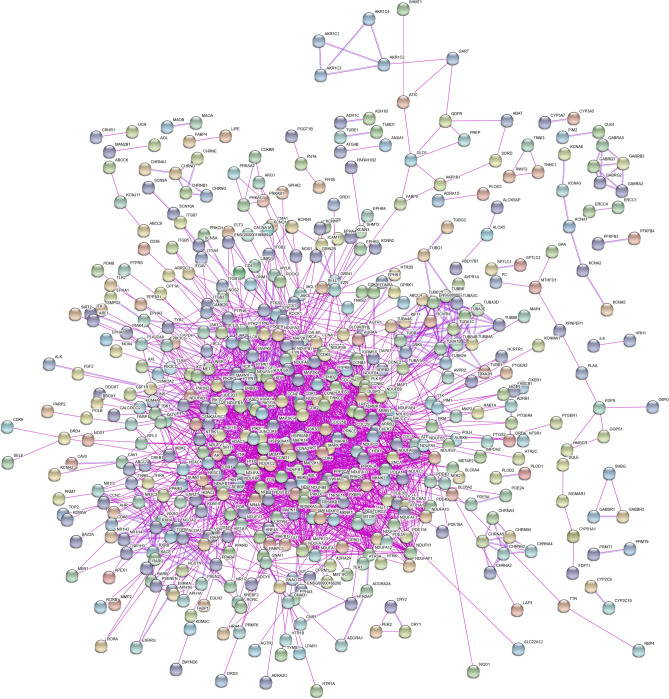
Protein–protein interaction network showing the relationships among targets of Fuzi. The nodes without linkage with other nodes were excluded from this network.
Figure 4
Figure 4
Gene ontology enrichment analysis showing the number of targets participating in biological process, cellular component, and molecular function.
Figure 5
Figure 5
Compound-target-pathway network showing the comprehensive mechanism of Fuzi in treating rheumatoid arthritis. From left to right, the nodes in three big circles correspond to compounds in Fuzi, targets of Fuzi responsible for the treatment of rheumatoid arthritis, and the enriched non-disease pathways of the targets. The full name of compounds and targets are shown in Table 1 and Supplementary Table S1, respectively.
Figure 6
Figure 6
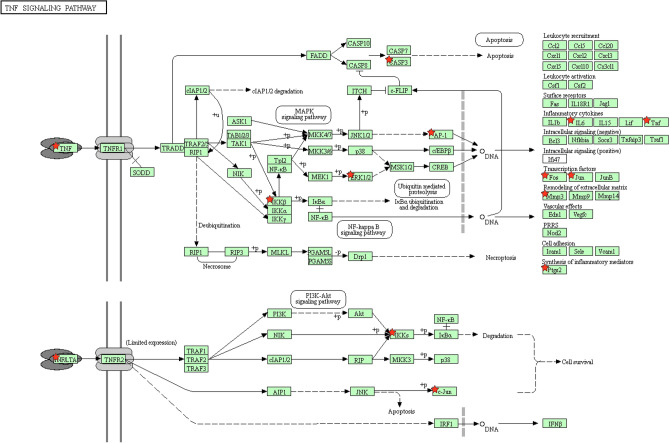
Distribution of the targets of Fuzi on the compressed TNF signaling pathway. The nodes with red star correspond to the targets of Fuzi, and the light blue nodes are targets in TNF signaling pathway. The compressed pathway was obtained from KEGG.
Figure 7
Figure 7
Compound-target-pathway network showing the comprehensive toxic mechanism of Fuzi. From left to right, the nodes correspond to compounds in Fuzi, targets of Fuzi responsible for toxicity, and the enriched pathways responsible for the toxicity. The full name of compounds and targets are shown in Table 1 and Supplementary Table S1, respectively.
Figure 8
Figure 8
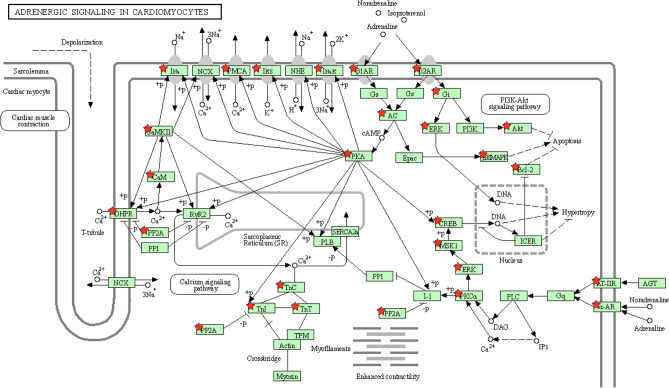
Distribution of the targets of Fuzi on the compressed adrenergic signaling in cardiomyocytes pathway. The nodes with red stars correspond to the targets of Fuzi, and the light blue nodes are targets in TNF signaling pathway. The compressed pathway was obtained from KEGG.
Figure 9
Figure 9
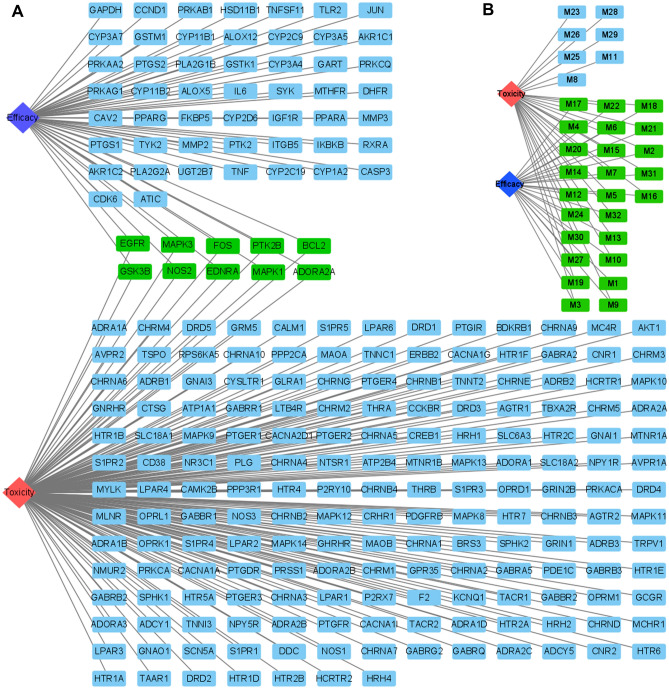
Comparison of the compounds and targets that are responsible for the toxicity and efficacy of Fuzi. The full name of compounds and targets are shown in Table 1 and Supplementary Table S1, respectively.

References

    1. Qadir, S. U. & Raja, V. Herbal Medicine: Old Practice and Modern Perspectives. (eds. Bhat, R. A., Hakeem, K. R., Dervash, M. A.). Phytomedicine. 149–180. (Academic Press, 2021).
    1. Boufridi A, Quinn RJ. Harnessing the properties of natural products. Annu. Rev. Pharmacol. Toxicol. 2018;58:451–470. - PubMed
    1. Lee DYW, Li QY, Liu J, Efferth T. Traditional Chinese herbal medicine at the forefront battle against COVID-19: Clinical experience and scientific basis. Phytomedicine. 2021;80:153337. - PMC - PubMed
    1. Panyod S, Ho CT, Sheen LY. Dietary therapy and herbal medicine for COVID-19 prevention: A review and perspective. J. Tradit. Complement. Med. 2020;10:420–427. - PMC - PubMed
    1. Debelle FD, Vanherweghem JL, Nortier JL. Aristolochic acid nephropathy: a worldwide problem. Kidney Int. 2008;74:158–169. - PubMed

Publication types

MeSH terms