


Schizotypal personality traits and the social learning of fear
- PMID: 34845255
- PMCID: PMC8630166
- DOI: 10.1038/s41598-021-02336-6
Schizotypal personality traits and the social learning of fear
Abstract
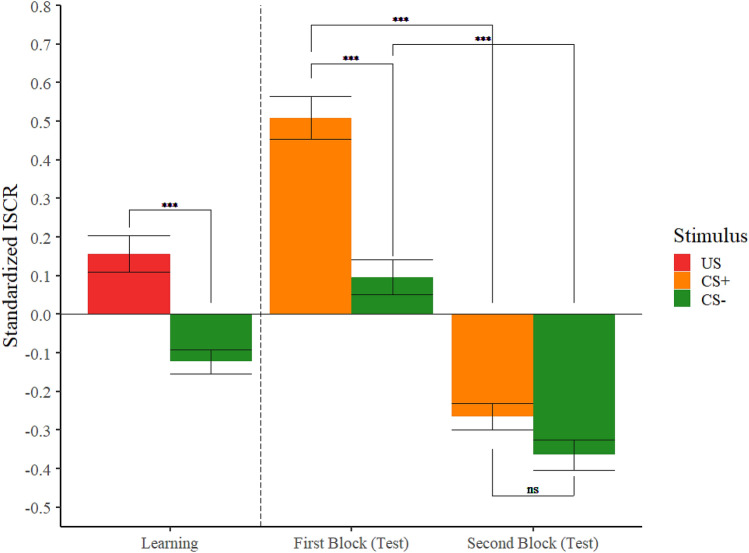
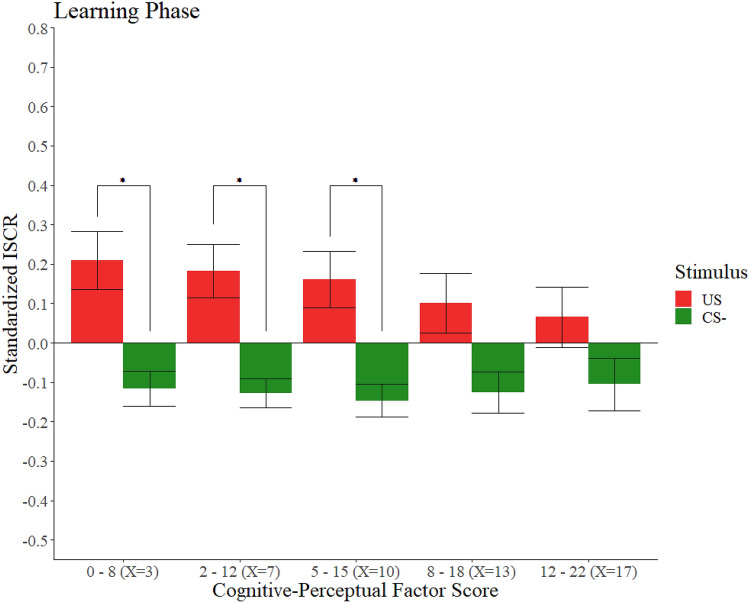
Schizotypy can be defined as a combination of traits qualitatively similar to those found in schizophrenia, but milder in their expression, that can be found in clinical and non-clinical populations. In this research, we explore, to our knowledge, for the first time, whether schizotypal personality traits may affect the acquisition of conditioned fear by social means only. Apart from being an essential capacity to ensure learning in safe environments, social fear learning shares important characteristics with direct fear acquisition, which also makes it a great candidate for developing successful extinction procedures. Undergraduate students (n = 72) performed a task of social fear learning. In this task, participants watched a video of a person that simulated to receive electric shocks (unconditioned stimulus; US) paired with a coloured square (conditioned stimulus plus; CS+), while another coloured square was never paired (conditioned stimulus minus; CS-) with the shock. After that, they were presented with a similar sequence of coloured screens. Their Skin Conductance Responses (SCRs) were registered during the whole process. Once they finished, they completed the Schizotypal Personality Questionnaire (SPQ). Our results revealed that participants with a low score in the Cognitive-Perceptual factor of the SPQ exhibited higher SCRs when they saw the US than when they saw the CS- (all ps < 0.01) during the learning phase. Nevertheless, those with higher scores did not present any difference in their SCRs toward both stimuli (all ps > 0.05), a pattern that has been similarly found in schizophrenia. During the final trials of the test phase, participants with the highest scores in the Disorganized factor were the only ones that maintained a higher SCR towards the CS+ than towards the CS- (p = 0.006), which could be associated with an impairment in their extinction processes.
© 2021. The Author(s).
Conflict of interest statement
The authors declare no competing interests.
Figures


References
-
- Claridge G, Beech T. Fully and quasi-dimensional constructions of schizotypy. Schizotypal Personal. 1995;29:192–216.
-
- Raine A. Schizotypal personality: Neurodevelopmental and psychosocial trajectories. Annu. Rev. Clin. Psychol. 2006;2:291–326. - PubMed
-
- Rössler W, et al. Psychotic experiences in the general population: A twenty-year prospective community study. Schizophr. Res. 2007;92:1–14. - PubMed
-
- Johns LC, Van Os J. The continuity of psychotic experiences in the general population. Clin. Psychol. Rev. 2001;21:1125–1141. - PubMed
Publication types
MeSH terms
LinkOut - more resources
Full Text Sources
