. 2021 Nov 29;11(1):23051.
doi: 10.1038/s41598-021-02364-2.

Computer aided designing of novel pyrrolopyridine derivatives as JAK1 inhibitors

Affiliations

Computer aided designing of novel pyrrolopyridine derivatives as JAK1 inhibitors

Seketoulie Keretsu et al. Sci Rep. .

Abstract

Janus kinases (JAKs) are a family of non-receptor kinases that play a key role in cytokine signaling and their aberrant activities are associated with the pathogenesis of various immune diseases. The JAK1 isoform plays an essential role in the types 1 and II interferon signaling and elicits signals from the interleukin-2, interleukin-4, gp130, and class 2 receptor families. It is ubiquitously expressed in humans and its overexpression has been linked with autoimmune diseases such as myeloproliferative neoplasm. Although JAK1 inhibitors such as Tofacitinib have been approved for medical use, the low potency and off-target effects of these inhibitors have limited their use and calls for the development of novel JAK1 inhibitors. In this study, we used computational methods on a series of pyrrolopyridine derivatives to design new JAK1 inhibitors. Molecular docking and molecular dynamics simulation methods were used to study the protein-inhibitor interactions. 3D-quantitative structure-activity relationship models were developed and were used to predict the activity of newly designed compounds. Free energy calculation methods were used to study the binding affinity of the inhibitors with JAK1. Of the designed compounds, seventeen of the compounds showed a higher binding energy value than the most active compound in the dataset and at least six of the compounds showed higher binding energy value than the pan JAK inhibitor Tofacitinib. The findings made in this study could be utilized for the further development of JAK1 inhibitors.


Conflict of interest statement

The authors declare no competing interests.

Figures
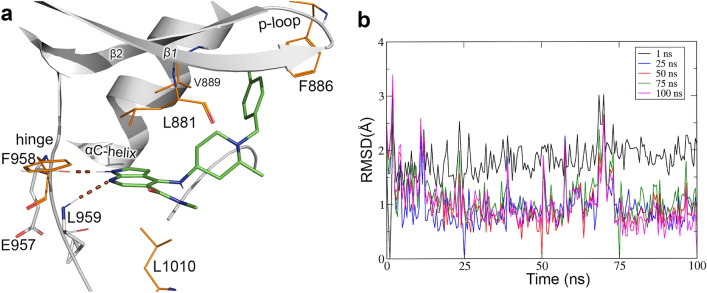
Figure 1
Figure 1
H-bond interactions of the most active compound (42) and JAK1 from the MD simulation. (a) Binding interactions between compound 42 (green) and JAK1 (grey). H-bond interactions are represented by brown dotted lines and residues forming H-bond interactions are shown in grey stick representations. Residues that formed hydrophobic interactions are shown in orange color lines. (b) Root mean square deviation (RMSD) of the ligand (compound 42) with respect to various snapshots (1 ns, 25 ns, 50 ns, 75 ns, and 100 ns) of the trajectory as references.
Figure 2
Figure 2
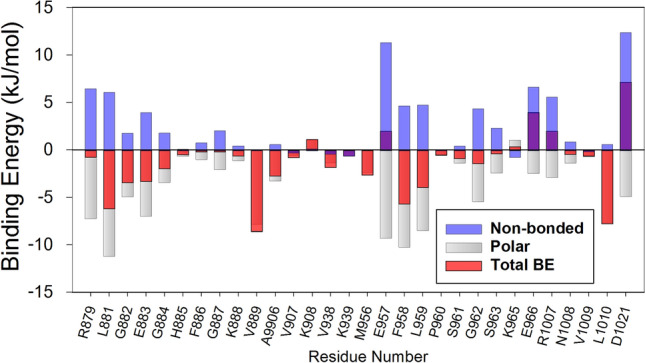
Residues that showed a high contribution to the total binding energy during the MD simulation of compound 42-JAK1 interaction. The energy values of non-bonded, polar, and total binding energy are shown in blue, grey, and red color respectively. Energy values are given in kJ/mol.
Figure 3
Figure 3
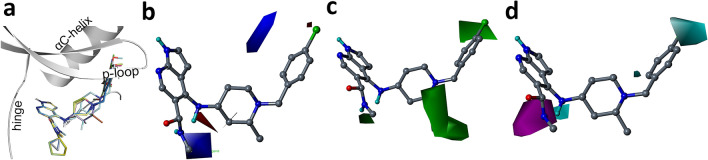
Alignment and contour maps from the CoMFA and CoMSIA models. (a) Alignment of the compounds inside the receptor. (b) Electrostatic contour map. Blue contour represents region favorable for electropositive substituents. (c) Steric contour map. Green contour represents a region favorable for bulky substituents. (d) Hydrophobic contour. Cyan contour represents regions favorable for hydrophobic substituents whereas, magenta color represent region favorable for non-hydrophobic substituents.
Figure 4
Figure 4
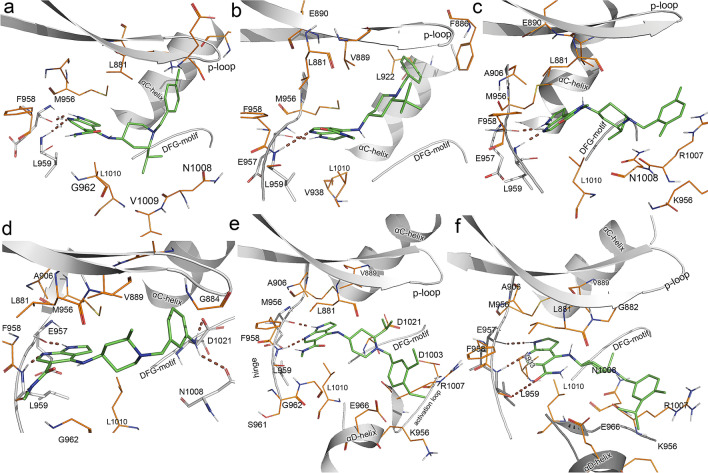
H-bond interactions of the designed compounds with JAK1 from the MD simulation. (a) D01-JAK1 interactions, (b) D07-JAK1 interactions, (c) D64-JAK1 interactions, (d) D108-JAK1 interactions, (e) D127-JAK1 interactions, (f) D135-JAK1 interactions. The inhibitors are shown in green color stick representations. H-bond interactions are represented by brown dotted lines and residues forming H-bonds are shown in grey stick representations. Residues that formed hydrophobic interactions are shown in orange color lines.

References

    1. Shuai K, Liu B. Regulation of JAK–STAT signalling in the immune system. Nat. Rev. Immunol. 2003;3(11):900–911. doi: 10.1038/nri1226. - DOI - PubMed
    1. Gadina M, Hilton D, Johnston JA, Morinobu A, Lighvani A, Zhou Y-J, Visconti R, O'Shea JJ. Signaling by type I and II cytokine receptors: Ten years after. Curr. Opin. Immunol. 2001;13(3):363–373. doi: 10.1016/S0952-7915(00)00228-4. - DOI - PubMed
    1. Levy DE, Darnell J. Stats: Transcriptional control and biological impact. Nat. Rev. Mol. Cell Biol. 2002;3(9):651–662. doi: 10.1038/nrm909. - DOI - PubMed
    1. Schwartz DM, Kanno Y, Villarino A, Ward M, Gadina M, O'Shea JJ. JAK inhibition as a therapeutic strategy for immune and inflammatory diseases. Nat. Rev. Drug Discovery. 2017;16(12):843–862. doi: 10.1038/nrd.2017.201. - DOI - PubMed
    1. O'Shea JJ, Schwartz DM, Villarino AV, Gadina M, McInnes IB, Laurence A. The JAK-STAT pathway: Impact on human disease and therapeutic intervention. Annu. Rev. Med. 2015;66:311–328. doi: 10.1146/annurev-med-051113-024537. - DOI - PMC - PubMed

Publication types

MeSH terms