


Comment
doi: 10.7554/eLife.74704.
How neurons adjust to diurnality
Affiliations
- PMID: 34845985
- PMCID: PMC8631939
- DOI: 10.7554/eLife.74704
Item in Clipboard
Comment
How neurons adjust to diurnality
Elife.
.
Abstract
Being active during the day requires a slow-closing ion channel that dampens the activity of neurons in a specific area of the brain.
Keywords: R. pumilio; circadian rhythms; computational biology; diurnality; electrical activity; mathematical modelling; neuroscience; suprachiasmatic nucleus; systems biology.
© 2021, Andreatta and Allen.
Conflict of interest statement
GA, CA No competing interests declared
Figures
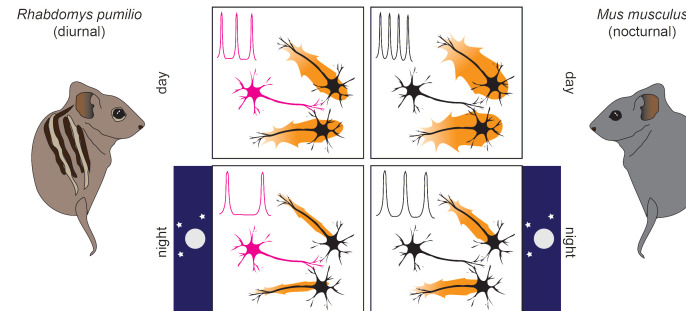
In both diurnal (left) and nocturnal (right) mammals, SCN activity (orange halos around neurons) is higher during the day (top, larger halos) than at night (bottom, smaller halos). In the R. pumilio SCN (left side) – but not in the mouse SCN (right side) – one out of three neurons (in magenta) shows a prolonged resting phase after inhibitory stimuli. This resting phase delays action potential firing, the frequency of which is shown in a simplified scheme on the upper left corner of each panel. This ‘brake’ to SCN excitability operates irrespective of the time of day, leading to reduced activity in the SCN of R. pumilio overall (left panels, smaller halos) while maintaining distinct excitation patterns between day and night. This activity pattern is likely an adaptation for diurnality.
Comment on
-
Daily electrical activity in the master circadian clock of a diurnal mammal.Elife. 2021 Nov 30;10:e68179. doi: 10.7554/eLife.68179. Elife. 2021. PMID: 34845984 Free PMC article.
References
Publication types
MeSH terms
LinkOut - more resources
Full Text Sources
