. 2021 Nov 30;11(1):23144.
doi: 10.1038/s41598-021-02587-3.

Proteomic profiling of human amnion for preterm birth biomarker discovery

Affiliations

Proteomic profiling of human amnion for preterm birth biomarker discovery

Maurizio Bruschi et al. Sci Rep. .

Abstract

Spontaneous preterm birth (PTB) complicates about 12% of pregnancies worldwide, remaining the main cause of neonatal morbidity and mortality. Spontaneous preterm birth PTBs is often caused by microbial-induced preterm labor, mediated by an inflammatory process threatening both maternal and newborn health. In search for novel predictive biomarkers of PTB and preterm prelabor rupture of the membranes (pPROM), and to improve understanding of infection related PTB, we performed an untargeted mass spectrometry discovery study on 51 bioptic mid zone amnion samples from premature babies. A total of 6352 proteins were identified. Bioinformatics analyses revealed a ranked core of 159 proteins maximizing the discrimination between the selected clinical stratification groups allowing to distinguish conditions of absent (FIR 0) from maximal Fetal Inflammatory Response (FIR 3) stratified in function of Maternal Inflammatory Response (MIR) grade. Matrix metallopeptidase-9 (MMP-9) was the top differentially expressed protein. Gene Ontology enrichment analysis of the core proteins showed significant changes in the biological pathways associated to inflammation and regulation of immune and infection response. Data suggest that the conditions determining PTB would be a transversal event, secondary to the maternal inflammatory response causing a breakdown in fetal-maternal tolerance, with fetal inflammation being more severe than maternal one. We also highlight matrix metallopeptidase-9 as a potential predictive biomarker of PTB that can be assayed in the maternal serum, for future investigation.


Conflict of interest statement

The authors declare no competing interests.

Figures
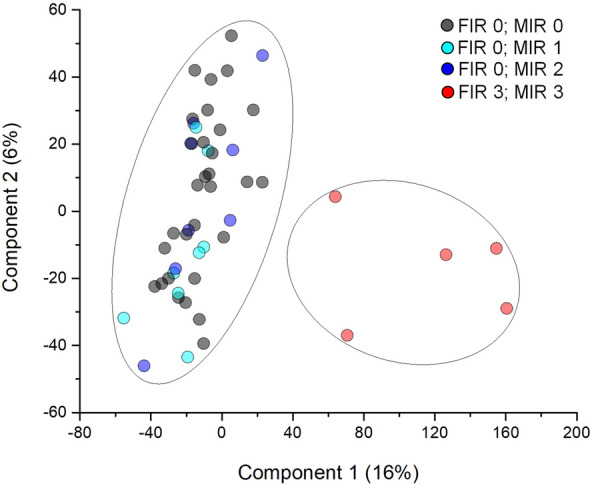
Figure 1
Figure 1
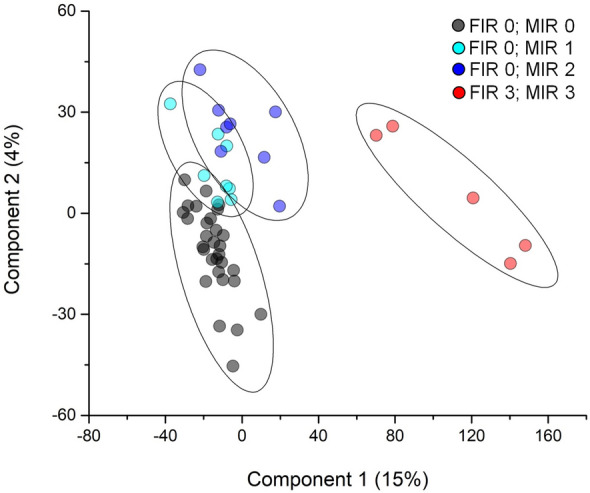
Multidimensional scaling (MDS) of bioptic amnion proteome profiles. Scatter plot of MDS analysis of FIR 3-MIR 3 (red circles), FIR 0-MIR 2 (blue circles), FIR 0-MIR 1 (cyan circles) and FIR 0-MIR 0 (black circles) samples. Ellipsis indicates 95% confidence interval. Plot shows clustering of two distinct groups (FIR 3 and FIR 0 samples).
Figure 2
Figure 2
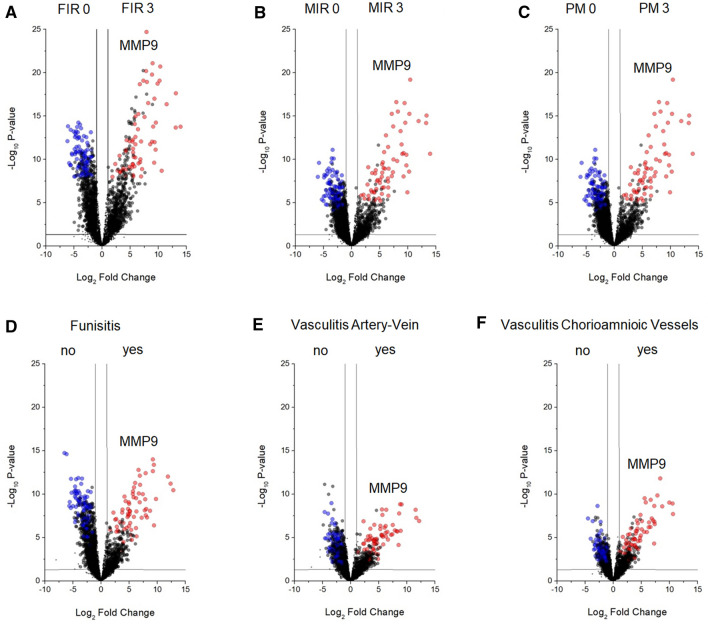
Volcano plots of all comparison. Volcano plot for (A) FIR 0 vs FIR 3; (B) MIR 0 vs MIR 3; (C) PM 0 vs PM 3; (D) absence vs presence of funisitis; (E) absence vs presence of umbilical artery or vein vasculitis; (F) absence vs presence of vasculitis of chorioamniotic vessels. Black, blue and red circles indicate the changes for the non-significant or significant of previously described groups, respectively. Black line indicates the limits of statistically significant. Black circles above the black line indicate the proteins with an identity < 70%.
Figure 3
Figure 3
Partial least square discriminant analysis (PLS-DA) of proteins core list. Scatter plot of PLS-DA analysis of FIR 3-MIR 3 (red circles), FIR 0-MIR 2 (blue circles), FIR 0/MIR 1 (cyan circles) and FIR 0/MIR 0 (black circles) samples. Ellipsis indicates 95% confidence interval. Plot shows clustering of two distinct groups (FIR 3 and FIR 0 samples). These proteins can clearly discriminate between the FIR 0 and FIR 3 samples. Besides, a good discrimination between FIR 0-MIR 0 and other FIR 0-MIR 1–2 groups are present.
Figure 4
Figure 4
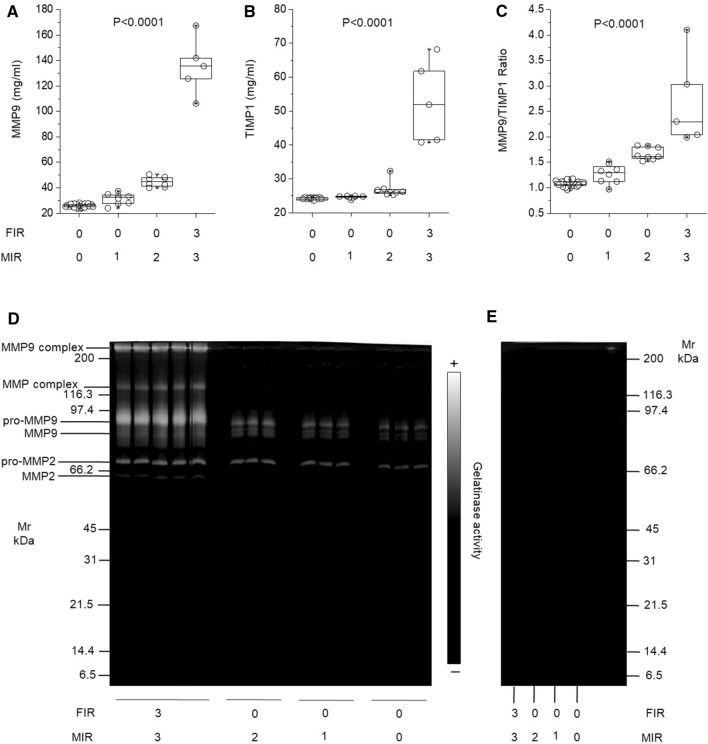
MMP9 and TIMP1 ELISA assay and zymogram of solubilized amnion bioptic samples. Box plots show the median and interquartile range value for (A) MMP9 and (B) TIMP1 proteins and (C) their ratio in all samples. MMP9 and TIMP1 were statistically more abundant in FIR 3-MIR 3 samples in comparison to all other samples (P < 0.0001). (D) full-length Zymogram gel shows the gelatinase activity of all FIR 3-MIR 3 and a randomized selection of the other solubilized bioptic amnion samples. (E) Full-length Zymogram of a randomized selection of one for each of the solubilized bioptic amnion samples incubated, during the digestion, overnight with 10 mM of EDTA. The enzymatic activity of all samples was completely inhibited. The ELISA assay and their enzymatic activity are in agreement with the data obtained in the proteomic analysis.

References

    1. Vogel JP, et al. The global epidemiology of preterm birth. Best Pract. Res. Clin. Obstet. Gynaecol. 2018;52:3–12. doi: 10.1016/j.bpobgyn.2018.04.003. - DOI - PubMed
    1. Romero R, et al. The preterm parturition syndrome. BJOG. 2006;113(Suppl 3):17–42. doi: 10.1111/j.1471-0528.2006.01120.x. - DOI - PMC - PubMed
    1. Green ES, Arck PC. Pathogenesis of preterm birth: Bidirectional inflammation in mother and fetus. Semin. Immunopathol. 2020;42:413–429. doi: 10.1007/s00281-020-00807-y. - DOI - PMC - PubMed
    1. Yudin MH, van Schalkwyk J, Van Eyk N. No. 233-antibiotic therapy in preterm premature rupture of the membranes. J. Obstet. Gynaecol. Can. 2017;39:e207–e212. doi: 10.1016/j.jogc.2017.06.003. - DOI - PubMed
    1. Menon R, Richardson LS. Preterm prelabor rupture of the membranes: A disease of the fetal membranes. Semin. Perinatol. 2017;41:409–419. doi: 10.1053/j.semperi.2017.07.012. - DOI - PMC - PubMed

Publication types

MeSH terms