


Perforated balloon technique mediated intracoronary delivery of nicorandil to treat coronary no-reflow phenomenon: a novel pharmacological solution to precarious situation
- PMID: 34849286
- PMCID: PMC8611271
Perforated balloon technique mediated intracoronary delivery of nicorandil to treat coronary no-reflow phenomenon: a novel pharmacological solution to precarious situation
Abstract
Background: Coronary no-reflow (NRF) following percutaneous coronary intervention (PCI) is infrequent but one of the most dreaded complication which results from impaired flow of microvascular bed. It is associated with adverse outcome if flow is not restored. Objective of this study was to find safety, effectiveness and outcome of intracoronary nikorandil (IC) administered using perforated balloon technique (PBT) to reverse NRF.
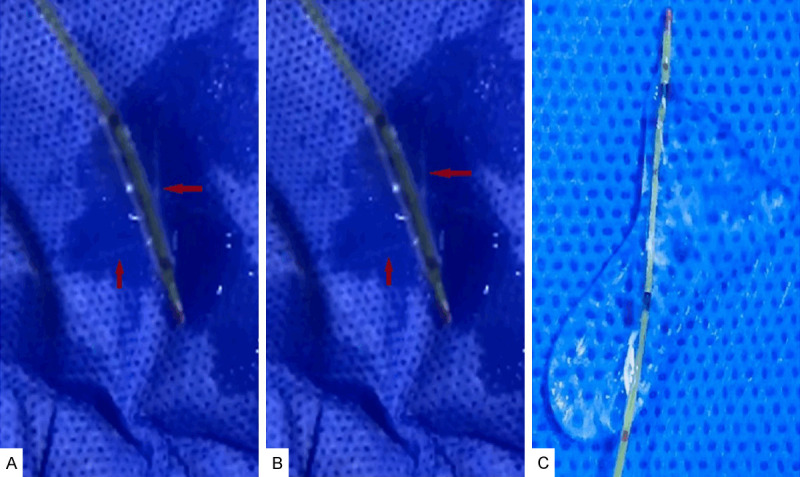
Method: 2-4 mg of nicorandil was diluted with 5 ml of normal saline and administered using PBT over 5-minute. Its effectiveness was evaluated after 10 minute qualitatively using TIMI flow and quantitatively corrected TIMI frame count (cTFC) method.
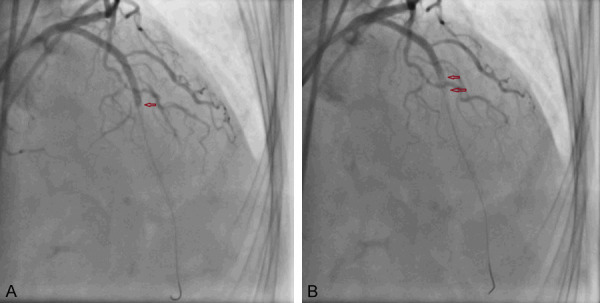
Result: Study comprised of 84 patients (out of 1789 patients undergoing PCI between January 2019 and February 2020). Their mean age was 57.8±17.9 years. Following PBT, TIMI III flow was successfully normalized in 71 subjects (84.5%), ten (12%) patients had TIMI II flow and it was not successful in three (3.5%) patients. TIMI flow grade got bettered from 1.03 to 2.58 and cTIMI frame count regressed from 52.9±11 to 16.5±5 (P < 0.001). PBT was well tolerated except short lived drop in blood pressure (n=10; 11.9%).
Conclusion: This study, for the first time to the best our knowledge, demonstrated that PBT mediated intracoronary administration of nikorandil distally was rapid, safe, and efficacious method to deal with NRF.
Keywords: Perforated balloon technique; TIMI flow; TIMI frame count; nicorandil; no-reflow; percutaneous coronary intervention.
AJCD Copyright © 2021.
Conflict of interest statement
None.
Figures





References
-
- Rezkalla SH, Kloner RA. No-reflow phenomenon. Circulation. 2002;105:656–662. - PubMed
-
- Ndrepepa G, Tiroch K, Keta D, Fusaro M, Seyfarth M, Pache J, Mehilli J, Schömig A, Kastrati A. Predictive factors and impact of no-reflow after primary percutaneous coronary intervention in patients with acute myocardial infarction. Circ Cardiovasc Interv. 2010;3:27–33. - PubMed
-
- Resnic FS, Wainstein M, Lee MK, Behrendt D, Wainstein RV, Ohno-Machado L, Kirshenbaum JM, Rogers CD, Popma JJ, Piana R. No-reflow is an independent predictor of death and myocardial infarction after percutaneous coronary intervention. Am Heart J. 2003;145:42–46. - PubMed
-
- Morishima I, Sone T, Okumura K, Tsuboi H, Kondo J, Mukawa H, Matsui H, Toki Y, Ito T, Hayakawa T. Angiographic no-reflow phenomenon as a predictor of adverse long-term outcome in patients treated with percutaneous transluminal coronary angioplasty for first myocardial infarction. J Am Coll Cardiol. 2000;36:1202–1209. - PubMed
-
- Bolognese L, Carrabba N, Parodi G, Santoro GM, Buonamici P, Cerisano G, Antoniucci D. Impact of microvascular dysfunction on left ventricular remodelling and long-term clinical outcome after primary coronary angioplasty for acute myocardial infarction. Circulation. 2004;109:1121–1126. - PubMed
LinkOut - more resources
Full Text Sources
Miscellaneous