


Cholesteryl ester transfer protein inhibitors: from high-density lipoprotein cholesterol to low-density lipoprotein cholesterol lowering agents?
- PMID: 34849601
- PMCID: PMC9648826
- DOI: 10.1093/cvr/cvab350
Cholesteryl ester transfer protein inhibitors: from high-density lipoprotein cholesterol to low-density lipoprotein cholesterol lowering agents?
Abstract
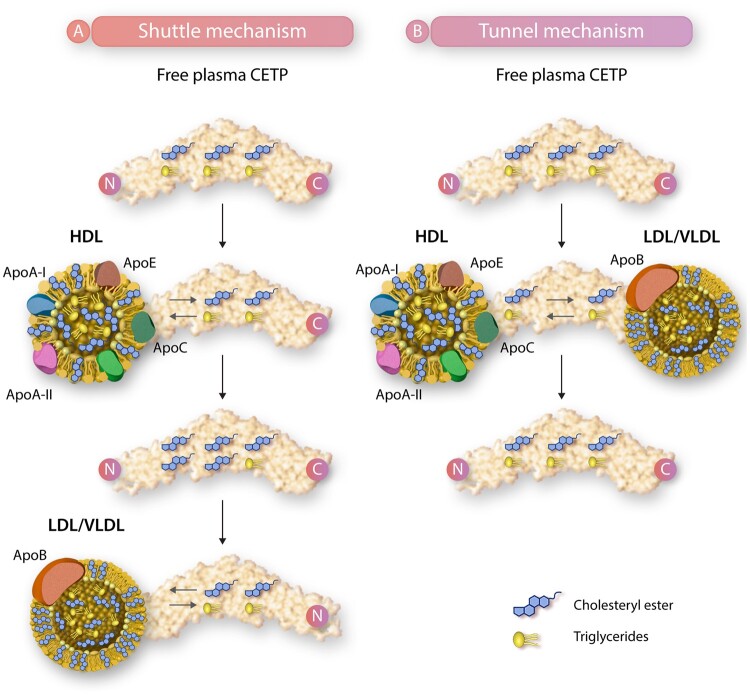
Cholesteryl ester transfer protein (CETP) is a liver-synthesized glycoprotein whose main functions are facilitating transfer of both cholesteryl esters from high-density lipoprotein (HDL) particles to apolipoprotein B (apoB)-containing particles as well as transfer of triglycerides from apoB-containing particles to HDL particles. Novel crystallographic data have shown that CETP exchanges lipids in the circulation by a dual molecular mechanism. Recently, it has been suggested that the atherosclerotic cardiovascular disease (ASCVD) benefit from CETP inhibition is the consequence of the achieved low-density lipoprotein cholesterol (LDL-C) and apoB reduction, rather than through the HDL cholesterol (HDL-C) increase. The use of CETP inhibitors is supported by genetic evidence from Mendelian randomization studies, showing that LDL-C lowering by CETP gene variants achieves equal ASCVD risk reduction as LDL-C lowering through gene proxies for statins, ezetimibe, and proprotein convertase subtilisin-kexin Type 9 inhibitors. Although first-generation CETP inhibitors (torcetrapib, dalcetrapib) were mainly raising HDL-C or had off-target effects, next generation CETP inhibitors (anacetrapib, evacetrapib) were also effective in reducing LDL-C and apoB and have been proven safe. Anacetrapib was the first CETP inhibitor to be proven effective in reducing ASCVD risk. In addition, CETP inhibitors have been shown to lower the risk of new-onset diabetes, improve glucose tolerance, and insulin sensitivity. The newest-generation CETP inhibitor obicetrapib, specifically designed to lower LDL-C and apoB, has achieved significant reductions of LDL-C up to 45%. Obicetrapib, about to enter phase III development, could become the first CETP inhibitor as add-on therapy for patients not reaching their guideline LDL-C targets.
Keywords: ASCVD; CETP inhibitor; HDL-C; LDL-C; CETP.
© The Author(s) 2021. Published by Oxford University Press on behalf of the European Society of Cardiology.
Conflict of interest statement
Conflict of interest: N.S.N. is co-founder of Lipid Tools. J.J.P.K. reports personal fees from AstraZeneca, CiVi Biopharma, CSL Behring, Draupnir, Esperion, Madrigal Pharmaceuticals, Matinas Biopharma, North Sea Therapeutics, Novo Nordisk, Novartis, Regeneron, RegenXBio, SirnaOmics, Staten Biotech, 89 Bio, and Omeicos and part-time employment at NewAmsterdam Pharma. M.D. is founder of Diomedea Medical and employed at NewAmsterdam Pharma.
Figures



References
-
- Baigent C, Blackwell L, Emberson J, Holland LE, Reith C, Bhala N, Peto R, Barnes EH, Keech A, Simes J, Collins R; Cholesterol Treatment Trialists’ (CTT) Collaboration . Efficacy and safety of more intensive lowering of LDL cholesterol: a meta-analysis of data from 170,000 participants in 26 randomised trials. Lancet 2010;376:1670–1681. - PMC - PubMed
-
- Nurmohamed NS, Navar AM, Kastelein JJP. New and emerging therapies for reduction of LDL-cholesterol and apolipoprotein B: JACC focus seminar 1/4. J Am Coll Cardiol 2021;77:1564–1575. - PubMed
-
- Ray KK, Molemans B, Schoonen WM, Giovas P, Bray S, Kiru G, Murphy J, Banach M, Servi S, De Gaita D, Gouni-Berthold I, Hovingh GK, Jozwiak JJ, Jukema JW, Kiss RG, Kownator S, Iversen HK, Maher V, Masana L, Parkhomenko A, Peeters A, Clifford P, Raslova K, Siostrzonek P, Romeo S, Tousoulis D, Vlachopoulos C, Vrablik M, Catapano AL, Poulter NR; DA VINCI Study . EU-wide cross-sectional observational study of lipid-modifying therapy use in secondary and primary care: the DA VINCI study. Eur J Prev Cardiol 2021;28:1279–1289. - PubMed
-
- Stroes ES, Thompson PD, Corsini A, Vladutiu GD, Raal FJ, Ray KK, Roden M, Stein E, Tokgözoğlu L, Nordestgaard BG, Bruckert E, Backer G, De Krauss RM, Laufs U, Santos RD, Hegele RA, Hovingh GK, Leiter LA, Mach F, März W, Newman CB, Wiklund O, Jacobson TA, Catapano AL, Chapman MJ, Ginsberg HN;European Atherosclerosis Society Consensus Panel . Statin-associated muscle symptoms: impact on statin therapy—European Atherosclerosis Society Consensus Panel Statement on Assessment, Aetiology and Management. Eur Heart J 2015;36:1012–1022. - PMC - PubMed
-
- Thompson PD, Panza G, Zaleski A, Taylor B. Statin-associated side effects. J Am Coll Cardiol 2016;67:2395–2410. - PubMed
MeSH terms
Substances
LinkOut - more resources
Full Text Sources
Other Literature Sources
Miscellaneous
