. 2021 Dec 2;49(21):12017-12034.
doi: 10.1093/nar/gkab1145.

The nuclear and cytoplasmic activities of RNA polymerase III, and an evolving transcriptome for surveillance

Affiliations

The nuclear and cytoplasmic activities of RNA polymerase III, and an evolving transcriptome for surveillance

Alan C Kessler et al. Nucleic Acids Res. .

Abstract

A 1969 report that described biochemical and activity properties of the three eukaryotic RNA polymerases revealed Pol III as highly distinguishable, even before its transcripts were identified. Now known to be the most complex, Pol III contains several stably-associated subunits referred to as built-in transcription factors (BITFs) that enable highly efficient RNA synthesis by a unique termination-associated recycling process. In vertebrates, subunit RPC7(α/β) can be of two forms, encoded by POLR3G or POLR3GL, with differential activity. Here we review promoter-dependent transcription by Pol III as an evolutionary perspective of eukaryotic tRNA expression. Pol III also provides nonconventional functions reportedly by promoter-independent transcription, one of which is RNA synthesis from DNA 3'-ends during repair. Another is synthesis of 5'ppp-RNA signaling molecules from cytoplasmic viral DNA in a pathway of interferon activation that is dysfunctional in immunocompromised patients with mutations in Pol III subunits. These unconventional functions are also reviewed, including evidence that link them to the BITF subunits. We also review data on a fraction of the human Pol III transcriptome that evolved to include vault RNAs and snaRs with activities related to differentiation, and in innate immune and tumor surveillance. The Pol III of higher eukaryotes does considerably more than housekeeping.


Figures

Figure 1.
Figure 1.
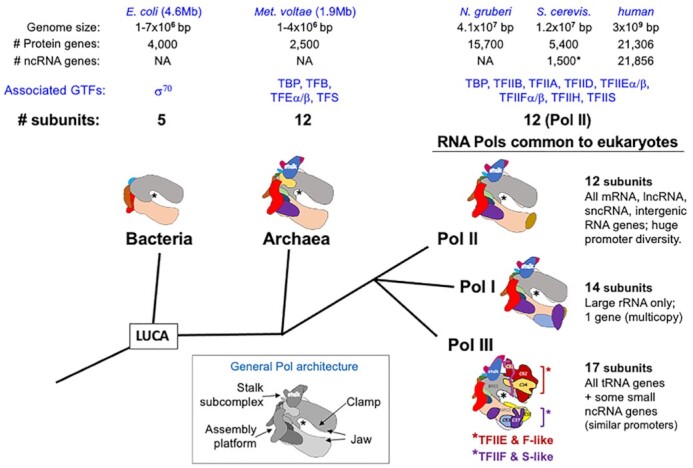
Evolutionary distinction of the RNA Polymerases. Phylogenetic tree of the multisubunit Pols. The DNA-binding clefts of the cartoon depictions of the Pols are indicated by an * in the active center. Columns above the cartoon representations of the Bacteria, Archaea and Eukarya Pols are headed by species names (Escherichia coli, Methanococcus voltae, Naegleria gruberi, Sachharomyces cerevisiae), followed by genome characteristics, associated GTFs (general transcription factors) and the number of Pol subunits. NA stands for not available. LUCA refers to last universal common ancestor. The right side illustrates the three Pols common to eukaryotes and their features as discussed in the text. Note that two subcomplexes referred to in the text as built-in transcription factors (BIFTs) with homology to GTFs TFIIE and TFIIF, are organized on Pol III as two subcomplexes on either side of the cleft, indicated by brackets. Inset: general architecture of Pol is depicted; see (2).
Figure 2.
Figure 2.
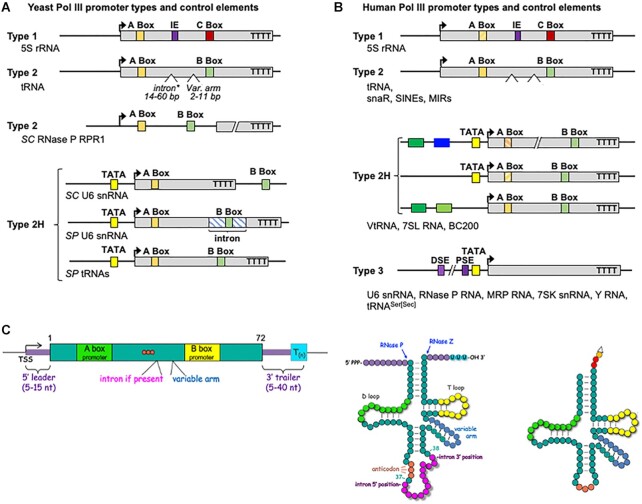
The different promoter types used to direct transcription of Pol III-dependent genes in yeast and human. (A) The two promoter types of yeast are depicted along with the hybrid subtype 2H, as suggested by (41). Type 1 is conserved from yeast to human and limited to 5S rRNA genes. Type 2 promoters contain an A Box and B Box, the distance between which varies as tRNA genes contain extra arms of variable length, and a subset contain introns of variable length. Type 2H (hybrid) promoters are similar to type 2 with an A-Box followed by a B-Box and also contain an upstream TATA element at −30. Bent arrows indicate the transcription start sites (TSS). In yeast (SC, Saccharomyces cerevisiae, SP Schizosaccharomyces pombe) type 2H have unique variations of the A- and B- Box seen in type 2. For SC RPR1 (RNase P RNA) the promoter elements are found upstream of what becomes the mature RNA species. For U6 the B Box is outside the mature RNA in SC and within an intron in SP. Not shown is the SC scR1 gene schematic encoding SRP RNA which has a TATA beginning at −31 relative to +1 of scR1. (B) The three promoter types in human are depicted along with the 2H subtypes which vary in upstream control elements (41), notable for 7SL, BC200 and VtRNAs (colored boxes). The type 3 promoter is present in higher eukaryotes (not found in yeast) consisting of a proximal sequence element (PSE), a TATA box and a distal sequence element (DSE). A type 3 promoter type, comprised of elements that direct assembly of the transcription complex exclusively from upstream of the TSS, is not found in yeast. Regardless of the variable types of promoters that direct initiation, the control element that terminates transcription by the Pols III from yeast to human, is a short oligo(T) tract on the non-template strand. (C) Left: A schematized tRNA gene is illustrated with its variable hallmark features, color-coded according to the tRNA cloverleaf models to the right. These include the Pol III terminator, the 5′pppN TSS = transcription start site, 5′ leader, 3′ trailer, variable arm and intron between the A and B Boxes. Note that three orange circles represent the anticodon. Middle: General cloverleaf model of a nascent precursor-tRNA with an intron and variable arm and other segments color-coded with the gene diagram. The RNase P and RNase Z cleavage sites are indicated, as are the 5′ppp and 3′OH ends. A tract of Us at the 3′ end that results from termination is the sequence-specific binding site for the La protein, pre-tRNA chaperone/maturation factor. Right: Representation of a corresponding mature tRNA. Following splicing and processing, CCA is added to the matured 3′ end, after which the amino acid is attached (open triangle).
Figure 3.
Figure 3.
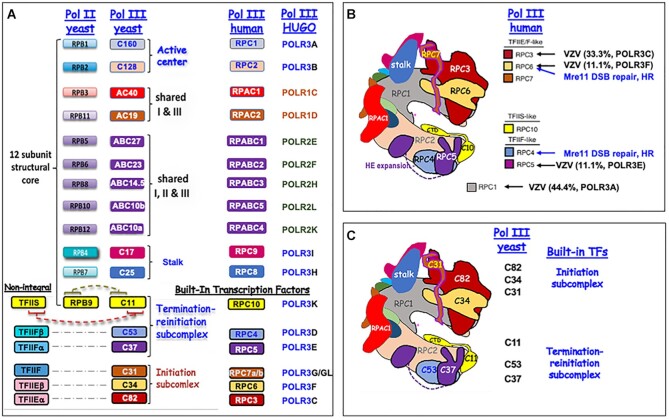
Schematic structural representation of Pol III. (A) Comparison of subunit compositions of Pol II and Pol III (yeast and human) with emphasis on the built-in transcription factors (BITFs) of Pol III. The human gene nomenclature is provided for the homologs under the column headed by HUGO. Note that humans have two alternate isoforms of RPC7 encoded by POLR3G and POLR3GL. (B) A structure model of human Pol III based on cryo-EM, modeled after Girbig et al. (51). HE expansion refers to the extra purple globular domain of RPC5 attached by a linker (dashed line) which is specific to higher eukaryotes. The subunits targeted by mutations found in VZV-susceptible patients (10) or in yeast-two hybrid studies for DSB repair (11) are indicated as discussed in the text indicated by arrows. Numbers in parentheses indicate the percentage of POLR3-unique VZV-susceptible alleles identified have been reported to date in the designated gene. (C) As in (B). the structure of Pol III is shown but with yeast nomenclature. The BITFs are indicated as such.
Figure 4.
Figure 4.
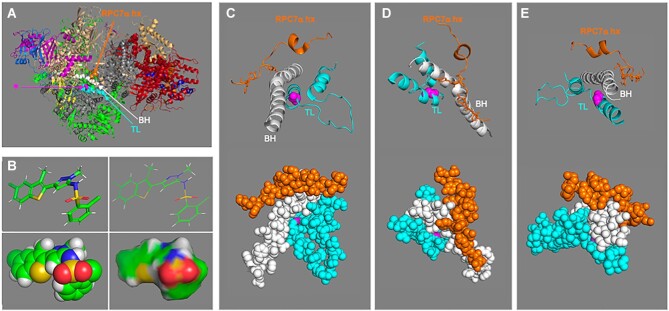
Structure model of human apo-Pol III presumed amino acid target of inhibitor ML-60218 (ML6). Based on cryo-EM structure PDB 7D59 reported by Wang et al. (82), all viewed and produced with PyMOL Molecular Graphics system. (A) The features of interest are as follows: bridge helix (BH), and trigger loop (TL) regions of RPC1 are shown as spheres in white and cyan respectively while the RPC7α helix (hx) is in orange. This color coding is carried through in panels C-E. In this model the target glycine, G1045 of RPC1 is shown in magenta in sphere representation (indicated by arrow asterisk) and the rest of the 17-subunit model is in cartoon. RPC1 is colored grey; the color code follows that in figure 3B for the Pol III-specific subunits with the shared subunits in green. (B) Four representations of the inhibitor ML-60218 (C19H15Cl2N3O2S2, molecular mass: 452.4 Da (https://pubchem.ncbi.nlm.nih.gov/compound/RNA-Polymerase-III-Inhibitor). The top two are stick and line representations, and the bottom are sphere and surface, all in the same rotational view. (C−E) Zoomed in views of different rotations of the human Pol III structure in panel A after removal of other residues to better reveal features of the close-ups. The top parts show cartoon views as in A and the bottoms show the same view in sphere representation.
Figure 5.
Figure 5.
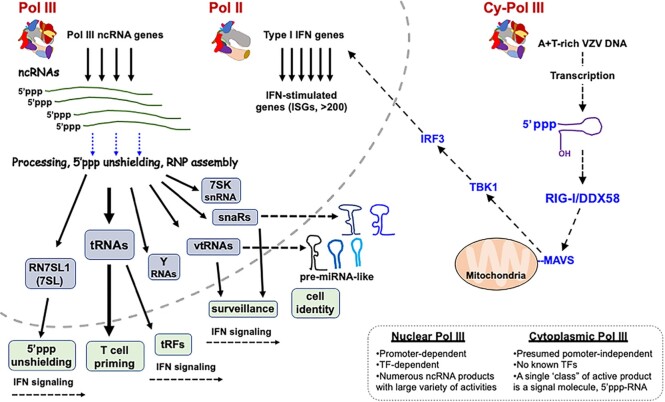
Nuclear Pol III and cy-Pol III have distinct activities in immune and other functions. The nuclear and cytoplasmic compartments are illustrated as separated by the curved dashed line. In the nucleus, Pol III transcribes ncRNA genes which go through gene-specific maturation events, including association with general and RNA-specific proteins. Removal of the 5′ppp occurs by the triphosphatase DUSP11, although other mechanisms are involved in shielding the 5′ppp end of nascent Pol III transcripts including binding by La and other proteins (see text). Some of the ncRNAs Pol III transcriptome activities in immune function are shown enclosed in green, including T cell priming by tRNAs, tRF generation from tRNA genes, RIG-I activation by 7SL/SRP RNA unshielding. Activities referred to as surveillance and cell identity involving the snaR and VtRNAs discussed in the text are also indicated. The dashed black arrows in the nuclear compartment indicate crosstalk with Pol II gene regulation such as snaR association with NF90/interleukin-3 factor and 7SK snRNA involvement in regulation of immune response genes. Furthermore, crosstalk to the Pol II transcriptome can occur via micro-RNAs generated after nuclear export of the parent vtRNAs and snaRs which can target mRNAs. In the cytoplasm, cy-Pol III transcribes A + T-rich DNA into a direct-activating RIG-I ligand, which signals through the mitochondrial-tethered MAVS, leading to Pol II-mediated transcriptional induction of IFN and ∼100 IFN-stimulated genes (ISGs). The insert lists general features of the contrasting Pol III transcription systems.

References

    1. Roeder R.G., Rutter W.J.. Multiple forms of DNA-dependent RNA polymerase in eukaryotic organisms. Nature. 1969; 224:234–237. - PubMed
    1. Werner F., Grohmann D. Evolution of multisubunit RNA polymerases in the three domains of life. Nat. Rev. Microbiol. 2011; 9:85–98. - PubMed
    1. Blombach F., Matelska D., Fouqueau T., Cackett G., Werner F.. Key concepts and challenges in archaeal transcription. J. Mol. Biol. 2019; 431:4184–4201. - PubMed
    1. Gurdon J., Brown D.D.. The transcription of 5S DNA injected into xenopus oocytes. Dev. Biol. 1978; 67:346–356. - PubMed
    1. Sklar V.E., Roeder R.G.. Transcription of specific genes in isolated nuclei by exogenous RNA polymerases. Cell. 1977; 10:405–414. - PubMed

Publication types

Substances