. 2022 Feb 28;50(4):e20.
doi: 10.1093/nar/gkab1131.

CRISPRroots: on- and off-target assessment of RNA-seq data in CRISPR-Cas9 edited cells

Affiliations

CRISPRroots: on- and off-target assessment of RNA-seq data in CRISPR-Cas9 edited cells

Giulia I Corsi et al. Nucleic Acids Res. .

Abstract

The CRISPR-Cas9 genome editing tool is used to study genomic variants and gene knockouts, and can be combined with transcriptomic analyses to measure the effects of such alterations on gene expression. But how can one be sure that differential gene expression is due to a successful intended edit and not to an off-target event, without performing an often resource-demanding genome-wide sequencing of the edited cell or strain? To address this question we developed CRISPRroots: CRISPR-Cas9-mediated edits with accompanying RNA-seq data assessed for on-target and off-target sites. Our method combines Cas9 and guide RNA binding properties, gene expression changes, and sequence variants between edited and non-edited cells to discover potential off-targets. Applied on seven public datasets, CRISPRroots identified critical off-target candidates that were overlooked in all of the corresponding previous studies. CRISPRroots is available via https://rth.dk/resources/crispr.


Figures

Figure 1.
Figure 1.
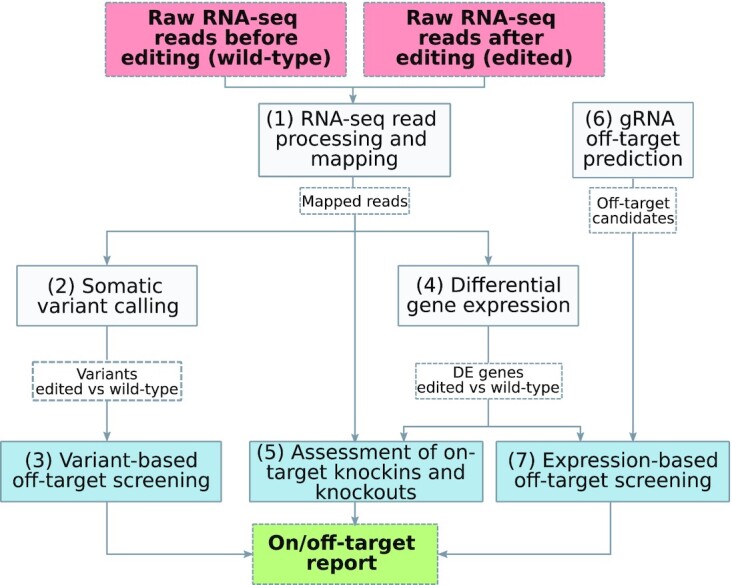
Overview of the CRISPRroots pipeline. We implemented the following main external tools in the seven modules: (1) Cutadapt, Bbduk, FastQC, MultiQC, STAR; (2) Mutect2; (3) RIsearch1; (4) featureCounts, DESeq2; (5) SAMtools; (6) RIsearch2, CRISPRoff; and (7) BEDtools, RIsearch1. The CRISPRroots specific modules are colored in blue. Key input/output files are displayed in dashed boxes. As an option, the off-target search and evaluation (modules 3, 6, 7) can run on a variant-aware version of the genome, generated after discovering germline variants with HaplotypeCaller.
Figure 2.
Figure 2.
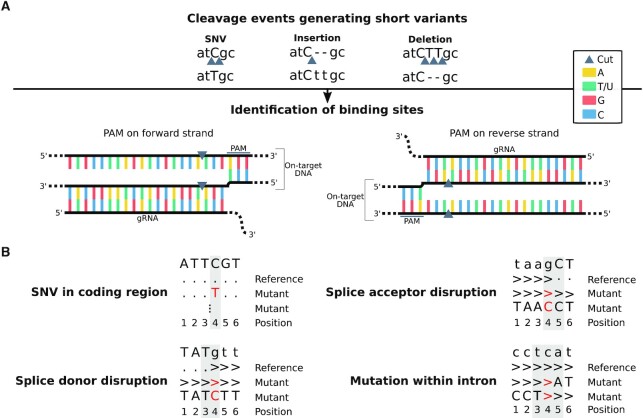
Analysis of sequence variations at possible on-/off-targets. (A) Strategy for variant-based off-target screening. Short genomic variants discovered from RNA-seq are screened to find Cas9 binding sites proximal to the possible ‘cut’ positions associated to the variants. All gRNA–DNA interactions ending at one of the identified binding sites are evaluated, and the energetically most favourable one is retained as most likely off-target for each variant. (B) Patterns of on-target single nucleotide variations. Four different types of on-target editing events are shown. For each of them, the reference pileup and examples of other possible mutant pileups (in red) are given. The positions analyzed to evaluate on-target edits are highlighted with grey boxes.
Figure 3.
Figure 3.
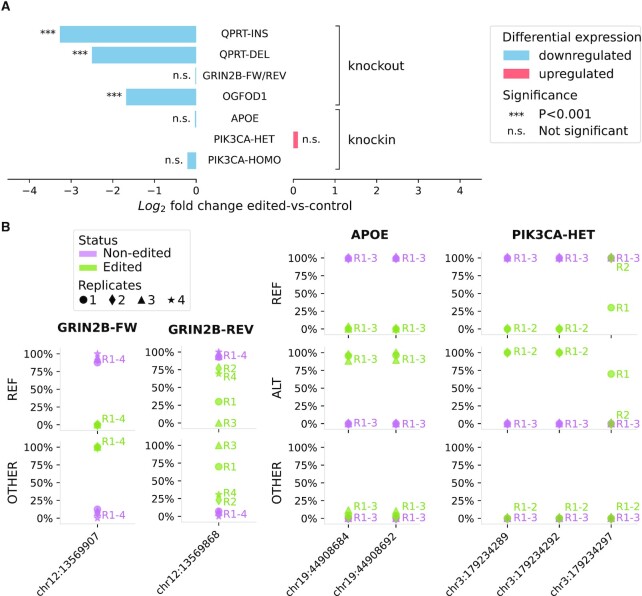
On-target Cas9-mediated edits in test datasets. (A) Transcript expression log2 fold change of genes targeted for Cas9-directed knockout or knockin computed by comparing expression levels in edited and non-edited cells with DESeq2. Significance determined by the Benjamini-Hochberg adjusted Wald test. (B) Fraction of reads mapping to edited nucleotides carrying the reference allele (REF), the alternative one (the intended edit) (ALT) or anything else (variant/indel/skip) (OTHER) in the test datasets GRIN2B, APOE, and PIK3CA-HET. The genomic coordinates of the edit in the human genome (hg38) are reported on the X-axis. Cell replicates are represented with different symbols. Note that only two of the three edited replicates of PIK3CA-HET have reads overlapping the loci described.
Figure 4.
Figure 4.
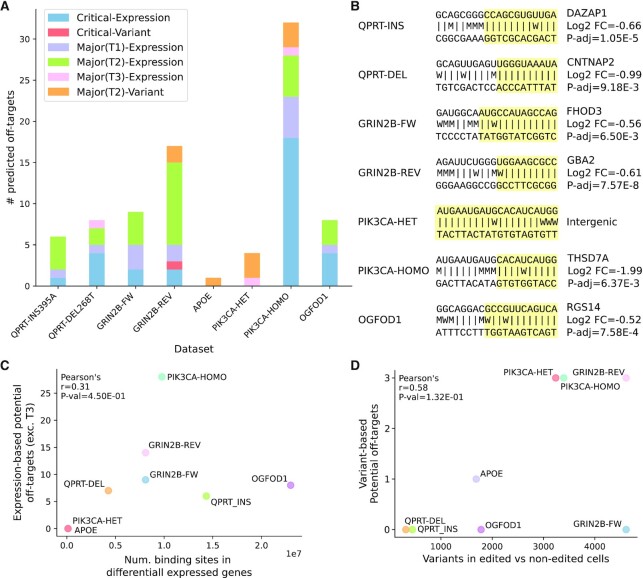
Predicted Cas9 off-target criticalities discovered in test datasets. (A) Number of predicted off-targets identified in each dataset split by degree of severity (critical or major) and by discovery method (variant or expression-based screening). Major predicted off-targets related to the expression-based screening are divided in type 1 (T1), type 2 (T2) and type 3 (T3). All major predicted off-targets related to variants are of type 2. (B) For each dataset the most favourable (lowest ΔGB) predicted off-target is reported (preference is given to the critical ones with canonical NGG PAM and not overlapping repeat-masked regions). The gRNA-DNA binding pattern is represented with the following symbols: |, canonical base pair; W, wobble base pair; M, mismatch. The portion of the gRNA-DNA interaction with lowest resulting binding energy ΔGB is highlighted in yellow, i.e. the region comprising the segment of the DNA target involved in the most energetically favourable binding interaction with the gRNA. Information on the associated downregulated gene(s) is provided (right). Log2 FC, log2 fold change; P-adj, Benjamini-Hochberg adjusted Wald test P-value. (C) Correlation between the number of Cas9 binding sites in the differentially expressed genes and the number of potential off-targets discovered by the expression-based CRISPRroots analysis. Major type 3 off-targets are excluded because they overlap non-expressed genes or intergenic regions. (D) Correlation between the number of short variants discovered from the RNA-seq in Cas9-edited vs controls cells and the number of variant-based potential off-targets.

References

    1. Jinek M., Chylinski K., Fonfara I., Hauer M., Doudna J.A., Charpentier E.. A programmable dual-RNA-guided DNA endonuclease in adaptive bacterial immunity. Science. 2012; 337:816–821. - PMC - PubMed
    1. Doudna J.A., Charpentier E.. The new frontier of genome engineering with CRISPR-Cas9. Science. 2014; 346:1258096. - PubMed
    1. Chuai G., Wang Q.-L., Liu Q.. In silico meets in vivo : towards computational CRISPR-based sgRNA design. Trends Biotechnol. 2017; 35:12–21. - PubMed
    1. Lin S., Staahl B.T., Alla R.K., Doudna J.A.. Enhanced homology-directed human genome engineering by controlled timing of CRISPR/Cas9 delivery. eLife. 2014; 3:e04766. - PMC - PubMed
    1. Zischewski J., Fischer R., Bortesi L.. Detection of on-target and off-target mutations generated by CRISPR/Cas9 and other sequence-specific nucleases. Biotechnol. Adv. 2017; 35:95–104. - PubMed

Publication types

MeSH terms

Substances