Metabolomic Analysis of Coronary Heart Disease in an African American Cohort From the Jackson Heart Study
- PMID: 34851361
- PMCID: PMC8637385
- DOI: 10.1001/jamacardio.2021.4925
Metabolomic Analysis of Coronary Heart Disease in an African American Cohort From the Jackson Heart Study
Abstract
Importance: African American individuals have disproportionate rates of coronary heart disease (CHD) but lower levels of coronary artery calcium (CAC), a marker of subclinical CHD, than non-Hispanic White individuals. African American individuals may have distinct metabolite profiles associated with incident CHD risk compared with non-Hispanic White individuals, and examination of these differences could highlight important processes that differ between them.
Objectives: To identify novel biomarkers of incident CHD and CAC among African American individuals and to replicate incident CHD findings in a multiethnic cohort.
Design, setting, and participants: This analysis targeted plasma metabolomic profiling of 2346 participants in the Jackson Heart Study (JHS), a prospective population-based cohort study that included 5306 African American participants who were examined at baseline (2000-2004) and 2 follow-up visits. Replication of CHD-associated metabolites was sought among 1588 multiethnic participants from the Women's Health Initiative (WHI), a prospective population-based multiethnic cohort study of 161 808 postmenopausal women who were examined at baseline (1991-1995) and ongoing follow-up visits. Regression analyses were performed for each metabolite to examine the associations with incident CHD and CAC scores. Data were collected from the WHI between 1994 and 2009 and from the JHS between 2000 and 2015. All data were analyzed from November 2020 to August 2021.
Exposures: Plasma metabolites.
Main outcomes and measures: Incident CHD was defined as definite or probable myocardial infarction or definite fatal CHD in both the JHS and WHI cohorts. In the JHS cohort, silent myocardial infarction between examinations (as determined by electrocardiography) and coronary revascularization were included in the incident CHD analysis. Coronary artery calcium was measured using a 16-channel computed tomographic system and reported as an Agatston score.
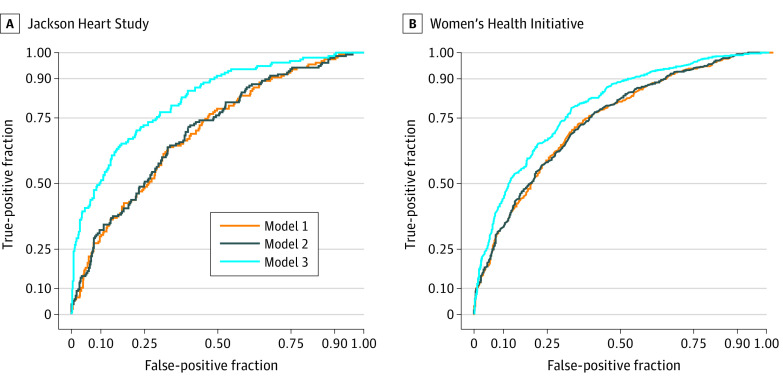
Results: Among 2346 African American individuals in the JHS cohort, the mean (SD) age was 56 (13) years, and 1468 individuals (62.6%) were female. Among 1588 postmenopausal women in the WHI cohort, the mean (SD) age was 67 (7) years; 217 individuals (13.7%) self-identified as African American, 1219 (76.8%) as non-Hispanic White, and 152 (9.6%) as other races or ethnicities. In the fully adjusted model including 1876 individuals, 46 of 303 targeted metabolites were associated with incident CHD (false discovery rate q <0.100). Data for 32 of the 46 metabolites were available in the WHI cohort, and 13 incident CHD-associated metabolites from the JHS cohort were replicated in the WHI cohort. A total of 1439 participants from the JHS cohort with available CAC scores received metabolomic profiling. Nine metabolites were associated with CAC scores. Minimal overlap was found between the results from the incident CHD and CAC analyses, with only 3 metabolites shared between the 2 analyses.
Conclusions and relevance: This cohort study identified metabolites that were associated with incident CHD among African American individuals, including 13 incident CHD-associated metabolites that were replicated in a multiethnic population and 9 novel metabolites that included N-acylamides, leucine, and lipid species. These findings may help to elucidate common and distinct metabolic processes that may be associated with CHD among individuals with different self-identified race.
Conflict of interest statement
Figures
References
Publication types
MeSH terms
Grants and funding
- HHSN268201600001C/HL/NHLBI NIH HHS/United States
- HHSN268201600003C/HL/NHLBI NIH HHS/United States
- HHSN268201800015I/HB/NHLBI NIH HHS/United States
- F32 HL150992/HL/NHLBI NIH HHS/United States
- HHSN268201600002C/HL/NHLBI NIH HHS/United States
- HHSN268201600004C/HL/NHLBI NIH HHS/United States
- HHSN268201300008C/HL/NHLBI NIH HHS/United States
- HHSN268201600018C/HL/NHLBI NIH HHS/United States
- K23 HL150327/HL/NHLBI NIH HHS/United States
- HHSN268201800013I/MD/NIMHD NIH HHS/United States
- K23 DK127073/DK/NIDDK NIH HHS/United States
- K08 HL145095/HL/NHLBI NIH HHS/United States
- R01 DK081572/DK/NIDDK NIH HHS/United States
- P30 DK040561/DK/NIDDK NIH HHS/United States