Randomized Controlled Trial
. 2021 Nov 26:76:e3549.
doi: 10.6061/clinics/2021/e3549. eCollection 2021.

Effect of a Single High-Dose Vitamin D3 on the Length of Hospital Stay of Severely 25-Hydroxyvitamin D-Deficient Patients with COVID-19

Affiliations
Randomized Controlled Trial

Effect of a Single High-Dose Vitamin D3 on the Length of Hospital Stay of Severely 25-Hydroxyvitamin D-Deficient Patients with COVID-19

Igor H Murai et al. Clinics (Sao Paulo). .

Abstract

Objectives: In this ancillary analysis of a multicenter, double-blinded, randomized, placebo-controlled trial, we investigated the effect of a single high dose of vitamin D3 on the length of hospital stay of patients with severe 25-hydroxyvitamin D deficiency and COVID-19.

Methods: The primary outcome was length of hospital stay, defined as the total number of days that patients remained hospitalized from the date of randomization until the date of hospital discharge. Secondary outcomes included serum levels of 25-hydroxyvitamin D, mortality during hospitalization, number of patients admitted to the intensive care unit, and number of patients who required mechanical ventilation. ClinicalTrials.gov: NCT04449718.

Results: Thirty-two patients were included in the study. The mean (SD) age was 58.5 (15.6) years, body mass index was 30.8 (8.6) kg/m2, and 25-hydroxyvitamin D level was 7.8 (1.6) ng/mL. No significant difference was observed in the median interquartile range of length of hospital stay between the vitamin D3 group (6.0 [4.0-18.0] days) versus placebo (9.5 [6.3-15.5] days) (log-rank p=0.74; hazard ratio, 1.13 [95% confidence interval (CI), 0.53-2.40]; p=0.76). Vitamin D3 significantly increased serum 25-hydroxyvitamin D levels in the vitamin D3 group compared with that in the placebo group (between-group difference, 23.9 ng/mL [95% CI, 17.7-30.1]; p<0.001).

Conclusions: A dose of 200.000 IU of vitamin D3 did not significantly reduce the length of hospital stay of patients with severe 25-hydroxyvitamin D deficiency and COVID-19.


Conflict of interest statement

No potential conflict of interest was reported.

Figures
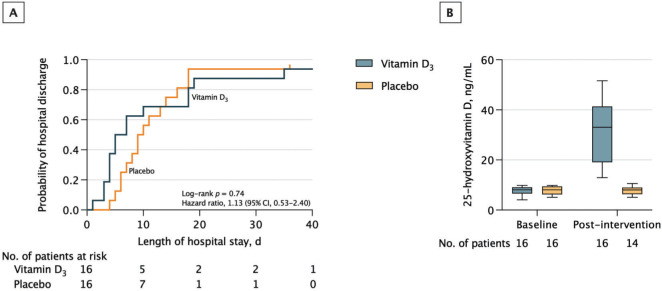
Figure 1
Figure 1. Hospital discharge and serum 25-hydroxyvitamin D levels. A, Vertical bars represent single censored events. The median (interquartile range [IQR]) observation time was not significantly different between the vitamin D3 group (6.0 [4.0-18.0] days) and the placebo group (9.5 [6.3-15.5] days) (log-rank p=0.74; HR for hospital discharge, 1.13 (95% confidence interval [CI], 0.53-2.40; p=0.76). B, 25-hydroxyvitamin D levels measured on the day of randomization (baseline) and on hospital discharge (post-intervention). A single high dose of vitamin D3 significantly increased 25-hydroxyvitamin D levels compared with the placebo (difference, 23.9 ng/mL [95% CI, 17.7-30.1]; p<0.001). The median IQR observation time of the post-intervention period was 6.0 (4.0-18.0) days for the vitamin D3 group and 9.5 (6.3-15.5) days for the placebo group. Intention-to-treat analysis was used.

References

    1. Bilezikian JP, Bikle D, Hewison M, Lazaretti-Castro M, Formenti AM, Gupta A, et al. MECHANISMS IN ENDOCRINOLOGY: Vitamin D and COVID-19. Eur J Endocrinol. 2020;183(5):R133–R147. doi: 10.1530/EJE-20-0665. - DOI - PMC - PubMed
    1. Martineau AR, Jolliffe DA, Hooper RL, Greenberg L, Aloia JF, Bergman P, et al. Vitamin D supplementation to prevent acute respiratory tract infections: systematic review and meta-analysis of individual participant data. BMJ. 2017;356:i6583. doi: 10.1136/bmj.i6583. - DOI - PMC - PubMed
    1. Carpagnano GE, Di Lecce V, Quaranta VN, Zito A, Buonamico E, Capozza E, et al. Vitamin D deficiency as a predictor of poor prognosis in patients with acute respiratory failure due to COVID-19. J Endocrinol Invest. 2021;44(4):765–71. doi: 10.1007/s40618-020-01370-x. - DOI - PMC - PubMed
    1. Hernández JL, Nan D, Fernandez-Ayala M, García-Unzueta M, Hernández-Hernández MA, López-Hoyos M, et al. Vitamin D Status in Hospitalized Patients with SARS-CoV-2 Infection. J Clin Endocrinol Metab. 2021;106(3):e1343–e1353. doi: 10.1210/clinem/dgaa733. - DOI - PubMed
    1. Jevalikar G, Mithal A, Singh A, Sharma R, Farooqui KJ, Mahendru S, et al. Lack of association of baseline 25-hydroxyvitamin D levels with disease severity and mortality in Indian patients hospitalized for COVID-19. Sci Rep. 2021;11(1):6258. doi: 10.1038/s41598-021-85809-y. - DOI - PMC - PubMed

Publication types

Associated data
