Evaluation of Microvascular Patterns Alone Using Endocytoscopy with Narrow-Band Imaging for Diagnosing Gastric Cancer
- PMID: 34852348
- PMCID: PMC8984999
- DOI: 10.1159/000520276
Evaluation of Microvascular Patterns Alone Using Endocytoscopy with Narrow-Band Imaging for Diagnosing Gastric Cancer
Abstract
Introduction: Although endocytoscopy (EC) with narrow-band imaging (NBI) is effective in diagnosing gastric cancer, no diagnostic system has been validated. We explored a specific diagnostic system for gastric cancer using EC with NBI.
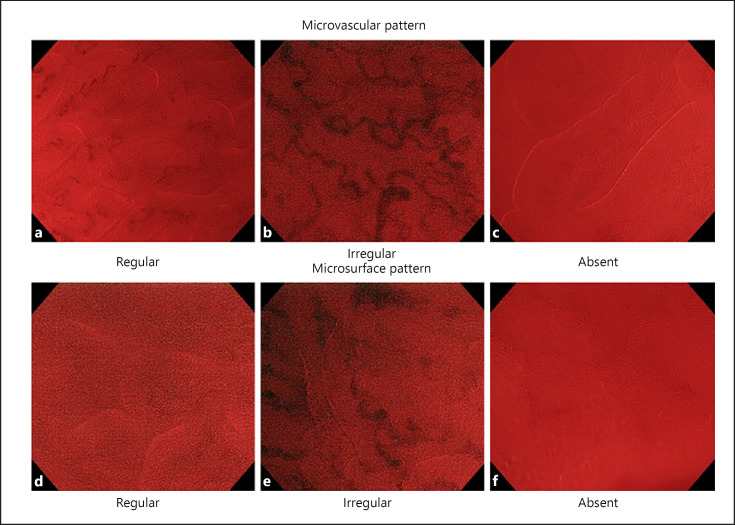
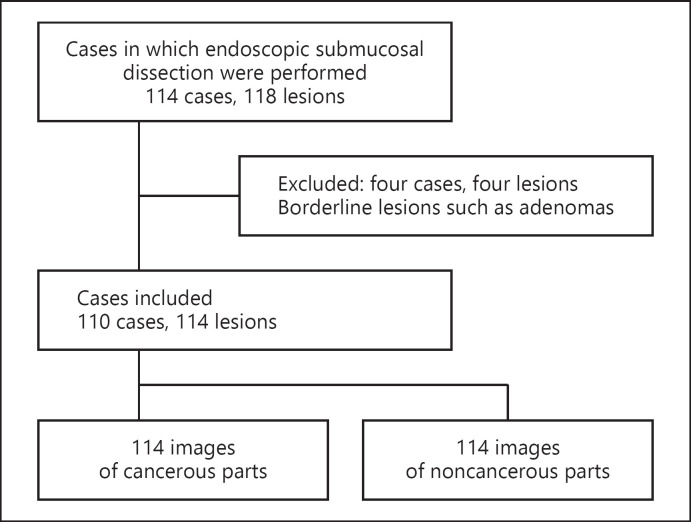
Methods: Equal numbers of images from cancerous and noncancerous areas (114 images each) were assessed by endoscopists with (development group: 33) and without (validation group: 28) specific training in magnifying endoscopy with NBI. Microvascular and microsurface patterns (MS) in each image were evaluated. Lesions were diagnosed as cancerous when patterns were deemed "irregular." The accuracy, sensitivity, specificity, positive predictive value, and negative predictive value of a diagnosis according to patterns on EC with NBI (microvascular pattern [MV] alone, MS alone, and both) were evaluated and compared between groups to determine the diagnostic performance.
Results: In the development and validation groups, diagnoses based on the MV alone had significantly higher accuracy (91.7% vs. 76.3%, p < 0.0001 and 92.5% vs. 67.5%, p < 0.0001, respectively) and sensitivity (88.6% vs. 68.3%, p < 0.0001 and 89.5% vs. 38.6%, p < 0.0001, respectively) than those based on the MS alone. In both groups, there were no significant differences in diagnostic accuracy between using the MV alone and both patterns.
Discussion/conclusion: Evaluation of the MV alone is a simple and accurate diagnostic method for gastric cancer. This system could find widespread applications in clinical practice.
Keywords: Diagnostic system; Gastric carcinoma; Magnifying endoscopy; Microsurface pattern.
© 2021 The Author(s). Published by S. Karger AG, Basel.
Conflict of interest statement
Yusuke Horiuchi has received a research grant from Grant-in-Aid for Early-Career Scientists (21K15962) and personal fees for specific speaking and teaching commitments as honoraria from Olympus Corporation, Tokyo, Japan and Kaken Pharmaceutical Co., Ltd, Tokyo, Japan. Toshiyuki Yoshio has received research grants from the Takeda Science Foundation and a Grant-in-Aid for Scientific Research (C) (19K08408). The other authors have no conflicts of interest to declare.
Figures

References
-
- Torre LA, Bray F, Siegel RL, Ferlay J, Lortet-Tieulent J, Jemal A. Global cancer statistics, 2012. CA Cancer J Clin. 2015 Mar;65((2)):87–108. - PubMed
-
- Bray F, Ferlay J, Soerjomataram I, Siegel RL, Torre LA, Jemal A. Global cancer statistics 2018: GLOBOCAN estimates of incidence and mortality worldwide for 36 cancers in 185 countries. CA Cancer J Clin. 2018 Nov;68((6)):394–424. - PubMed
-
- Ferro A, Peleteiro B, Malvezzi M, Bosetti C, Bertuccio P, Levi F, et al. Worldwide trends in gastric cancer mortality (1980–2011), with predictions to 2015, and incidence by subtype. Eur J Cancer. 2014 May;50((7)):1330–44. - PubMed
-
- Allum WH, Blazeby JM, Griffin SM, Cunningham D, Jankowski JA, Wong R, et al. Guidelines for the management of oesophageal and gastric cancer. Gut. 2011 Nov;60((11)):1449–72. - PubMed
-
- Thrumurthy SG, Chaudry MA, Hochhauser D, Mughal M. The diagnosis and management of gastric cancer. BMJ. 2013 Nov 4;347:f6367. - PubMed
MeSH terms
LinkOut - more resources
Full Text Sources
Medical