


Tryptophan metabolism and bacterial commensals prevent fungal dysbiosis in Arabidopsis roots
- PMID: 34853170
- PMCID: PMC8670527
- DOI: 10.1073/pnas.2111521118
Tryptophan metabolism and bacterial commensals prevent fungal dysbiosis in Arabidopsis roots
Abstract
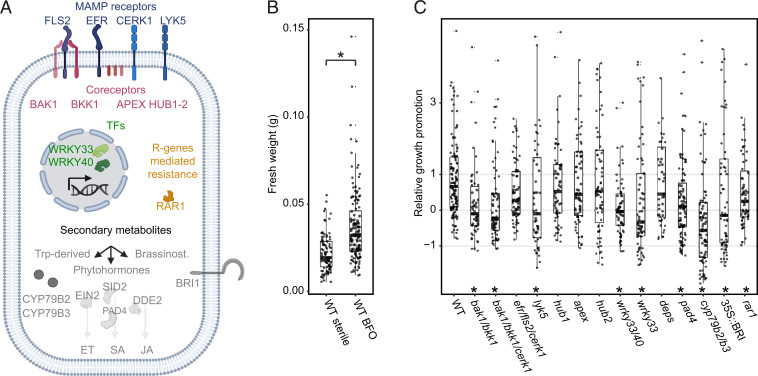
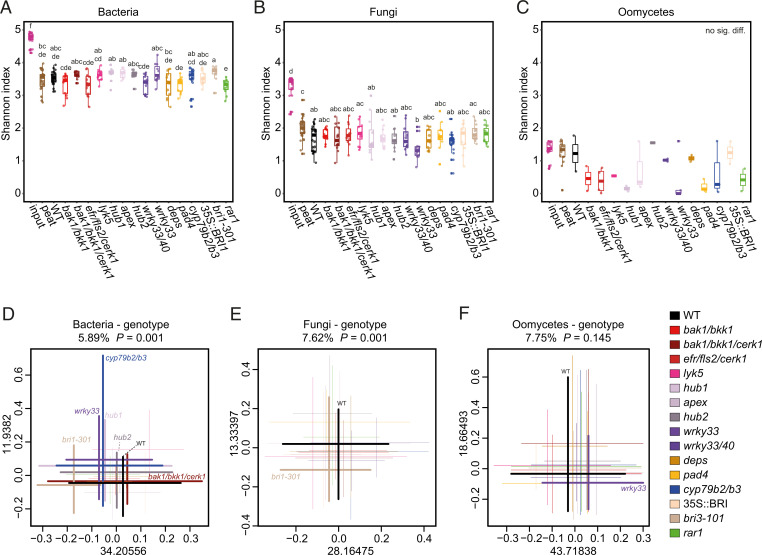
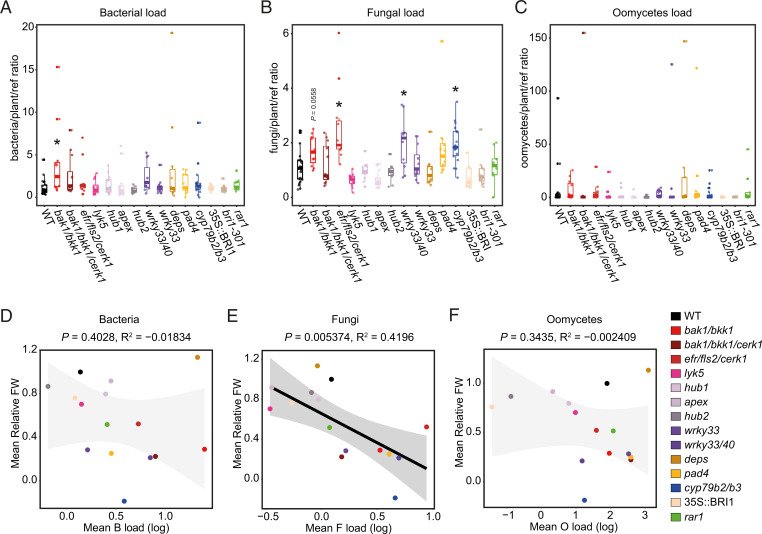
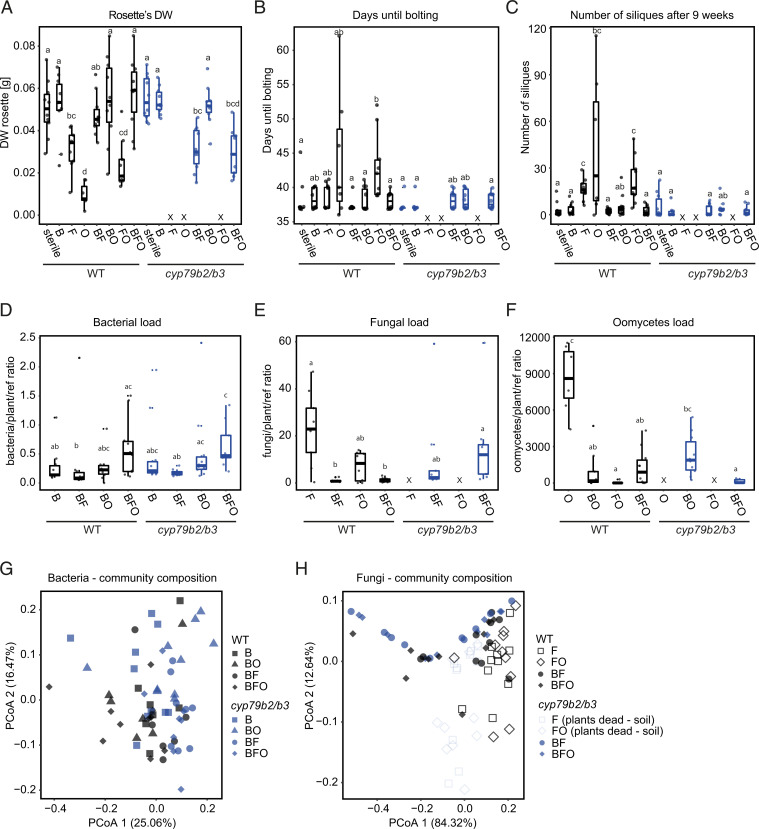
In nature, roots of healthy plants are colonized by multikingdom microbial communities that include bacteria, fungi, and oomycetes. A key question is how plants control the assembly of these diverse microbes in roots to maintain host-microbe homeostasis and health. Using microbiota reconstitution experiments with a set of immunocompromised Arabidopsis thaliana mutants and a multikingdom synthetic microbial community (SynCom) representative of the natural A. thaliana root microbiota, we observed that microbiota-mediated plant growth promotion was abolished in most of the tested immunocompromised mutants. Notably, more than 40% of between-genotype variation in these microbiota-induced growth differences was explained by fungal but not bacterial or oomycete load in roots. Extensive fungal overgrowth in roots and altered plant growth was evident at both vegetative and reproductive stages for a mutant impaired in the production of tryptophan-derived, specialized metabolites (cyp79b2/b3). Microbiota manipulation experiments with single- and multikingdom microbial SynComs further demonstrated that 1) the presence of fungi in the multikingdom SynCom was the direct cause of the dysbiotic phenotype in the cyp79b2/b3 mutant and 2) bacterial commensals and host tryptophan metabolism are both necessary to control fungal load, thereby promoting A. thaliana growth and survival. Our results indicate that protective activities of bacterial root commensals are as critical as the host tryptophan metabolic pathway in preventing fungal dysbiosis in the A. thaliana root endosphere.
Keywords: microbial homeostasis; microbial interactions; plant holobiont; plant innate immunity; root microbiome.
Copyright © 2021 the Author(s). Published by PNAS.
Conflict of interest statement
The authors declare no competing interest.
Figures
References
-
- Berendsen R. L., Pieterse C. M. J., Bakker P. A. H. M., The rhizosphere microbiome and plant health. Trends Plant Sci. 17, 478–486 (2012). - PubMed
-
- Thiergart T., et al. , Root microbiota assembly and adaptive differentiation among European Arabidopsis populations. Nat. Ecol. Evol. 4, 122–131 (2020). - PubMed
-
- Fitzpatrick C. R., et al. , The plant microbiome: From ecology to reductionism and beyond. Annu. Rev. Microbiol. 74, 81–100 (2020). - PubMed
-
- Jones J. D. G., Dangl J. L., The plant immune system. Nature 444, 323–329 (2006). - PubMed
Publication types
MeSH terms
Substances
LinkOut - more resources
Full Text Sources
Other Literature Sources
Molecular Biology Databases
