


Predictors of Incident Mild Cognitive Impairment and Its Course in a Diverse Community-Based Population
- PMID: 34853178
- PMCID: PMC8726570
- DOI: 10.1212/WNL.0000000000013017
Predictors of Incident Mild Cognitive Impairment and Its Course in a Diverse Community-Based Population
Abstract
Background and objectives: To investigate sociodemographic and medical predictors of incident mild cognitive impairment (MCI) and subsequent course of MCI at follow-up, including sustained MCI diagnosis, classification as cognitively normal, and progression to dementia.
Methods: Within a community-based cohort, diagnoses of MCI were made with a published algorithm. Diagnosis of dementia was based on clinical consensus. Cox regressions estimated hazard ratios of incident MCI associated with several predictors. Modified Poisson regressions estimated relative risks associated with predictors of diagnostic status at follow-up after incidence.
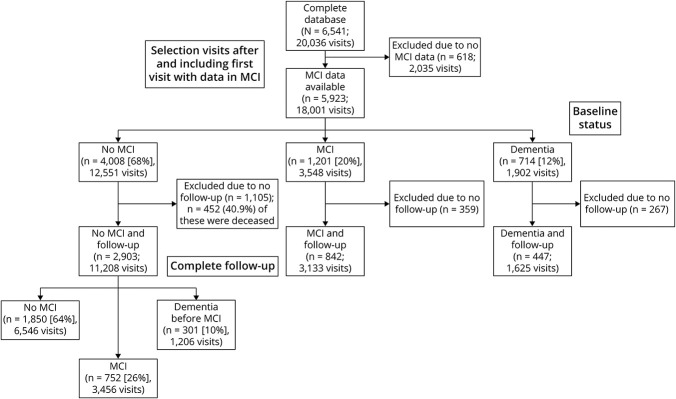
Results: Among 2,903 cognitively normal participants at baseline, 752 developed MCI over an average of 6.3 (SD 4.5) years (incidence rate 56 per 1,000 person-years). Presence of APOE ε4 and higher medical burden increased risk of incident MCI, while more years of education, more leisure activities, and higher income decreased this risk. Of the incident MCI cases, after an average of 2.4 years of follow-up, 12.9% progressed to dementia, 9.6% declined in functioning and did not meet the algorithmic criteria for MCI but did not meet the clinical criteria for dementia, 29.6% continued to meet MCI criteria, and 47.9% no longer met MCI criteria. Multidomain MCI, presence of APOE ε4, depressive symptoms, and antidepressant use increased the risk of progression to dementia.
Discussion: This community-based study showed that almost half of the individuals with incident MCI diagnoses were classified as cognitively normal at follow-up. Predictors of incident MCI demonstrably differed from those of subsequent MCI course; these findings can refine expectations for cognitive and functional course of those presenting with MCI.
Copyright © 2021 The Author(s). Published by Wolters Kluwer Health, Inc. on behalf of the American Academy of Neurology.
Figures

References
-
- Petersen RC, Smith GE, Waring SC, Ivnik RJ, Tangalos EG, Kokmen E. Mild cognitive impairment: clinical characterization and outcome. Arch Neurol. 1999;56(3):303-308. - PubMed
-
- Solfrizzi V, Panza F, Colacicco AM, et al. Vascular risk factors, incidence of MCI, and rates of progression to dementia. Neurology. 2004;63(12):1882-1891. - PubMed
-
- Tervo S, Kivipelto M, Hänninen T, et al. Incidence and risk factors for mild cognitive impairment: a population-based three-year follow-up study of cognitively healthy elderly subjects. Dement Geriatr Cogn Disord. 2004;17(3):196-203. - PubMed
