Randomized Controlled Trial
. 2021 Dec 1;11(1):23205.
doi: 10.1038/s41598-021-02547-x.

Persistent pulmonary pathology after COVID-19 is associated with high viral load, weak antibody response, and high levels of matrix metalloproteinase-9

Collaborators, Affiliations
Randomized Controlled Trial

Persistent pulmonary pathology after COVID-19 is associated with high viral load, weak antibody response, and high levels of matrix metalloproteinase-9

Tøri Vigeland Lerum et al. Sci Rep. .

Abstract

The association between pulmonary sequelae and markers of disease severity, as well as pro-fibrotic mediators, were studied in 108 patients 3 months after hospital admission for COVID-19. The COPD assessment test (CAT-score), spirometry, diffusion capacity of the lungs (DLCO), and chest-CT were performed at 23 Norwegian hospitals included in the NOR-SOLIDARITY trial, an open-labelled, randomised clinical trial, investigating the efficacy of remdesivir and hydroxychloroquine (HCQ). Thirty-eight percent had a CAT-score ≥ 10. DLCO was below the lower limit of normal in 29.6%. Ground-glass opacities were present in 39.8% on chest-CT, parenchymal bands were found in 41.7%. At admission, low pO2/FiO2 ratio, ICU treatment, high viral load, and low antibody levels, were predictors of a poorer pulmonary outcome after 3 months. High levels of matrix metalloproteinase (MMP)-9 during hospitalisation and at 3 months were associated with persistent CT-findings. Except for a negative effect of remdesivir on CAT-score, we found no effect of remdesivir or HCQ on long-term pulmonary outcomes. Three months after hospital admission for COVID-19, a high prevalence of respiratory symptoms, reduced DLCO, and persistent CT-findings was observed. Low pO2/FiO2 ratio, ICU-admission, high viral load, low antibody levels, and high levels of MMP-9 were associated with a worse pulmonary outcome.


Conflict of interest statement

Gunnar Einvik reports grants from Boehringer Ingelheim in relation to previous work, unrelated to the submitted report. The other authors declare no competing interests.

Figures
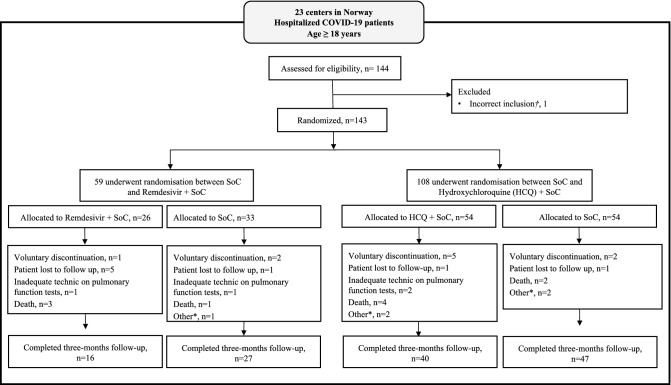
Figure 1
Figure 1
Flow chart of the participant flow. *Other: Emigration, progression of cancer diseases, general health deterioration, prolonged corrected QT-time during treatment with HCQ; Excluded from the full analysis set. HCQ hydroxychloroquine.
Figure 2
Figure 2
The CAT-score results for the overall population 3 months following hospital admission for COVID-19. CAT-score is an eight-item questionnaire designed to assess and quantify the impact of COPD symptoms on health status. The items comprise symptoms of chough, phlegm, feeling of chest tightness, breathlessness, limitations in activities, confidence, sleep problems, and energy. Each item ranging from 0 = no symptoms, to 5 = high symptom burden. CAT-score COPD Assessment Test score, COPD chronic obstructive pulmonary disease.
Figure 3
Figure 3
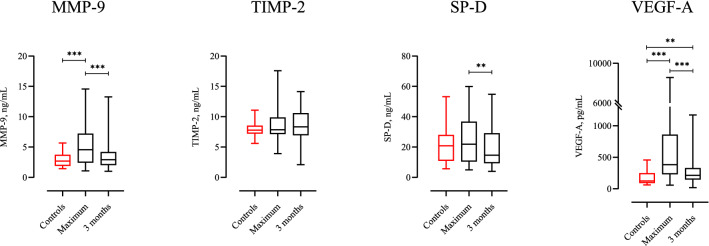
Group comparison of pro-fibrotic markers between 24 healthy control subjects, and all participants’ maximum plasma levels during hospital stay and at the 3-months follow-up evaluation, performed with Mann–Whitney U test and Wilcoxon paired test. Controls, 24 healthy control subjects. Maximum, maximum plasma levels during the hospital stay. 3 months, plasma levels at the 3-month follow-up. MMP-9 matrix metalloproteinase 9, TIMP-2 tissue inhibitor of metalloproteinases 2, SP-D surfactant protein D, VEGF-A vascular endothelial growth factor. Median MMP-9 level healthy control subjects: 2.70 ng/mL, median maximum level MMP-9: 3.83 ng/mL, median MMP-9 level at 3 months: 2.93 ng/mL. Median TIMP-2 level healthy control subjects: 7.78 ng/mL, median maximum level TIMP-2: 7.85 ng/mL, median TIMP-2 level at 3 months: 8.76 ng/mL. Median SP-D level healthy control subjects: 20.9 ng/mL, median maximum level SP-D 16.4, median SP-D level at 3 months: 14.1 ng/mL. Median VEGF-A level healthy control subjects: 125 pg/mL, median maximum VEGF-A level: 277 pg/mL, median VEGF-A level at 3 months: 216 pg/mL. *p < 0.05, **p < 0.01, ***p < 0.001.

References

    1. Zhou P, et al. A pneumonia outbreak associated with a new coronavirus of probable bat origin. Nature. 2020;579:270–273. doi: 10.1038/s41586-020-2012-7. - DOI - PMC - PubMed
    1. Lerum TV, et al. Dyspnoea, lung function and CT findings 3 months after hospital admission for COVID-19. Eur. Respir. J. 2020 doi: 10.1183/13993003.03448-2020. - DOI - PMC - PubMed
    1. Guler SA, et al. Pulmonary function and radiological features four months after COVID-19: First results from the national prospective observational Swiss COVID-19 lung study. Eur. Respir. J. 2021;57:2003690. doi: 10.1183/13993003.03690-2020. - DOI - PMC - PubMed
    1. Salvi R, Patankar P. Emerging pharmacotherapies for COVID-19. Biomed. Pharmacother. 2020;128:110267. doi: 10.1016/j.biopha.2020.110267. - DOI - PMC - PubMed
    1. WHO Solidarity Trial Consortium Repurposed antiviral drugs for covid-19—Interim WHO solidarity trial results. N. Engl. J. Med. 2020 doi: 10.1056/NEJMoa2023184. - DOI - PMC - PubMed

Publication types

MeSH terms