


Spontaneous angiogram-negative subarachnoid hemorrhage: a retrospective single center cohort study
- PMID: 34853936
- PMCID: PMC8761132
- DOI: 10.1007/s00701-021-05069-7
Spontaneous angiogram-negative subarachnoid hemorrhage: a retrospective single center cohort study
Abstract
Background: Spontaneous angiogram-negative subarachnoid hemorrhage (SAH) is considered a benign illness with little of the aneurysmal SAH-related complications. We describe the clinical course, SAH-related complications, and outcome of patients with angiogram-negative SAH.
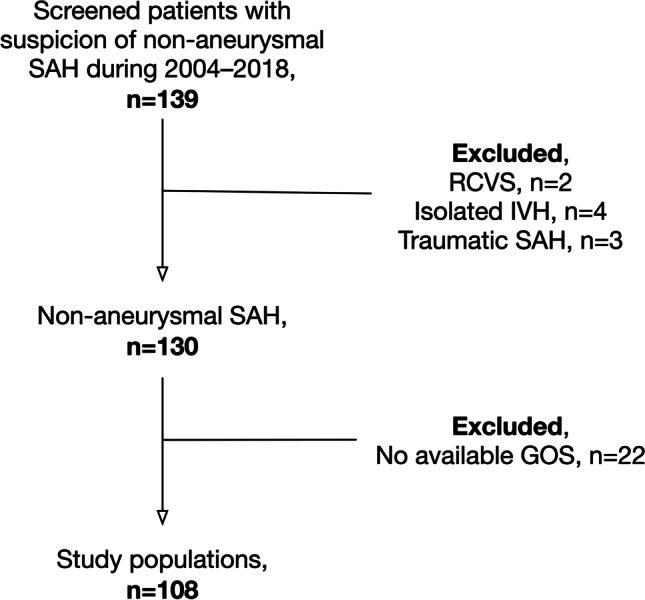
Methods: We retrospectively reviewed all adult patients admitted to a neurosurgical intensive care unit during 2004-2018 due to spontaneous angiogram-negative SAH. Our primary outcome was a dichotomized Glasgow Outcome Scale (GOS) at 3 months. We assessed factors that associated with outcome using multivariable logistic regression analysis.
Results: Of the 108 patients included, 84% had a favorable outcome (GOS 4-5), and mortality was 5% within 1 year. The median age was 58 years, 51% were female, and 93% had a low-grade SAH (World Federation of Neurosurgical Societies grading I-III). The median number of angiograms performed per patient was two. Thirty percent of patients showed radiological signs of acute hydrocephalus, 28% were acutely treated with an external ventricular drain, 13% received active vasospasm treatment and 17% received a permanent shunt. In the multivariable logistic regression model, only acute hydrocephalus associated with unfavorable outcome (odds ratio = 4.05, 95% confidence interval = 1.05-15.73). Two patients had a new bleeding episode.
Conclusion: SAH-related complications such as hydrocephalus and vasospasm are common after angiogram-negative SAH. Still, most patients had a favorable outcome. Only acute hydrocephalus was associated with unfavorable outcome. The high rate of SAH-related complications highlights the need for neurosurgical care in these patients.
Keywords: Intensive care unit; Perimesencephalic subarachnoid hemorrhage; Spontaneous subarachnoid hemorrhage; Subarachnoid hemorrhage.
© 2021. The Author(s).
Conflict of interest statement
The authors declare no competing interests.
References
Publication types
MeSH terms
LinkOut - more resources
Full Text Sources
Medical
