


CD123 Expression Is Associated With High-Risk Disease Characteristics in Childhood Acute Myeloid Leukemia: A Report From the Children's Oncology Group
- PMID: 34855461
- PMCID: PMC8769096
- DOI: 10.1200/JCO.21.01595
CD123 Expression Is Associated With High-Risk Disease Characteristics in Childhood Acute Myeloid Leukemia: A Report From the Children's Oncology Group
Abstract
Purpose: Increased CD123 surface expression has been associated with high-risk disease characteristics in adult acute myeloid leukemia (AML), but has not been well-characterized in childhood AML. In this study, we defined CD123 expression and associated clinical characteristics in a uniformly treated cohort of pediatric patients with newly diagnosed AML enrolled on the Children's Oncology Group AAML1031 phase III trial (NCT01371981).
Materials and methods: AML blasts within diagnostic bone marrow specimens (n = 1,040) were prospectively analyzed for CD123 protein expression by multidimensional flow cytometry immunophenotyping at a central clinical laboratory. Patients were stratified as low-risk or high-risk on the basis of (1) leukemia-associated cytogenetic and molecular alterations and (2) end-of-induction measurable residual disease levels.
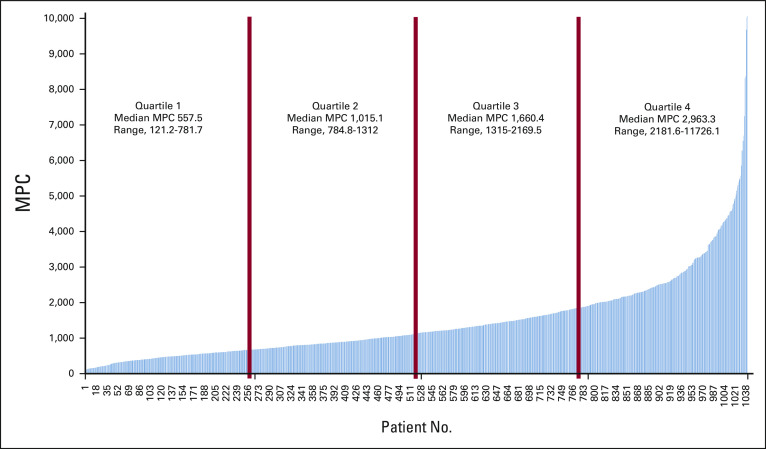
Results: The study population was divided into CD123 expression-based quartiles (n = 260 each) for analysis. Those with highest CD123 expression (quartile 4 [Q4]) had higher prevalence of high-risk KMT2A rearrangements and FLT3-ITD mutations (P < .001 for both) and lower prevalence of low-risk t(8;21), inv(16), and CEBPA mutations (P < .001 for all). Patients in lower CD123 expression quartiles (Q1-3) had similar relapse risk, event-free survival, and overall survival. Conversely, Q4 patients had a significantly higher relapse risk (53% v 39%, P < .001), lower event-free survival (49% v 69%, P < .001), and lower overall survival (32% v 50%, P < .001) in comparison with Q1-3 patients. CD123 maintained independent significance for outcomes when all known contemporary high-risk cytogenetic and molecular markers were incorporated into multivariable Cox regression analysis.
Conclusion: CD123 is strongly associated with disease-relevant cytogenetic and molecular alterations in childhood AML. CD123 is a critical biomarker and promising immunotherapeutic target for children with relapsed or refractory AML, given its prevalent expression and enrichment in patients with high-risk genetic alterations and inferior clinical outcomes with conventional therapy.
Conflict of interest statement
Figures



Comment in
-
CD123 expression linked to high-risk disease in children with acute myeloid leukemia.Cancer. 2022 Apr 1;128(7):1357-1358. doi: 10.1002/cncr.34152. Cancer. 2022. PMID: 35266674 No abstract available.
References
-
- Ihle JN: Interleukin-3 and hematopoiesis. Chem Immunol 51:65-106, 1992 - PubMed
-
- Broughton SE, Dhagat U, Hercus TR, et al. : The GM-CSF/IL-3/IL-5 cytokine receptor family: From ligand recognition to initiation of signaling. Immunol Rev 250:277-302, 2012 - PubMed
-
- Graf M, Hecht K, Reif S, et al. : Expression and prognostic value of hemopoietic cytokine receptors in acute myeloid leukemia (AML): Implications for future therapeutical strategies. Eur J Haematol 72:89-106, 2004 - PubMed
-
- Jordan CT, Upchurch D, Szilvassy SJ, et al. : The interleukin-3 receptor alpha chain is a unique marker for human acute myelogenous leukemia stem cells. Leukemia 14:1777-1784, 2000 - PubMed
Publication types
MeSH terms
Substances
Associated data
Grants and funding
LinkOut - more resources
Full Text Sources
Other Literature Sources
Medical
Miscellaneous
