


Preeclampsia Predicts Risk of Hospitalization for Heart Failure With Preserved Ejection Fraction
- PMID: 34857089
- PMCID: PMC8647839
- DOI: 10.1016/j.jacc.2021.09.1360
Preeclampsia Predicts Risk of Hospitalization for Heart Failure With Preserved Ejection Fraction
Abstract
Background: Preeclampsia is associated with increased risk of future heart failure (HF), but the relationship between preeclampsia and HF subtypes are not well-established.
Objectives: The objective of this analysis was to identify the risk of HF with preserved ejection fraction (HFpEF) following a delivery complicated by preeclampsia/eclampsia.
Methods: A retrospective cohort study using the New York and Florida state Healthcare Cost and Utilization Project State Inpatient Databases identified delivery hospitalizations between 2006 and 2014 for women with and without preeclampsia/eclampsia. The authors identified women admitted for HF after discharge from index delivery hospitalization until September 30, 2015, using International Classification of Diseases-9th Revision-Clinical Modification diagnosis codes. Patients were followed from discharge to the first instance of primary outcome (HFpEF hospitalization), death, or end of study period. Secondary outcomes included hospitalization for any HF and HF with reduced ejection fraction, separately. The association between preeclampsia/eclampsia and HFpEF was analyzed using Cox proportional hazards models.
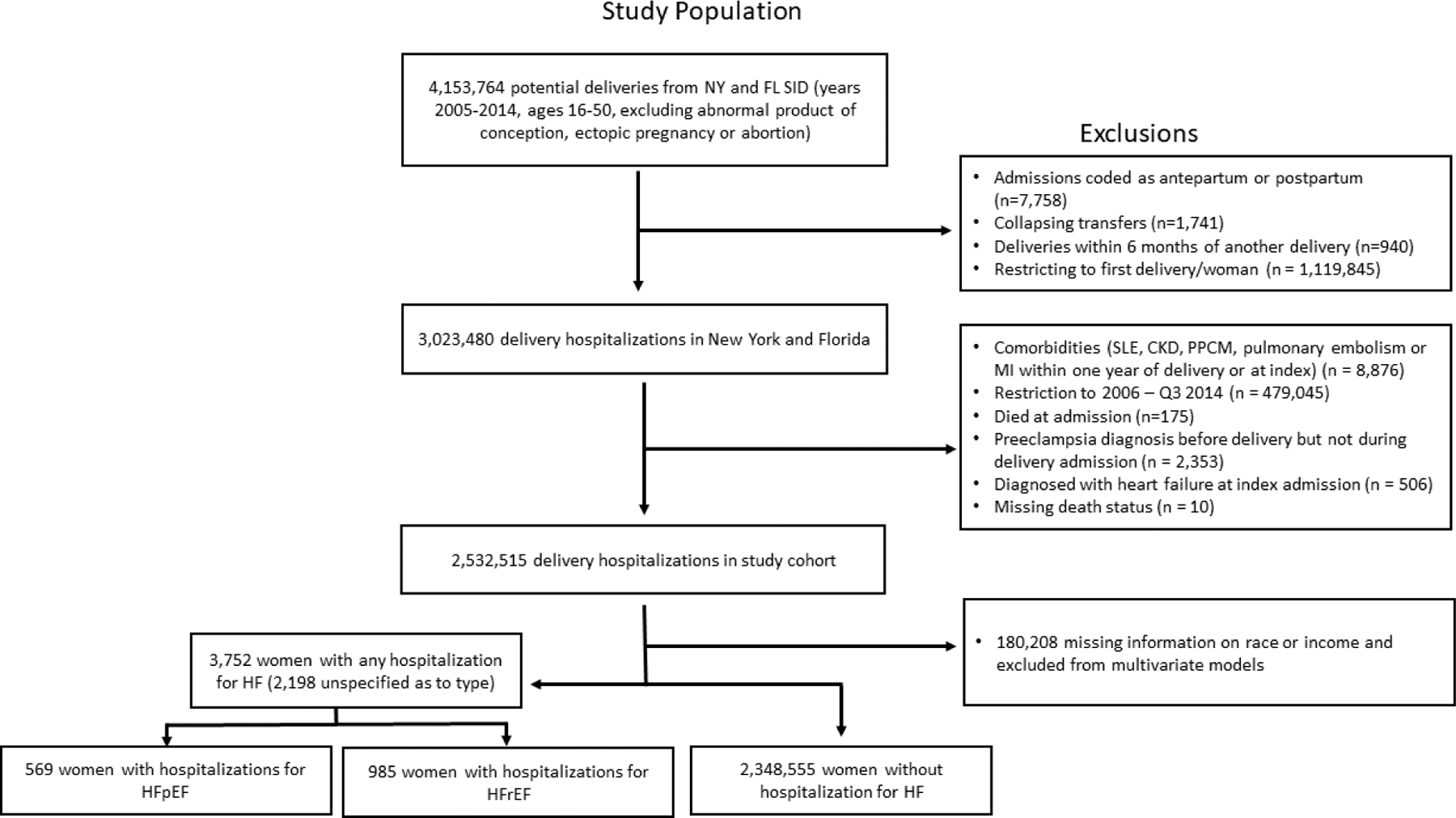
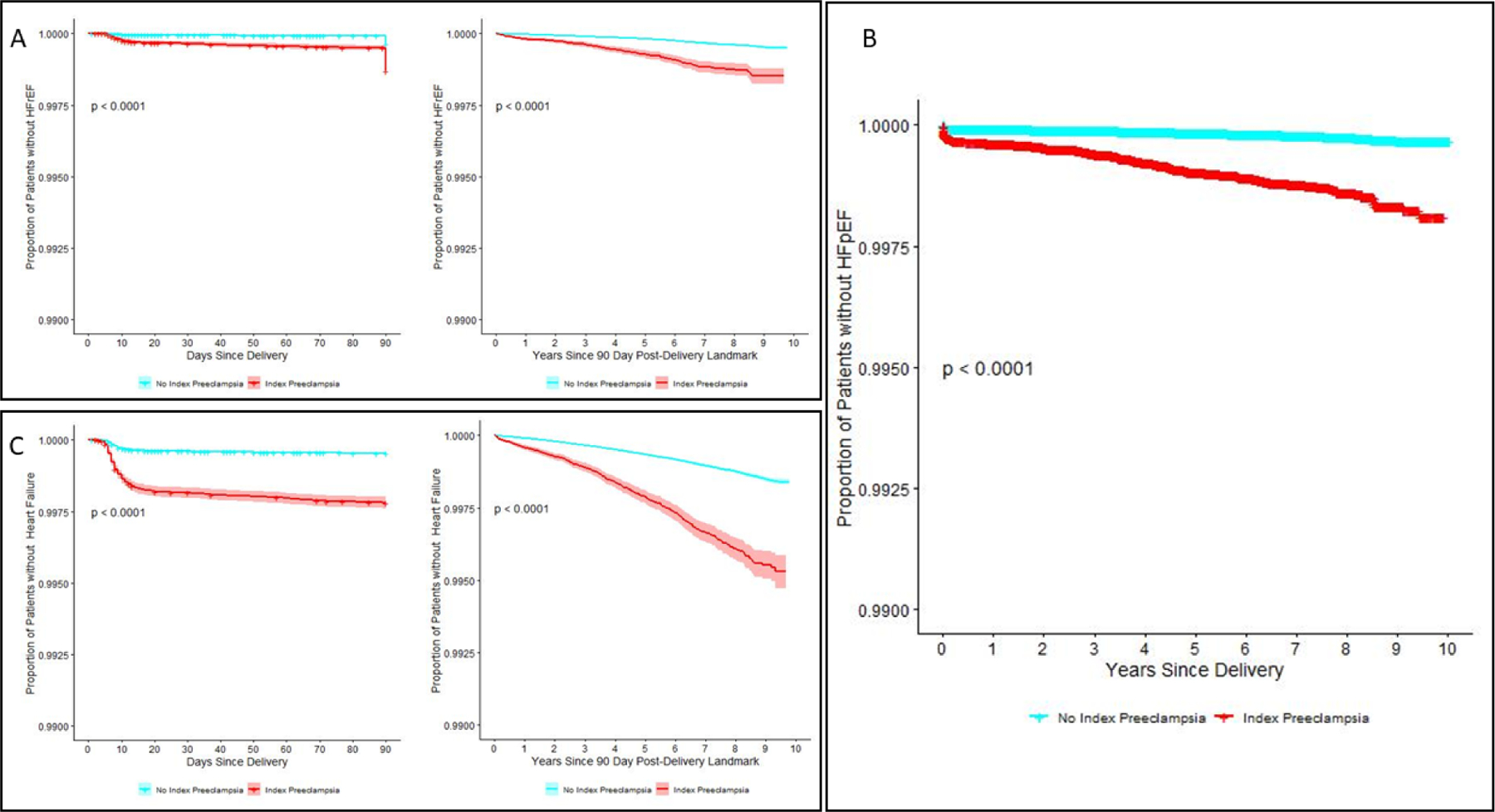
Results: There were 2,532,515 women included in the study: 2,404,486 without and 128,029 with preeclampsia/eclampsia. HFpEF hospitalization was significantly more likely among women with preeclampsia/eclampsia, after adjusting for baseline hypertension and other covariates (aHR: 2.09; 95% CI: 1.80-2.44). Median time to onset of HFpEF was 32.2 months (interquartile range: 0.3-65.0 months), and median age at HFpEF onset was 34.0 years (interquartile range: 29.0-39.0 years). Both traditional (hypertension, diabetes mellitus) and sociodemographic (Black race, rurality, low income) risk factors were also associated with HFpEF and secondary outcomes.
Conclusions: Preeclampsia/eclampsia is an independent risk factor for future hospitalizations for HFpEF.
Keywords: HFpEF; heart failure; preeclampsia; pregnancy; women.
Copyright © 2021 American College of Cardiology Foundation. Published by Elsevier Inc. All rights reserved.
Conflict of interest statement
Funding Support and Author Disclosures This study was supported in part by the Washington University Institute of Clinical and Translational Sciences grant UL1 TR002345 from the National Center for Advancing Translational Sciences of the National Institutes of Health, by grant number R24 HS19455 through the Agency for Healthcare Research and Quality (AHRQ), and by The Longer Life Foundation Grant # 2020-005. The authors have reported that they have no relationships relevant to the contents of this paper to disclose.
Figures
Comment in
-
Understanding Heart Failure in Women With Preeclampsia: A Call for Prevention.J Am Coll Cardiol. 2021 Dec 7;78(23):2291-2293. doi: 10.1016/j.jacc.2021.09.1361. J Am Coll Cardiol. 2021. PMID: 34857090 No abstract available.
-
When Preclinical Data Meet Epidemiology: Preeclampsia and Future HFpEF.J Am Coll Cardiol. 2022 Apr 12;79(14):e241. doi: 10.1016/j.jacc.2021.12.038. J Am Coll Cardiol. 2022. PMID: 35393025 No abstract available.
-
Reply: When Preclinical Data Meet Epidemiology: Preeclampsia and Future HFpEF.J Am Coll Cardiol. 2022 Apr 12;79(14):e243. doi: 10.1016/j.jacc.2022.01.044. J Am Coll Cardiol. 2022. PMID: 35393026 No abstract available.
References
-
- Abalos E, Cuesta C, Grosso AL, Chou D, Say L. Global and regional estimates of preeclampsia and eclampsia: a systematic review. European journal of obstetrics, gynecology, and reproductive biology 2013;170:1–7. - PubMed
-
- Wu P, Haththotuwa R, Kwok CS et al. Preeclampsia and Future Cardiovascular Health: A Systematic Review and Meta-Analysis. Circulation Cardiovascular quality and outcomes 2017;10. - PubMed
-
- McDonald SD, Malinowski A, Zhou Q, Yusuf S, Devereaux PJ. Cardiovascular sequelae of preeclampsia/eclampsia: a systematic review and meta-analyses. American heart journal 2008;156:918–30. - PubMed
Publication types
MeSH terms
Grants and funding
LinkOut - more resources
Full Text Sources
Other Literature Sources
Medical
Research Materials
Miscellaneous
