Review
. 2021 Nov 10:12:674074.
doi: 10.3389/fimmu.2021.674074. eCollection 2021.

Pathogenesis and Mechanism of Gastrointestinal Infection With COVID-19

Affiliations
Review

Pathogenesis and Mechanism of Gastrointestinal Infection With COVID-19

Hao Zhang et al. Front Immunol. .

Abstract

As a new infectious disease, COVID-19 is spread through the respiratory tract in most cases. Its source and pathological mechanism are not clear. The most common clinical feature is pulmonary infection. Also, a lot patients have gastrointestinal symptoms. Angiotensin-converting enzyme 2 (ACE2) is a functional cellular receptor for SARS-CoV-2, which is like SARS-CoV, a coronavirus associated with severe acute respiratory syndrome (SARS) outbreak in 2003. The tissues and cells expressing ACE2 are potential targets for SARS-CoV-2 infection, and the high expression of ACE2 in intestinal epithelial cells marks that SARS-CoV-2 may directly infect intestinal epithelial cells. Recent studies also suggest that SARS-CoV-2 existed and replicated in intestinal environment for a long time. The interaction between SARS-CoV-2 and RAS system leads to the decrease of local anti-inflammatory ability. The virus cycle leads to excessive imbalance of immune response and cytokine release. The downregulation of ACE2 after viral infection leads to gastrointestinal dysfunction. The above are the causes of gastrointestinal symptoms. Here, we reviewed the possible causes and mechanisms of gastrointestinal symptoms caused by COVID-19. Additionally, we discussed the influence of gastrointestinal symptoms on the prognosis of patients.

Keywords: RAS system; angiotensin-converting enzyme 2 (ACE2); coronavirus disease 2019 (COVID-19); cytokine storm; gastrointestinal tract; gut–lung axis.


Conflict of interest statement

The authors declare that the research was conducted in the absence of any commercial or financial relationships that could be construed as a potential conflict of interest.

Figures
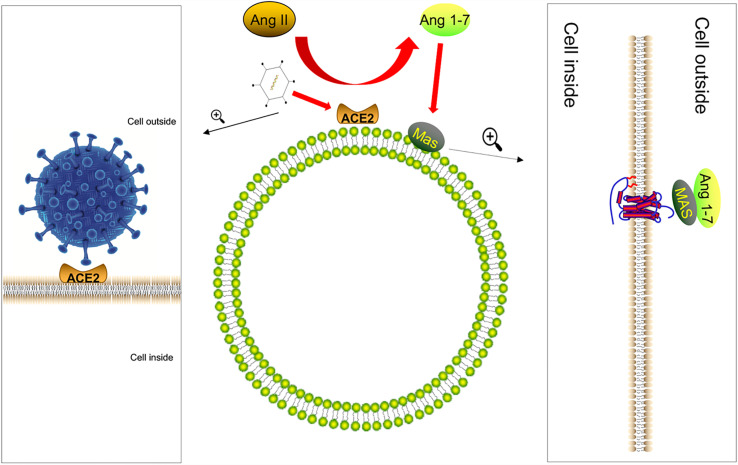
Figure 1
Figure 1
The S protein of COVID-19 infects the host by combining with ACE2. After the virus infects the host, the expression of ACE2 protein is downregulated. ACE2 converts Ang II, the main biologically active molecule of RAS, to Ang 1-7; Ang (1Mel7) has anti-inflammatory and anti-remodeling effects after binding to the Mas receptor and coupling with Gq protein. Therefore, after the virus infects the host, it is likely to cause the intestinal anti-inflammatory ability to decrease.
Figure 2
Figure 2
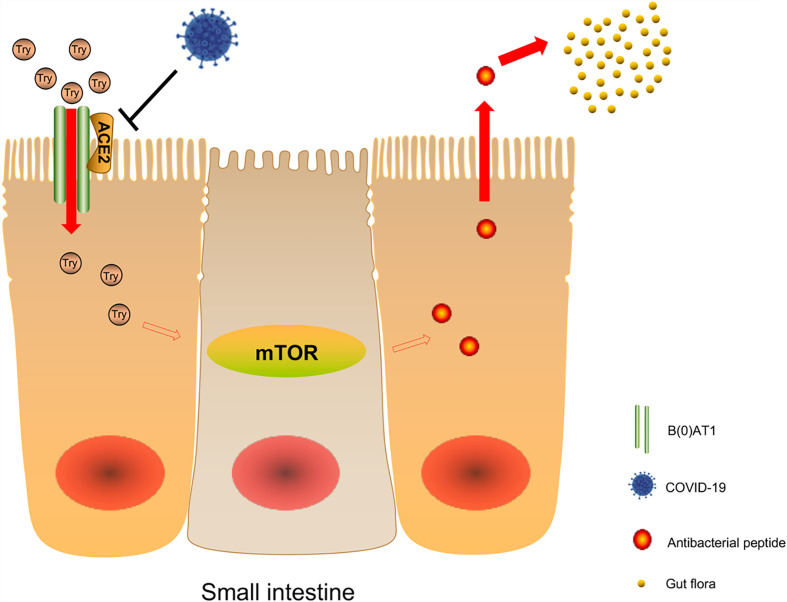
Possible mechanism of COVID-19 affecting intestinal microbiota. Sodium-dependent neutral amino acid transporter B(0)AT1 is expressed in small intestinal cells and plays an important role in amino acid absorption, while the expression and function of B(0)AT1 depend on the existence of ACE2. After viral infection, the decrease of ACE2 expression will lead to the decrease of B(0)AT1 expression, and dietary tryptophan is mainly absorbed through the B0AT1/ACE2 transport pathway on the surface of the small intestine epithelium, resulting in a significant decrease in plasma tryptophan levels, and lack of tryptophan and its metabolite nicotinamide leads to a decrease in mTOR pathway activity, which affects the expression of antibacterial peptides in the intestinal flora.
Figure 3
Figure 3
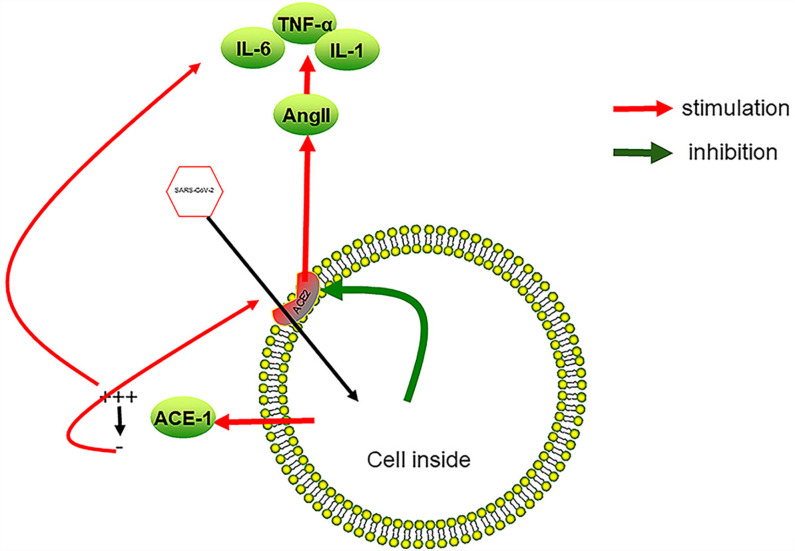
SARS-CoV-2 infection causes inflammation of vascular endothelial cells. After SARS-CoV-2 enters endothelial cells from ACE2, it promotes the reduction of ACE2 on the cell surface, which in turn leads to an increase in AngII in the blood, a decrease in local anti-inflammatory ability, and an increase in the expression of cytokines such as TNF-α, IL-6, and IL-1. Overexpression of inflammatory factors leads to the damage of vascular endothelial cells and the formation of a local procoagulant state. On the other hand, SARS-CoV-2 causes ACE1 to fall off the cell surface at the initial stage of infection, which promotes local plasma leakage and the expression of inflammatory factors. As the free ACE1 drops to a very low level, ACE2 is induced, which, in turn, promotes SARS-CoV-2 to enter endothelial cells. A vicious cycle between SARS-CoV-2 infection and overexpression of inflammatory factors forms.

References

    1. Lu H, Stratton CW, Tang Y-W. Outbreak of Pneumonia of Unknown Etiology in Wuhan, China: The Mystery and the Miracle. J Med Virol (2020) 92:401–2. doi: 10.1002/jmv.25678 - DOI - PMC - PubMed
    1. Gupta S, Parker J, Smits S, Underwood J, Dolwani S. Persistent Viral Shedding of SARS-CoV-2 in Faeces - a Rapid Review. Colorectal Dis (2020) 22:611–20. doi: 10.1111/codi.15138 - DOI - PMC - PubMed
    1. van Doorn AS, Meijer B, Frampton CMA, Barclay ML, de Boer NKH. Systematic Review With Meta-Analysis: SARS-CoV-2 Stool Testing and the Potential for Faecal-Oral Transmission. Aliment Pharmacol Ther (2020) 52:1276–88. doi: 10.1111/apt.16036 - DOI - PMC - PubMed
    1. Du W, Yu J, Liu X, Chen H, Lin L, Li Q. Persistence of SARS-CoV-2 Virus RNA in Feces: A Case Series of Children. J Infect Public Health (2020) 13:926–31. doi: 10.1016/j.jiph.2020.05.025 - DOI - PMC - PubMed
    1. Lin L, Jiang X, Zhang Z, Huang S, Zhang Z, Fang Z, et al. Gastrointestinal Symptoms of 95 Cases With SARS-CoV-2 Infection. Gut (2020) 69:997–1001. doi: 10.1136/gutjnl-2020-321013 - DOI - PubMed

Publication types