


Mammalian complex III heme dynamics studied with pump-probe spectroscopy and red light illuminations
- PMID: 34858701
- PMCID: PMC8606124
- DOI: 10.1364/BOE.441118
Mammalian complex III heme dynamics studied with pump-probe spectroscopy and red light illuminations
Abstract
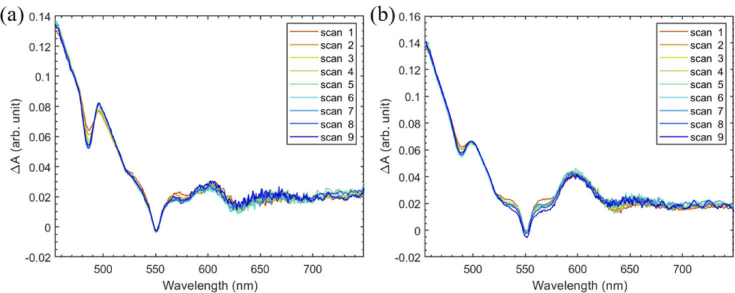
The electronic or molecular mechanisms that initiate photobiomodulation (PBM) in cells are not yet fully understood. The porcine complex III (C-III) of the electron transport chain was characterized with transient absorption spectroscopy (TAS). We then applied our recently developed continuous wave laser coupled TAS procedure (CW-TAS) to investigate the effect of red light irradiances on the heme dynamics of C-III in its c1 reduced state. The time constants were found to be 3.3 ± 0.3 ps for vibrational cooling of the oxidized state and 4.9 ± 0.4 ps for rebinding of the photodissociated axial ligand of the c1 reduced state. The analysis of the CW-TAS procedure yielded no significant changes in the C-III heme dynamics. We rule out the possibility of 635 nm CW light at 4.7 mW/cm2 inducing a PBM effect on the heme dynamic of C-III, specifically with the photodissociation of its axial ligand.
© 2021 Optical Society of America under the terms of the OSA Open Access Publishing Agreement.
Conflict of interest statement
The authors declare no conflicts of interest.
Figures


References
-
- Karu T. I., “Cellular and molecular mechanisms of photobiomodulation (low-power laser therapy),” IEEE J. Sel. Top. Quantum Electron. 20(2), 143–148 (2014). 10.1109/JSTQE.2013.2273411 - DOI
-
- Eells J. T., Wong-Riley M. T. T., VerHoeve J., Henry M., Buchman E. V., Kane M. P., Gould L. J., Das R., Jett M., Hodgson B. D., “Mitochondrial signal transduction in accelerated wound and retinal healing by near-infrared light therapy,” Mitochondrion 4(5-6), 559–567 (2004). 10.1016/j.mito.2004.07.033 - DOI - PubMed
LinkOut - more resources
Full Text Sources