


Remote Patient Monitoring Program for COVID-19 Patients Following Hospital Discharge: A Cross-Sectional Study
- PMID: 34859244
- PMCID: PMC8630581
- DOI: 10.3389/fdgth.2021.721044
Remote Patient Monitoring Program for COVID-19 Patients Following Hospital Discharge: A Cross-Sectional Study
Abstract
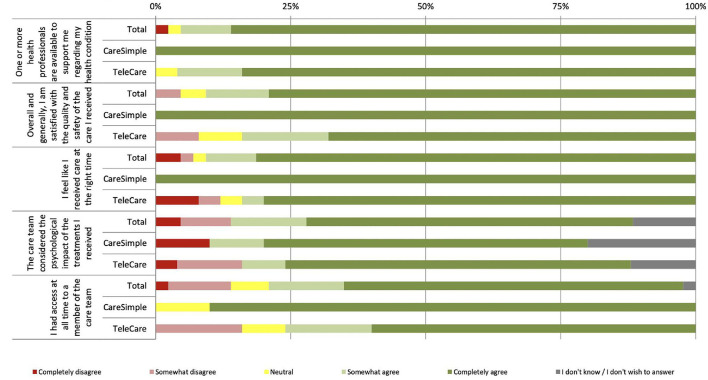
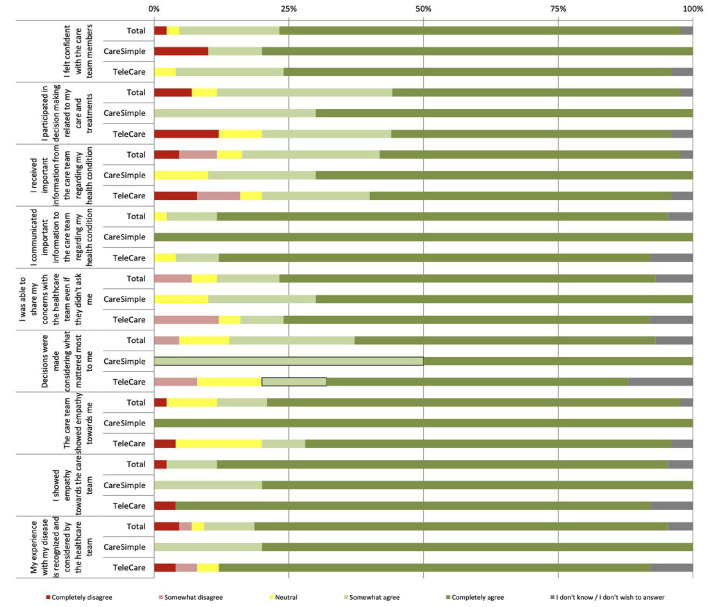
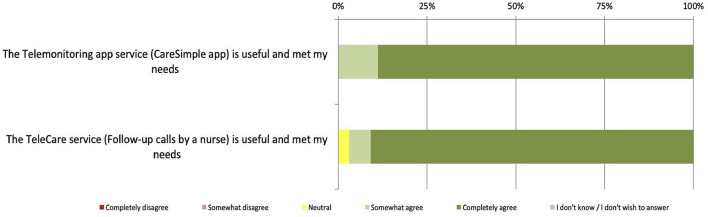
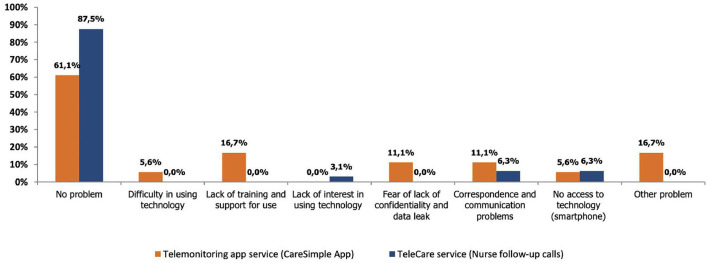
Background: The COVID-19 pandemic created an urgent need to act to reduce the spread of the virus and alleviate congestion from healthcare services, protect healthcare providers, and help them maintain satisfactory quality and safety of care. Remote COVID-19 monitoring platforms emerged as potential solutions. Objective: The purpose of this study was to evaluate the capacity and contribution of two different platforms used to remotely monitor patients with COVID-19 to maintain quality, safety, and patient engagement in care, as well as their acceptability, usefulness, and user-friendliness from the user's perspective. The first platform is focused on telecare phone calls (Telecare-Covid), and the second is a telemonitoring app (CareSimple-Covid). Methods: We performed a cross-sectional study. The data were collected through a phone survey from May to August 2020. Data were analyzed using descriptive statistics and t-test analysis. Participants' responses and comments on open-ended questions were analyzed using content analysis to identify certain issues and challenges and potential avenues for improving the platforms. Results: Fifty one patients participated in the study. Eighteen participants used the CareSimple-Covid platform and 33 participants used the Telecare-Covid platform. Overall, the satisfaction rate for quality and safety of care for the two platforms was 80%. Over 88% of the users on each platform considered the platforms' services to be engaging, useful, user-friendly, and appropriate to their needs. The survey identified a few significant differences in users' perceptions of each platform: empathy toward users and the quality and safety of the care received were rated significantly higher on the CareSimple-Covid platform than on the Telecare-Covid platform. Users appreciated four aspects of these telehealth approaches: (1) the ease of access to services and the availability of care team members; (2) the user-friendliness of the platforms; (3) the continuity of care provided, and (4) the wide range of services delivered. Users identified some technical limitations and raised certain issues, such as the importance of maintaining human contact, data security, and confidentiality. Improvement suggestions include promoting access to connected devices; enhancing communications between institutions, healthcare users, and the public on confidentiality and personal data protection standards; and integrating a participatory approach to telehealth platform development and deployment efforts. Conclusion: This study provides preliminary evidence that the two remote monitoring platforms are well-received by users, with very few significant differences between them concerning users' experiences and views. This type of program could be considered for use in a post-pandemic era and for other post-hospitalization clienteles. To maximize efficiency, the areas for improvement and the issues identified should be addressed with a patient-centered approach.
Keywords: COVID-19; evaluation; remote patient monitoring; telehealth; telemonitoring; user experience.
Copyright © 2021 Bouabida, Malas, Talbot, Desrosiers, Lavoie, Lebouché, Taguemout, Rafie, Lessard and Pomey.
Conflict of interest statement
The authors declare that the research was conducted in the absence of any commercial or financial relationships that could be construed as a potential conflict of interest.
Figures
References
LinkOut - more resources
Full Text Sources
