


Genomic and clinical findings in myeloid neoplasms with PDGFRB rearrangement
- PMID: 34859285
- PMCID: PMC8742810
- DOI: 10.1007/s00277-021-04712-8
Genomic and clinical findings in myeloid neoplasms with PDGFRB rearrangement
Abstract
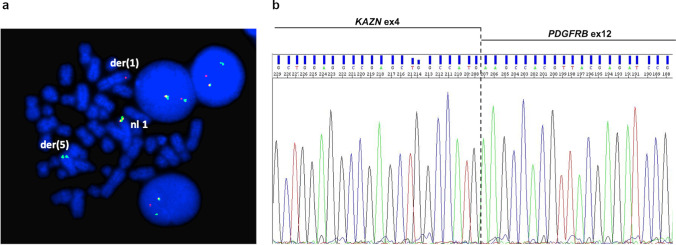
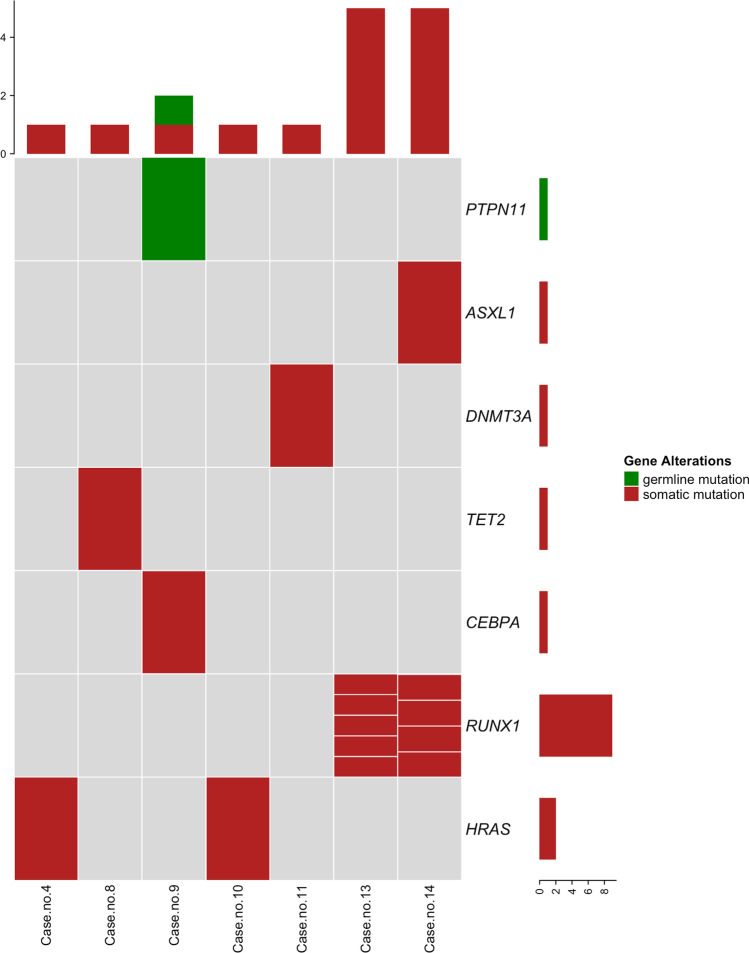
Platelet-derived growth factor receptor B (PDGFRB) gene rearrangements define a unique subgroup of myeloid and lymphoid neoplasms frequently associated with eosinophilia and characterized by high sensitivity to tyrosine kinase inhibition. To date, various PDGFRB/5q32 rearrangements, involving at least 40 fusion partners, have been reported. However, information on genomic and clinical features accompanying rearrangements of PDGFRB is still scarce. Here, we characterized a series of 14 cases with a myeloid neoplasm using cytogenetic, single nucleotide polymorphism array, and next-generation sequencing. We identified nine PDGFRB translocation partners, including the KAZN gene at 1p36.21 as a novel partner in a previously undescribed t(1;5)(p36;q33) chromosome change. In all cases, the PDGFRB recombination was the sole cytogenetic abnormality underlying the phenotype. Acquired somatic variants were mainly found in clinically aggressive diseases and involved epigenetic genes (TET2, DNMT3A, ASXL1), transcription factors (RUNX1 and CEBPA), and signaling modulators (HRAS). By using both cytogenetic and nested PCR monitoring to evaluate response to imatinib, we found that, in non-AML cases, a low dosage (100-200 mg) is sufficient to induce and maintain longstanding hematological, cytogenetic, and molecular remissions.
Keywords: Chromosome translocations; Imatinib; KAZN; Molecular monitoring; PDGFRB.
© 2021. The Author(s).
Conflict of interest statement
The authors declare no competing interests.
Figures
References
-
- Ondrejka SL, Jegalian AG, Kim AS, Chabot-Richards DS, Giltnane J, Czuchlewski DR, Shetty S, Sekeres MA, Yenamandra A, Head D, Jagasia M, His ED. PDGFRB-rearranged T-lymphoblastic leukemia/lymphoma occurring with myeloid neoplasms: the missing link supporting a stem cell origin. Haematologica. 2014;99:e148–e151. doi: 10.3324/haematol.2014.105452. - DOI - PMC - PubMed
-
- Swerdlow SH, Campo E, Harris NL, Jaffe ES, Pileri SA, Stein H, Thiele J (2017) WHO classification of tumours of haematopoietic and lymphoid tissues. Lyon, France
-
- Jawhar M, Naumann N, Schwaab J, Baurmann H, Casper J, Dang TA, Dietze L, Döhner K, Hänel A, Lathan B, Link H, Lotfi S, Maywald O, Mielke S, Müller L, Platzbecker U, Prümmer O, Thomssen H, Töpelt K, Panse J, Vieler T, Hofmann WK, Haferlach T, Haferlach C, Fabarius A, Hochhaus A, Cross NCP, Reiter A, Metzgeroth G. Imatinib in myeloid/lymphoid neoplasms with eosinophilia and rearrangement of PDGFRB in chronic or blast phase. Ann Hematol. 2017;96:1463–1470. doi: 10.1007/s00277-017-3067-x. - DOI - PubMed
-
- Fang H, Tang G, Loghavi S, Greipp P, Wang W, Verstovsek S, Medeiros LJ, Reichard KK, Miranda RN, Wang SA. Systematic use of fluorescence in-situ hybridisation and clinicopathological features in the screening of PDGFRB rearrangements of patients with myeloid/lymphoid neoplasms. Histopathology. 2020;76:1042–1054. doi: 10.1111/his.14097. - DOI - PubMed
-
- Zabriskie MS, Antelope O, Verma AR, Draper LR, Eide CA, Pomicter AD, Tran TH, Druker BJ, Tyner JW, Miles RR, Graham JM, Hwang JH, Varley KE, Toydemir RM, Deininger MW, Raetz EA, O'Hare T. A novel AGGF1-PDGFRb fusion in pediatric T-cell acute lymphoblastic leukemia. Haematologica. 2018;103:e87–e91. doi: 10.3324/haematol.2017.165282. - DOI - PMC - PubMed
MeSH terms
Substances
Grants and funding
LinkOut - more resources
Full Text Sources
Molecular Biology Databases
Research Materials
Miscellaneous
