. 2022 Feb;12(2):335-349.
doi: 10.1007/s13346-021-01091-5. Epub 2021 Dec 3.

Models and methods to characterise levonorgestrel release from intradermally administered contraceptives

Affiliations

Models and methods to characterise levonorgestrel release from intradermally administered contraceptives

Adnan Al Dalaty et al. Drug Deliv Transl Res. 2022 Feb.

Abstract

Microneedle (MN)-based technologies have been proposed as a means to facilitate minimally invasive sustained delivery of long-acting hormonal contraceptives into the skin. Intradermal administration is a new route of delivery for these contraceptives and therefore no established laboratory methods or experimental models are available to predict dermal drug release and pharmacokinetics from candidate MN formulations. This study evaluates an in vitro release (IVR) medium and a medium supplemented with ex vivo human skin homogenate (SH) as potential laboratory models to investigate the dermal release characteristics of one such hormonal contraceptive that is being tested for MN delivery, levonorgestrel (LNG), and provides details of an accompanying novel two-step liquid-liquid drug extraction procedure and sensitive reversed-phase HPLC-UV assay. The extraction efficiency of LNG was 91.7 ± 3.06% from IVR medium and 84.6 ± 1.6% from the medium supplemented with SH. The HPLC-UV methodology had a limit of quantification of 0.005 µg/mL and linearity between 0.005 and 25 µg/mL. Extraction and detection methods for LNG were exemplified in both models using the well-characterised, commercially available sustained-release implant (Jadelle®). Sustained LNG release from the implant was detected in both media over 28 days. This study reports for the first time the use of biologically relevant release models and a rapid, reliable and sensitive methodology to determine release characteristics of LNG from intradermally administered long-acting drug delivery systems.

Keywords: Contraception; Intradermal; Levonorgestrel; Method; Microneedles; Skin.


Conflict of interest statement

The authors declare no competing interests.

Figures
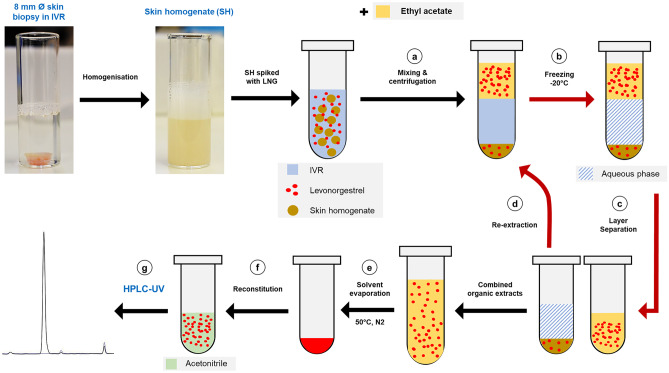
Fig. 1
Fig. 1
Schematic illustration of the validated LLE (liquid–liquid extraction) procedure for LNG extraction from SH medium. SH medium was prepared by homogenising an 8 mm diameter skin biopsy in IVR medium using a vertical bar homogeniser. The SH medium was then spiked with an LNG calibration standard and extracted with ethyl acetate as follows: the mixture was vigorously vortex-mixed and then centrifuged (a). The mixture was then stored at –20 °C (b) allowing the aqueous phase to freeze and enabling the organic supernatant to be collected (c). The aqueous layer was then thawed and re-extracted (d), and the combined organic extracts were evaporated to dryness (e). Finally, the residual powder was reconstituted in acetonitrile (f) and analysed by HPLC–UV (g)
Fig. 2
Fig. 2
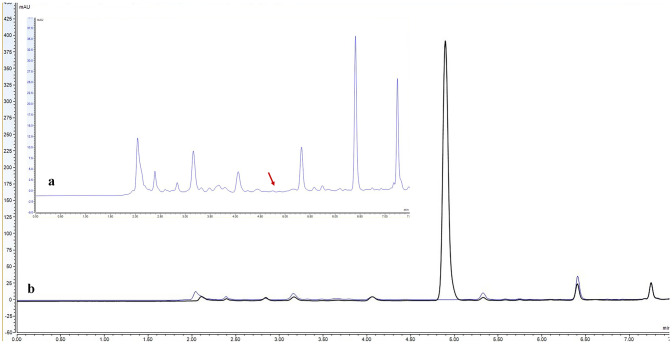
Illustrative overlaid HPLC–UV chromatograms of (a) the extract of SH medium and (b) the extract of LNG spiked in SH medium. (a) Magnified HPLC–UV chromatogram of extracted SH medium (negative control), with the red arrow indicating the absence of interfering peaks at the optimized LNG retention time. (b) Representative HPLC–UV chromatogram of extracted LNG (black) from spiked SH medium (1.6 µg/ml) compared to the SH extract alone, i.e. the negative control (grey). A sharp, symmetrical peak at ~ 4.8 min is LNG. Both SH extracts were prepared while developing the two-step extraction procedure and analysed using the optimised HPLC–UV method (“Optimised HPLC–UV method”). X axis: time (min), Y axis: UV absorbance (mAU)
Fig. 3
Fig. 3
The extraction recovery efficiencies of different organic solvents from two simple media (water and IVR medium) using a ‘high’ (1.6 µg/mL) or ‘low’ (0.4 µg/mL) spiked LNG concentration. Extraction recovery efficiencies were calculated in comparison to an untreated extraction control (EC1) which was not subject to any of the extraction steps. Data shown are the means ± SD. For water samples; n = 6. For IVR samples at high concentration; n = 3 except for tert-butyl methyl-ether and isoamyl alcohol where n = 2, while at low concentration; n = 2 each except for isoamyl alcohol where n = 0
Fig. 4
Fig. 4
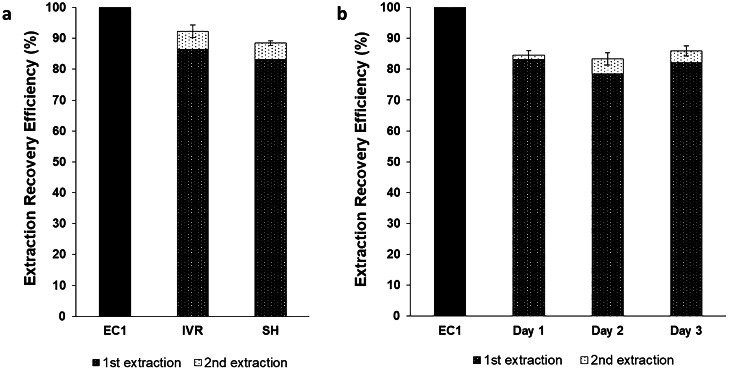
Optimisation and validation of a two-step LLE (liquid–liquid extraction) procedure to recover LNG from IVR or SH media. (a) The extraction recovery efficiencies of LNG from spiked IVR and SH media samples (19 µg/mL of LNG) compared to the untreated extraction control (EC1). The two-step extraction procedure used 500 and 150 µL of ethyl acetate, respectively. Data for IVR and SH media is the mean average ± SD (n = 3). (b) Repeated analysis of the extraction recovery efficiencies of LNG from spiked SH medium (3.6 µg/mL of LNG) compared to EC1. Experiments were repeated daily, in triplicate, for 3 consecutive days and used the optimised two-step extraction procedure (Fig. 1). Data for day 1, day 2 and day 3 is the mean average ± SD (n = 3)
Fig. 5
Fig. 5
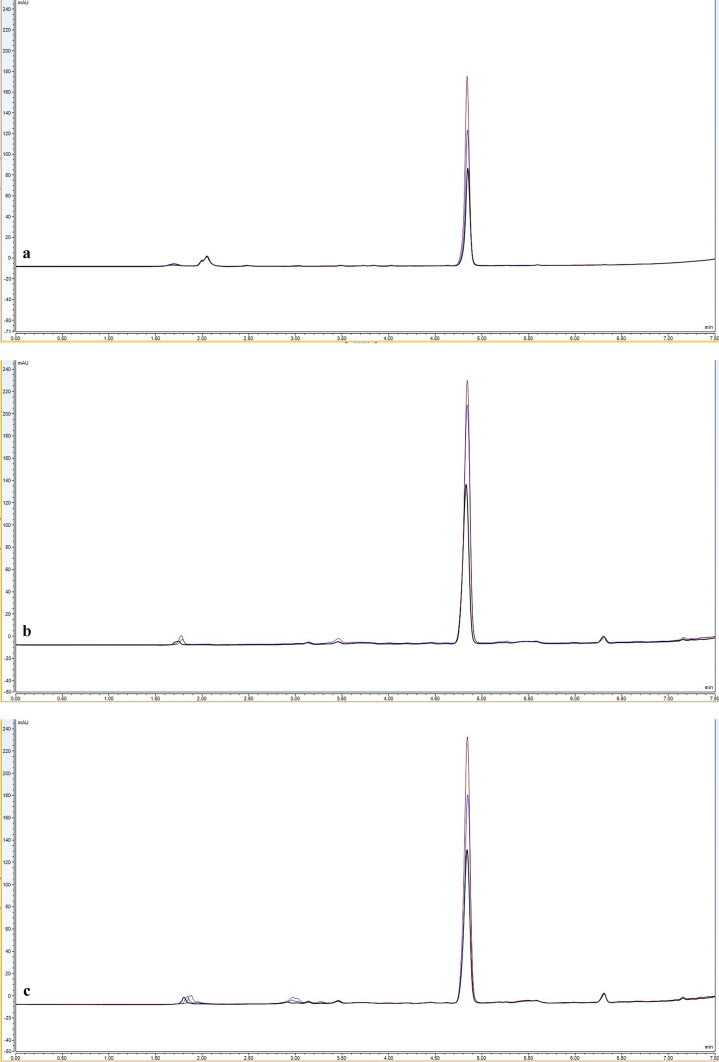
Illustrative overlaid HPLC–UV chromatograms of LNG released from Jadelle® implants in IVR (a, b) and SH (c) media. Samples of IVR (n = 1) and SH media (n = 1) were collected at days 7 (black), 14 (blue) and 28 (brown). LNG in IVR samples (a) was directly assayed by HPLC using the optimised method (“Optimised HPLC–UV method”). Further IVR samples (b) were subjected to an extraction step to illustrate the efficiency of the extraction procedure. In SH samples, (c) LNG was also recovered using the optimised extraction procedure (“LLE of LNG from human skin homogenate medium”) prior to analysis

References

    1. Starbird E, Norton M. Investing in family planning: key to achieving the sustainable development goals. Glob Heal Sci Pract [Internet]. 2020;4(2):191–210. Available from: 10.9745/GHSP-D-15-00374 - PMC - PubMed
    1. Vrettakos C, Bajaj T. Levonorgestrel. [Updated 2 Mar 2021]. In: StatPearls [Internet]. Treasure Island (FL): StatPearls Publishing. 2021. Available from: https://www.ncbi.nlm.nih.gov/books/NBK539737/
    1. Gemzell-danielsson K, Berger C, Lalitkumar PG, Berger C, Lalitkumar PG, Gemzell-danielsson K, et al. Mechanisms of action of oral emergency contraception. Gynecol Endocrinol [Internet]. 2014;3590:8–11. Available from: 10.3109/09513590.2014.950648 - PubMed
    1. Graham S, Fraser IS. The progestogen-only mini pill. Contraception [Internet]. 1982;26(4):373–88. Available from: 10.1016/0010-7824(82)90104-4 - PubMed
    1. Beatty MN, Blumenthal PD. The levonorgestrel-releasing intrauterine system: safety, efficacy, and patient acceptability. Ther Clin Risk Manag [Internet]. 2009;5:561–74. Available from: 10.2147/tcrm.s5624 - PMC - PubMed

Publication types

Substances

LinkOut - more resources