


Inherited TP53 Variants and Risk of Prostate Cancer
- PMID: 34863587
- PMCID: PMC8891030
- DOI: 10.1016/j.eururo.2021.10.036
Inherited TP53 Variants and Risk of Prostate Cancer
Abstract
Background: Inherited germline TP53 pathogenic and likely pathogenic variants (gTP53) cause autosomal dominant multicancer predisposition including Li-Fraumeni syndrome (LFS). However, there is no known association of prostate cancer with gTP53.
Objective: To determine whether gTP53 predisposes to prostate cancer.
Design, setting, and participants: This multi-institutional retrospective study characterizes prostate cancer incidence in a cohort of LFS males and gTP53 prevalence in a prostate cancer cohort.
Outcome measurements and statistical analysis: We evaluated the spectrum of gTP53 variants and clinical features associated with prostate cancer.
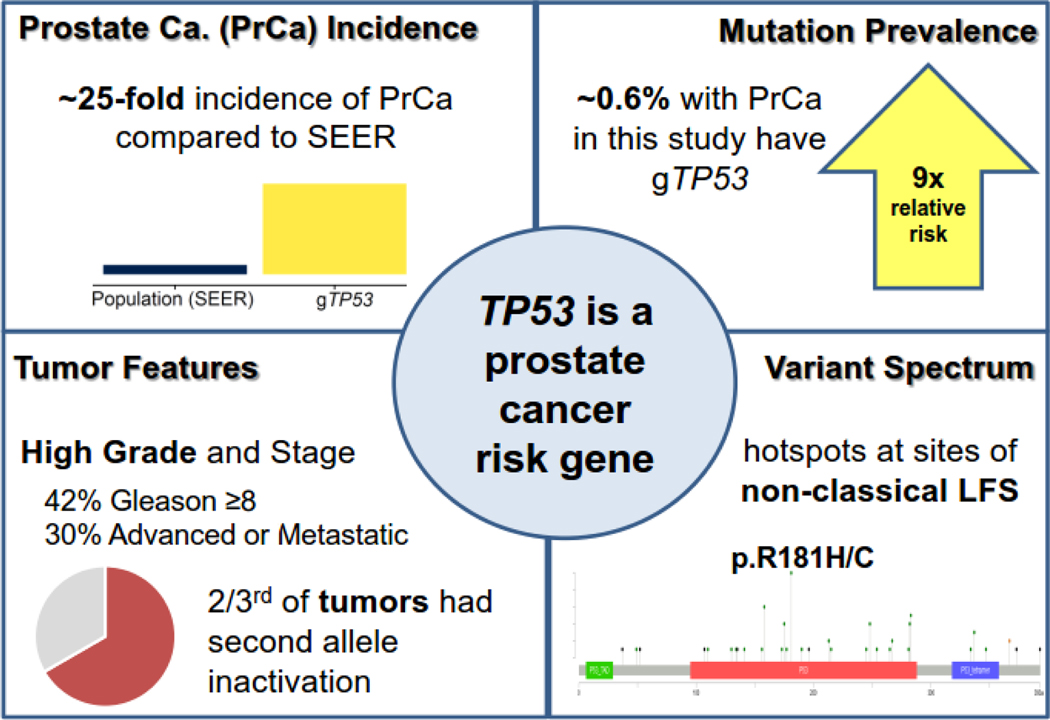
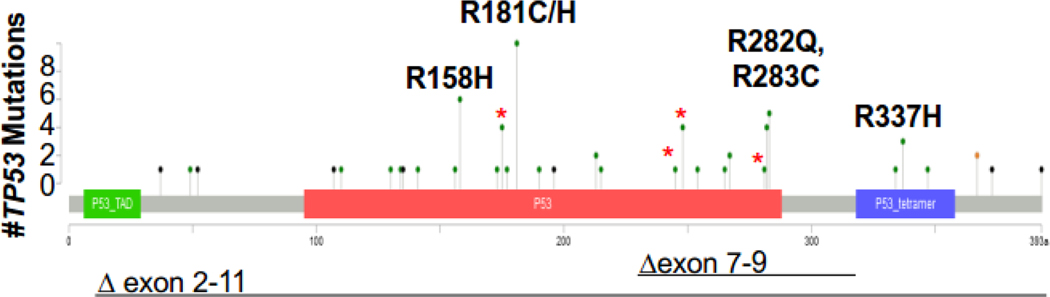
Results and limitations: We identified 31 prostate cancer cases among 163 adult LFS males, including 26 of 54 aged ≥50 yr. Among 117 LFS males without prostate cancer at the time of genetic testing, six were diagnosed with prostate cancer over a median (interquartile range [IQR]) of 3.0 (1.3-7.2) yr of follow-up, a 25-fold increased risk (95% confidence interval [CI] 9.2-55; p < 0.0001). We identified gTP53 in 38 of 6850 males (0.6%) in the prostate cancer cohort, a relative risk 9.1-fold higher than that of population controls (95% CI 6.2-14; p < 0.0001; gnomAD). We observed hotspots at the sites of attenuated variants not associated with classic LFS. Two-thirds of available gTP53 prostate tumors had somatic inactivation of the second TP53 allele. Among gTP53 prostate cancer cases in this study, the median age at diagnosis was 56 (IQR: 51-62) yr, 44% had Gleason ≥8 tumors, and 29% had advanced disease at diagnosis.
Conclusions: Complementary analyses of prostate cancer incidence in LFS males and gTP53 prevalence in prostate cancer cohorts suggest that gTP53 predisposes to aggressive prostate cancer. Prostate cancer should be considered as part of LFS screening protocols and TP53 considered in germline prostate cancer susceptibility testing.
Patient summary: Inherited pathogenic variants in the TP53 gene are likely to predispose men to aggressive prostate cancer.
Keywords: Attenuated; Genetic testing; Germline; Hypomorphic mutation; Inherited cancer syndrome; Li-Fraumeni syndrome; Pathogenic variant; Prostate cancer; Screening; TP53.
Copyright © 2021 The Author(s). Published by Elsevier B.V. All rights reserved.
Figures
Comment in
-
TP53: Another Piece of the Prostate Cancer Genetics Puzzle.Eur Urol. 2022 Mar;81(3):251-252. doi: 10.1016/j.eururo.2021.11.023. Epub 2021 Dec 9. Eur Urol. 2022. PMID: 34895923 No abstract available.
-
Re: Kara N. Maxwell, Heather H. Cheng, Jacquelyn Powers, et al. Inherited TP53 Variants and Risk of Prostate Cancer. Eur Urol 2022;81:243-50: Off-core Li-Fraumeni Syndrome Spectrum Cancers: Increasing Interest for Prostate Cancer?Eur Urol. 2022 Dec;82(6):e172-e173. doi: 10.1016/j.eururo.2022.07.038. Epub 2022 Sep 22. Eur Urol. 2022. PMID: 36153247 No abstract available.
References
-
- Eeles R, Goh C, Castro E, et al. The genetic epidemiology of prostate cancer and its clinical implications. Nat Rev Urol 2014;11:18–31. - PubMed
-
- Malkin D, Li FP, Strong LC, et al. Germ line p53 mutations in a familial syndrome of breast cancer, sarcomas, and other neoplasms. Science 1990;250:1233–8. - PubMed
-
- Bougeard G, Renaux-Petel M, Flaman JM, et al. Revisiting Li-Fraumeni syndrome from TP53 mutation carriers. J Clin Oncol 2015;33:2345–52. - PubMed
Publication types
MeSH terms
Substances
Grants and funding
LinkOut - more resources
Full Text Sources
Medical
Research Materials
Miscellaneous
