


Fungal infections diagnosis - Past, present and future
- PMID: 34863883
- PMCID: PMC8634697
- DOI: 10.1016/j.resmic.2021.103915
Fungal infections diagnosis - Past, present and future
Abstract
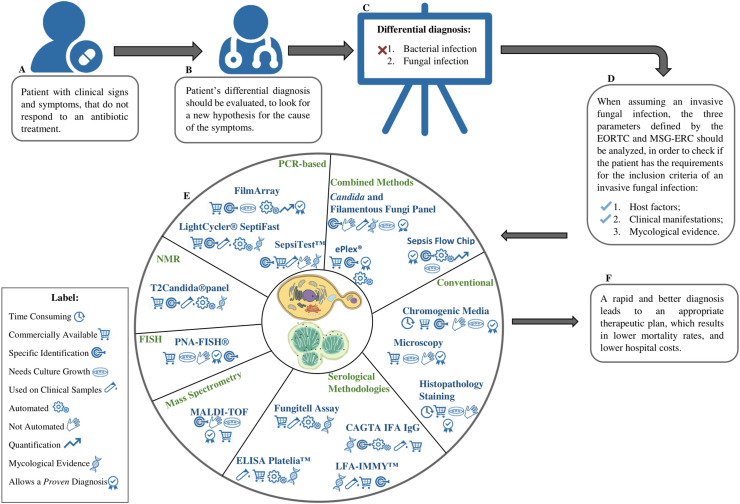
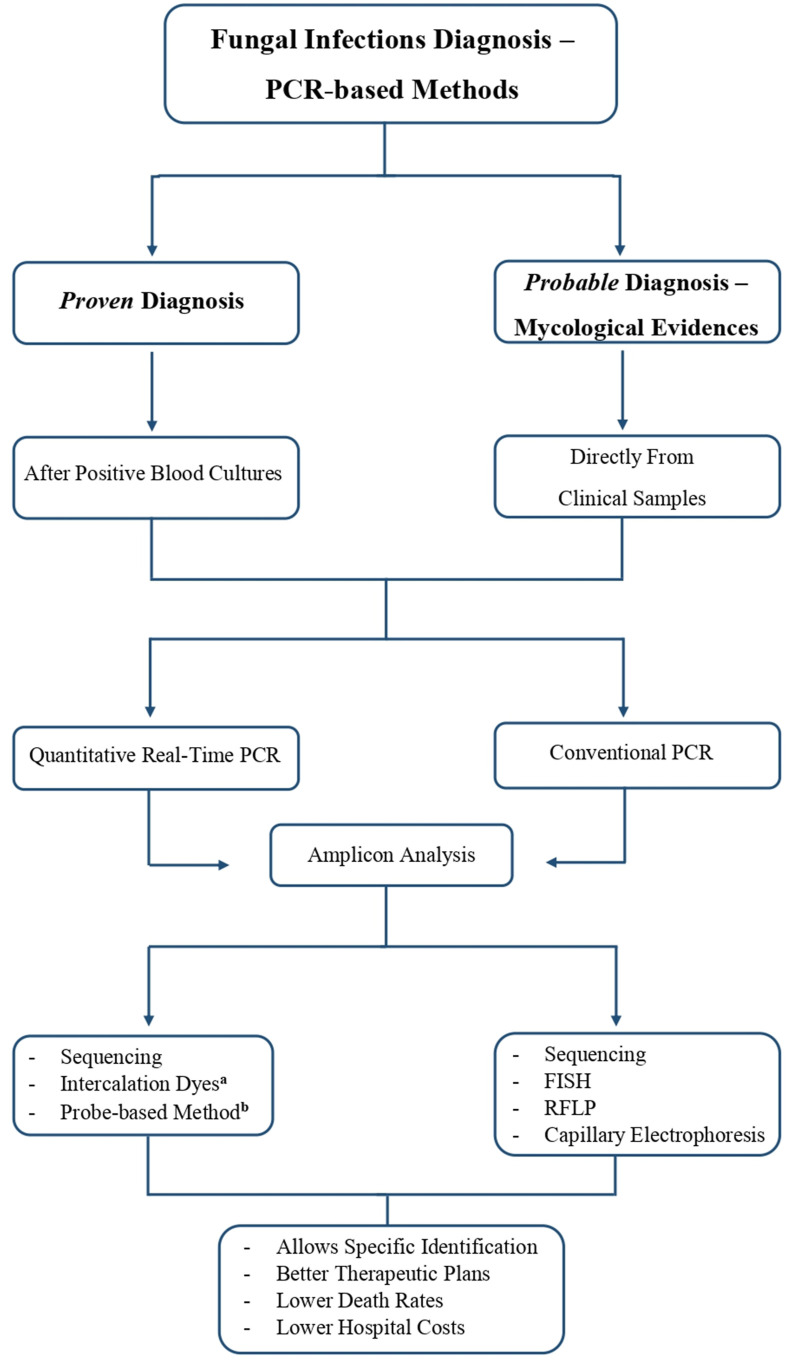
Despite the scientific advances observed in the recent decades and the emergence of new methodologies, the diagnosis of systemic fungal infections persists as a problematic issue. Fungal cultivation, the standard method that allows a proven diagnosis, has numerous disadvantages, as low sensitivity (only 50% of the patients present positive fungal cultures), and long growth time. These are factors that delay the patient's treatment and, consequently, lead to higher hospital costs. To improve the accuracy and quickness of fungal infections diagnosis, several new methodologies attempt to be implemented in clinical microbiology laboratories. Most of these innovative methods are independent of pathogen isolation, which means that the diagnosis goes from being considered proven to probable. In spite of the advantage of being culture-independent, the majority of the methods lack standardization. PCR-based methods are becoming more and more commonly used, which has earned them an important place in hospital laboratories. This can be perceived now, as PCR-based methodologies have proved to be an essential tool fighting against the COVID-19 pandemic. This review aims to go through the main steps of the diagnosis for systemic fungal infection, from diagnostic classifications, through methodologies considered as "gold standard", to the molecular methods currently used, and finally mentioning some of the more futuristic approaches.
Keywords: Fungal infections diagnosis; Gold standard methodologies; PCR-based methodologies; Probable diagnosis; Proven diagnosis.
Copyright © 2021 Institut Pasteur. Published by Elsevier Masson SAS. All rights reserved.
Conflict of interest statement
Declaration of competing interest All authors report no conflicts of interest relevant to this article.
Figures
References
-
- Echavarria M., Robinson C.R.T.A. Manual of clinical microbiology. 11th ed. ASM Press; Washington DC: 2015. Taxonomy and classification of fungi; pp. 1935–1943.
-
- Konopka J.B., Casadevall A., Taylor J.W., Heitman J., Cowen L. Colloq. Rep.; 2019. One health: fungal pathogens of humans, animals and plants; pp. 1–3.
-
- Visited on-line: november 17 Clinical fungi. Atlas clin fungi. 2021. www.clinicalfungi.org
Publication types
MeSH terms
LinkOut - more resources
Full Text Sources
Medical
Miscellaneous
