


A Comparison of the Effect of Physical Activity and Cognitive Training on Dual-Task Performance in Older Adults
- PMID: 34865009
- PMCID: PMC9159062
- DOI: 10.1093/geronb/gbab216
A Comparison of the Effect of Physical Activity and Cognitive Training on Dual-Task Performance in Older Adults
Abstract
Objectives: Studies suggest that cognitive training and physical activity can improve age-related deficits in dual-task performances. However, both of these interventions have never been compared in the same study. This article investigates the improvement in dual-task performance in 2 types of exercise training groups and a cognitive training group and explores if there are specific dual-task components that are more sensitive or more likely to improve following each type of training.
Methods: Seventy-eight healthy inactive participants older than the age of 60 (M = 69.98, SD = 5.56) were randomized to one of three 12-week training programs: aerobic training (AET) = 26, gross motor abilities (GMA) = 27, and cognition (COG) = 25. Before and after the training program, the participants underwent physical fitness tests, and cognitive evaluations involving a computerized cognitive dual task. The AET consisted of high- and low-intensity aerobic training, the GMA of full-body exercises focusing on agility, balance, coordination, and stretching, and the COG of tablet-based exercises focusing on executive functions.
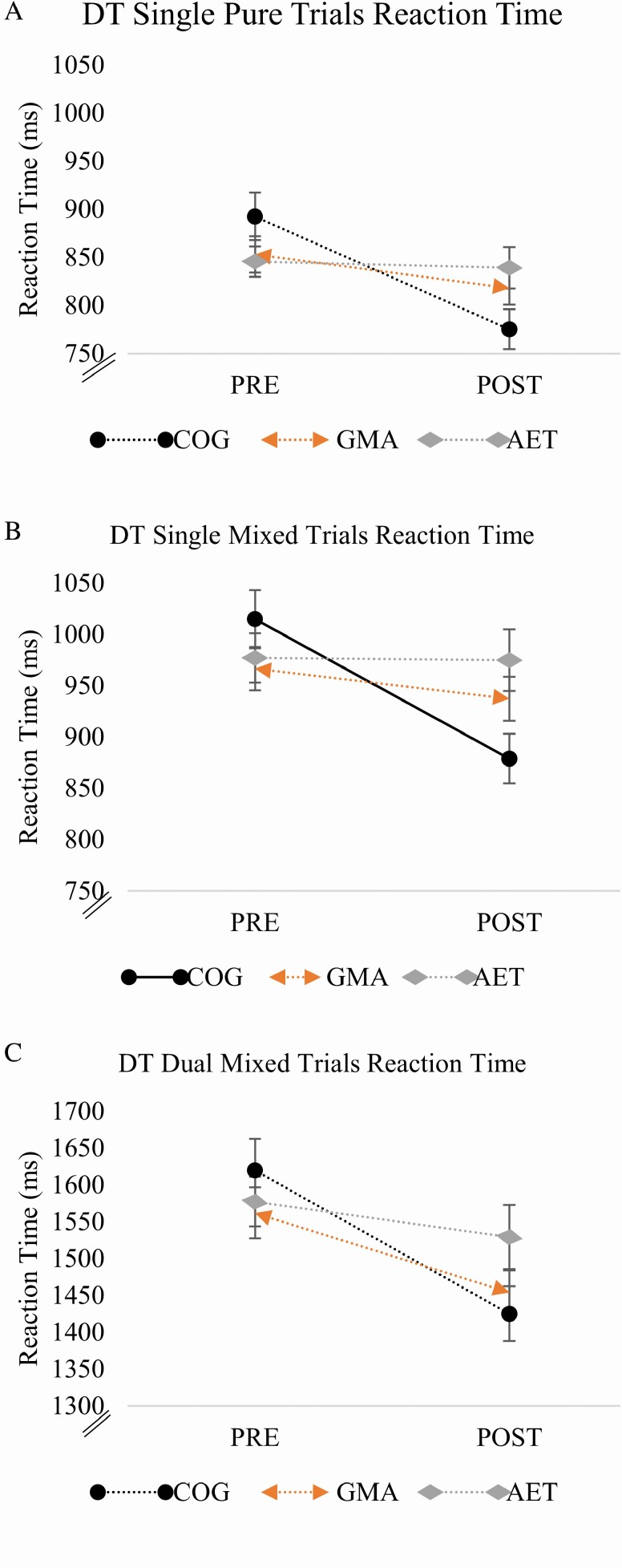
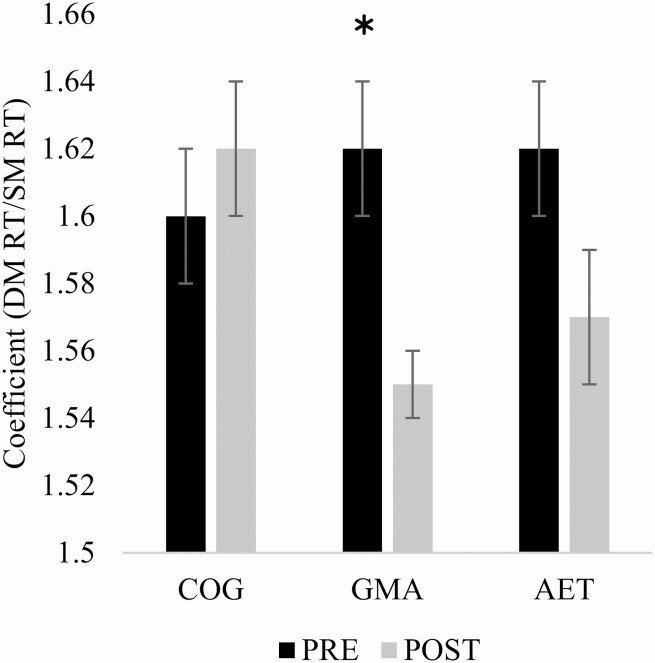
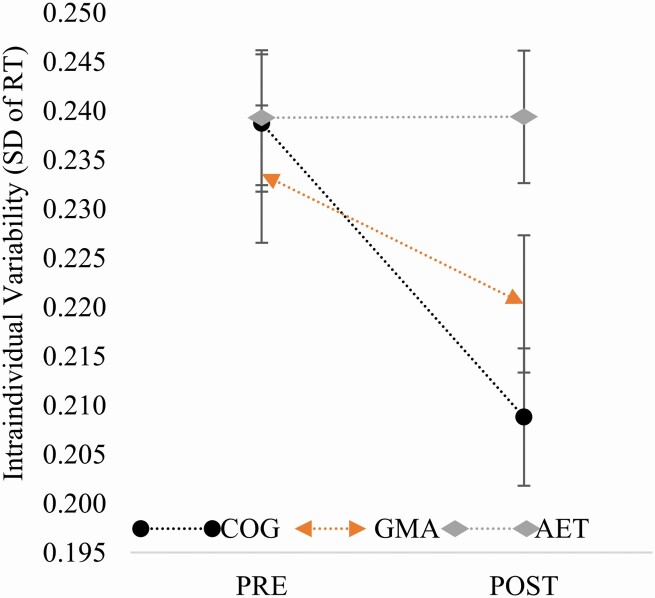
Results: Repeated-measures analysis of variance on reaction time data revealed a group × time interaction (F(2,75) = 11.91, p < .01) with COG having the greatest improvement, followed by a significant improvement in the GMA group. Secondary analysis revealed the COG to also improve the intraindividual variability in reaction time (F(1,24) = 8.62, p < .01), while the GMA improved the dual-task cost (F(1,26) = 12.74, p < .01).
Discussion: The results show that physical and cognitive training can help enhance dual-task performance by improving different aspects of the task, suggesting that different mechanisms are in play.
Keywords: Cognitive aging; Cognitive training; Dual-tasking; Physical training.
© The Author(s) 2021. Published by Oxford University Press on behalf of The Gerontological Society of America. All rights reserved. For permissions, please e-mail: journals.permissions@oup.com.
Figures
References
-
- Ainslie, P. N., Cotter, J. D., George, K. P., Lucas, S., Murrell, C., Shave, R., Thomas, K. N., Williams, M. J., & Atkinson, G. (2008). Elevation in cerebral blood flow velocity with aerobic fitness throughout healthy human ageing. The Journal of Physiology, 586(16), 4005–4010. doi:10.1113/jphysiol.2008.158279 - DOI - PMC - PubMed
-
- Berryman, N., Bherer, L., Nadeau, S., Lauzière, S., Lehr, L., Bobeuf, F., Lussier, M., Kergoat, M. J., Vu, T. T., & Bosquet, L. (2014). Multiple roads lead to Rome: Combined high-intensity aerobic and strength training vs. gross motor activities leads to equivalent improvement in executive functions in a cohort of healthy older adults. Age (Dordrecht, Netherlands), 36(5), 9710. doi:10.1007/s11357-014-9710-8 - DOI - PMC - PubMed
-
- Bherer, L., Gagnon, C., Langeard, A., Lussier, M., Desjardins-Crépeau, L., Berryman, N., Bosquet, L., Vu, T. T. M., Fraser, S., Li, K. Z. H., & Kramer, A. F. (2020). Synergistic effects of cognitive training and physical exercise on dual-task performance in older adults. The Journals of Gerontology, Series B: Psychological Sciences and Social Sciences, 76(8), 1533–1541. doi:10.1093/geronb/gbaa124 - DOI - PMC - PubMed
Publication types
MeSH terms
Grants and funding
LinkOut - more resources
Full Text Sources
Miscellaneous
