. 2022 Mar 15;225(6):947-956.
doi: 10.1093/infdis/jiab585.

Severe Acute Respiratory Syndrome Coronavirus 2 (SARS-CoV-2)-Specific Memory B Cells From Individuals With Diverse Disease Severities Recognize SARS-CoV-2 Variants of Concern

Affiliations

Severe Acute Respiratory Syndrome Coronavirus 2 (SARS-CoV-2)-Specific Memory B Cells From Individuals With Diverse Disease Severities Recognize SARS-CoV-2 Variants of Concern

Zoe L Lyski et al. J Infect Dis. .

Abstract

The unprecedented severe acute respiratory syndrome coronavirus 2 (SARS-CoV-2) pandemic has called for substantial investigations into the capacity of the human immune system to protect against reinfection and keep pace with the evolution of SARS-CoV-2. We evaluated the magnitude and durability of the SARS-CoV-2-specific antibody responses against parental WA-1 SARS-CoV-2 receptor-binding domain (RBD) and a representative variant of concern (VoC) RBD using antibodies from 2 antibody compartments: long-lived plasma cell-derived plasma antibodies and antibodies encoded by SARS-CoV-2-specific memory B cells (MBCs). Thirty-five participants naturally infected with SARS-CoV-2 were evaluated; although only 25 of 35 participants had VoC RBD-reactive plasma antibodies, 34 of 35 (97%) participants had VoC RBD-reactive MBC-derived antibodies. Our finding that 97% of previously infected individuals have MBCs specific for variant RBDs provides reason for optimism regarding the capacity of vaccination, prior infection, and/or both, to elicit immunity with the capacity to limit disease severity and transmission of VoCs as they arise and circulate.

Keywords: COVID-19; antibody; disease severity; limiting dilution assay; memory B-cell; variant of concern.


Figures

Figure 1.
Figure 1.
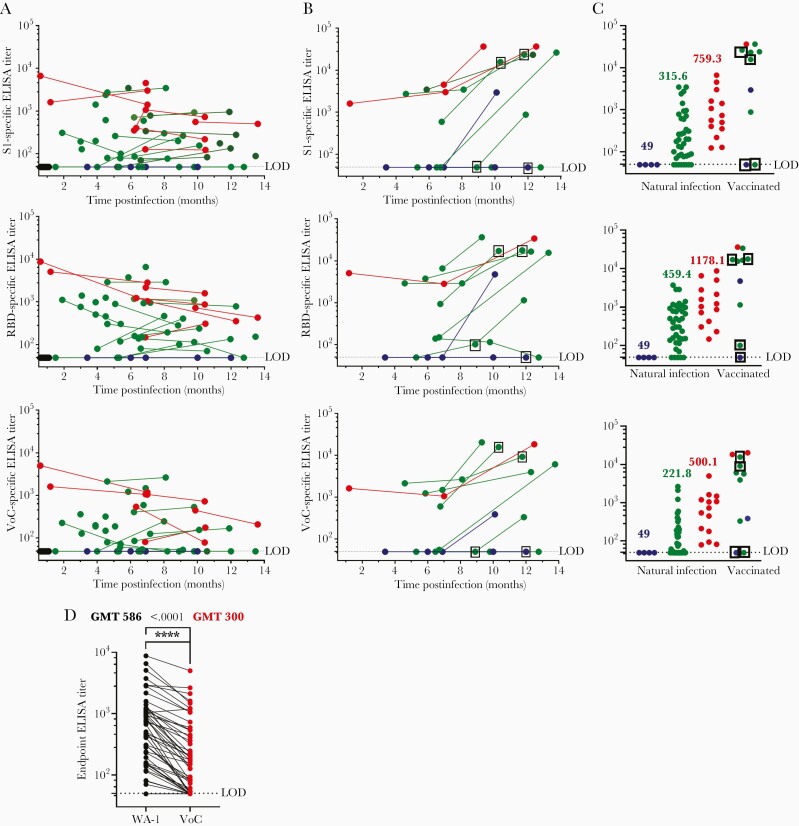
Plasma antibody titers over time, stratified by disease severity. A, Plasma enzyme-linked immunosorbent assay (ELISA) titers for pre-2020 plasma (black, n = 6), asymptomatic (blue, n = 4 from 2 participants), nonhospitalized (green, n = 39 from 26 participants), and hospitalized (red, n = 14 from 7 participants) samples. B, Plasma endpoint ELISA titer following messenger RNA vaccination. Boxed samples indicate draw after 1 dose (11–33 days post–first dose); other samples taken after second dose (16–72 days post–second dose). C, Magnitude of antibody responses, stratified by disease severity. Geometric mean titers are listed above each group. D, Comparison between ELISA titers against receptor-binding domain (RBD) WA-1 and variant of concern RBD. Samples from participants who received a vaccination prior to the second draw were excluded from the data analysis. Paired t test was performed indicating significant differences between the values (P < .0001); significance denoted by ∗∗∗∗. Limit of detection is set at 50; all samples below the limit of detection are assigned an arbitrary value of 49. Abbreviations: ELISA, enzyme-linked immunosorbent assay; GMT, geometric mean titer; LOD, limit of detection; RBD, receptor-binding domain; VoC, variant of concern.
Figure 2.
Figure 2.
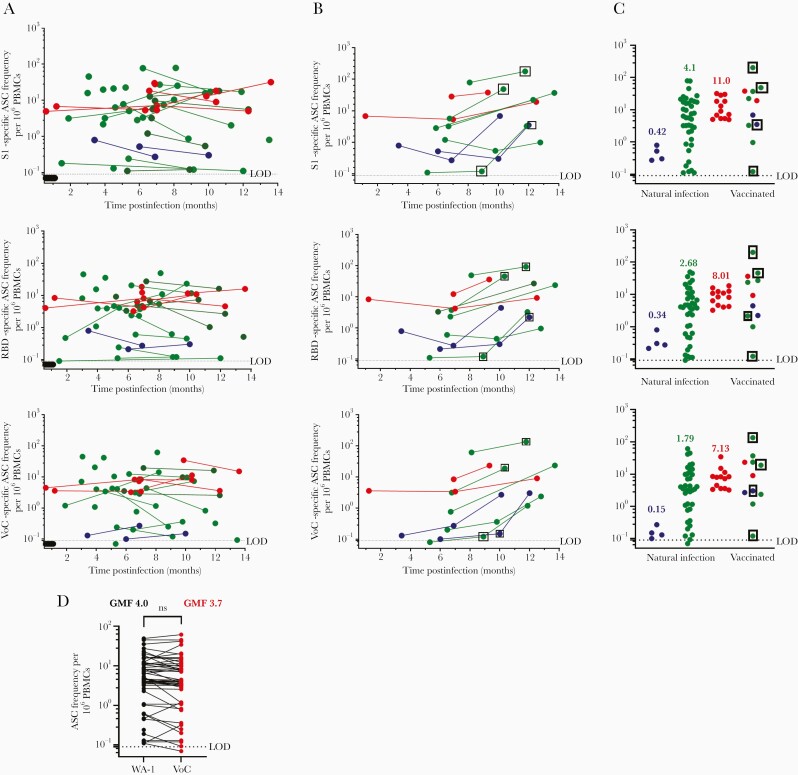
Severe acute respiratory syndrome coronavirus 2 (SARS-CoV-2)–specific memory B-cell (MBC) frequency over time and stratified by disease severity. A, MBC SARS CoV-2–specific frequency for pre-2020 (black, n = 6), asymptomatic (blue, n = 4 from 2 participants), nonhospitalized (green, n = 39 from 26 participants), and hospitalized (red, n = 13 from 7 participants) samples. B, MBC frequency following messenger RNA vaccination. Boxed samples indicate draw after 1 dose (11–33 days post–first dose); other samples taken after second dose (16–72 days post–second dose). C, Magnitude of MBC frequencies, stratified by disease severity. Geometric mean frequencies are listed above each group. D, Comparison between receptor-binding domain (RBD)–specific MBC frequency against WA-1 RBD and variant of concern (VoC) RBD. t test of log-transformed data, with no statistically significant difference between WA-1 and VoC MBC antibody binding. Limit of detection is set at 0.1; all samples below the limit of detection are assigned an arbitrary value of 0.07. Abbreviations: ASC, antibody-secreting cell; GMF, geometric mean frequency; LOD, limit of detection; ns, not significant; PBMCs, peripheral blood mononuclear cells; RBD, receptor-binding domain; VoC, variant of concern.
Figure 3.
Figure 3.
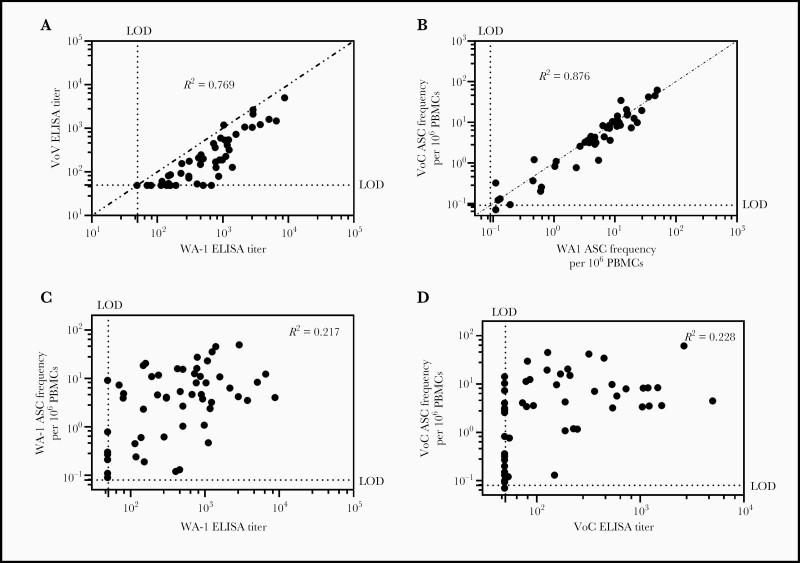
The relationship between WA-1 and variant of concern (VoC) antibody binding and memory B-cell (MBC) frequency as well as the relationship between long-lived plasma cell–derived antibody titers and MBC frequency for each antigen. A, Correlation between VoC and WA-1 receptor-binding domain (RBD)–specific enzyme-linked immunosorbent assay (ELISA) titers. Spearman correlation coefficient (R2) = 0.769; P < .0001. B, Correlation between RBD-VoC and RBD-WA-1–specific MBC frequency. Dotted line signifies line of identity. Spearman correlation coefficient (R2) = 0.876; P < .0001. C, Correlation between WA-1 RBD MBC frequency and ELISA titer (R2 = 0.217) and between VoC RBD MBC frequency and ELISA titer (R2 = 0.228). Abbreviations: ASC, antibody-secreting cell; ELISA, enzyme-linked immunosorbent assay; LOD, limit of detection; PBMCs, peripheral blood mononuclear cells; VoC, variant of concern.

Update of

References

    1. Huang C, Wang Y, Li X, et al. . Clinical features of patients infected with 2019 novel coronavirus in Wuhan, China. Lancet 2020; 395:497–506. - PMC - PubMed
    1. Rydyznski Moderbacher C, Ramirez SI, Dan JM, et al. . Antigen-specific adaptive immunity to SARS-CoV-2 in acute COVID-19 and associations with age and disease severity. Cell 2020; 183:996–1012.e19. - PMC - PubMed
    1. Sette A, Crotty S.. Adaptive immunity to SARS-CoV-2 and COVID-19. Cell 2021; 184:861–80. - PMC - PubMed
    1. Zost SJ, Gilchuk P, Chen RE, et al. . Rapid isolation and profiling of a diverse panel of human monoclonal antibodies targeting the SARS-CoV-2 spike protein. Nat Med 2020; 26:1422–27. - PMC - PubMed
    1. Gaebler C, Wang Z, Lorenzi JCC, et al. . Evolution of antibody immunity to SARS-CoV-2. Nature 2021; 591:639–44. - PMC - PubMed

Publication types

Substances

Supplementary concepts