


Selective targeting of angiopoietin-like 3 (ANGPTL3) with vupanorsen for the treatment of patients with familial partial lipodystrophy (FPLD): results of a proof-of-concept study
- PMID: 34865644
- PMCID: PMC8647384
- DOI: 10.1186/s12944-021-01589-4
Selective targeting of angiopoietin-like 3 (ANGPTL3) with vupanorsen for the treatment of patients with familial partial lipodystrophy (FPLD): results of a proof-of-concept study
Abstract
Background: Familial partial lipodystrophy (FPLD) is a rare disease characterized by selective loss of peripheral subcutaneous fat, associated with dyslipidemia and diabetes mellitus. Reductions in circulating levels of ANGPTL3 are associated with lower triglyceride and other atherogenic lipids, making it an attractive target for treatment of FPLD patients. This proof-of-concept study was conducted to assess the efficacy and safety of targeting ANGPTL3 with vupanorsen in patients with FPLD.
Methods: This was an open-label study. Four patients with FPLD (two with pathogenic variants in LMNA gene, and two with no causative genetic variant), diabetes (HbA1c ≥ 7.0 % and ≤ 12 %), hypertriglyceridemia (≥ 500 mg/dL), and hepatic steatosis (hepatic fat fraction, HFF ≥ 6.4 %) were included. Patients received vupanorsen subcutaneously at a dose of 20 mg weekly for 26 weeks. The primary endpoint was the percent change from baseline in fasting triglycerides at Week 27. Other endpoints analyzed at the same time point included changes in ANGPTL3, fasting lipids and lipoproteins, insulin secretion/sensitivity, postprandial lipids, and glycemic changes in response to a mixed meal test, HFF measured by MRI, and body composition measured by dual-energy absorptiometry (DEXA).
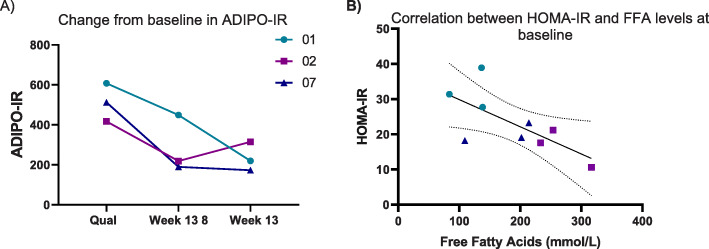
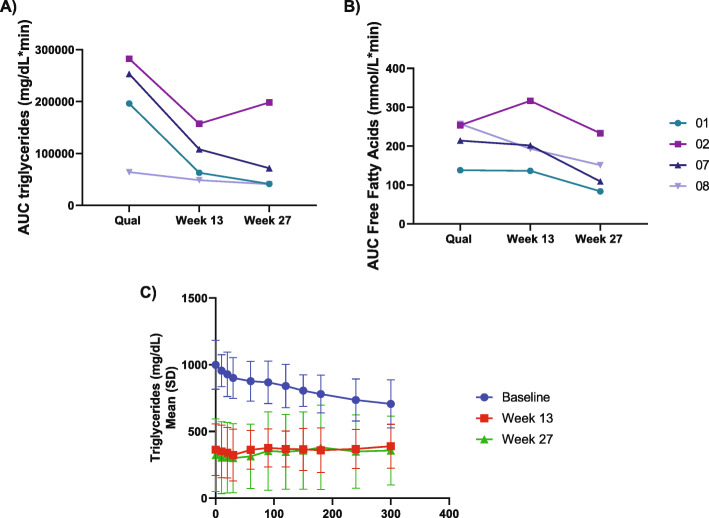
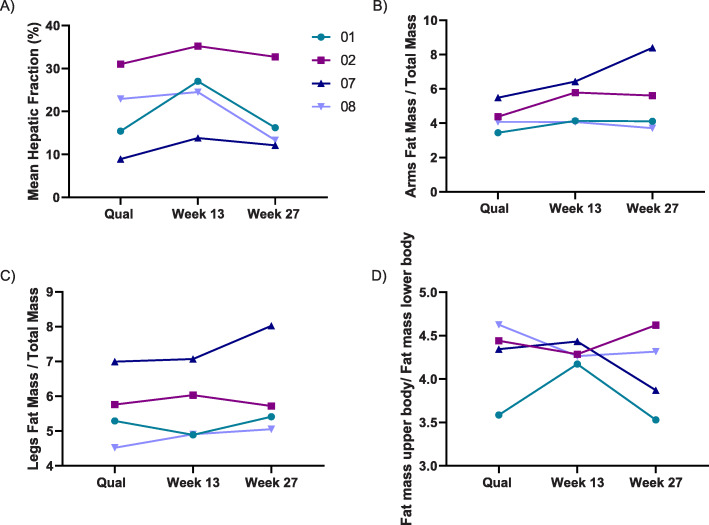
Results: Baseline mean ± SD fasting triglyceride level was 9.24 ± 4.9 mmol/L (817.8 ± 431.9 mg/dL). Treatment resulted in reduction in fasting levels of triglycerides by 59.9 %, ANGPTL3 by 54.7 %, and in several other lipoproteins/lipids, including very low-density lipoprotein cholesterol by 53.5 %, non-high-density lipoprotein cholesterol by 20.9 %, and free fatty acids (FFA) by 41.7 %. The area under the curve for postprandial triglycerides, FFA, and glucose was reduced by 60 %, 32 %, and 14 %, respectively. Treatment with vupanorsen also resulted in 55 % reduction in adipose tissue insulin resistance index, while other insulin sensitivity indices and HbA1c levels were not changed. Additional investigations into HFF and DEXA parameters suggested dynamic changes in fat partitioning during treatment. Adverse events observed were related to common serious complications associated with diabetes and FPLD. Vupanorsen was well tolerated, and there was no effect on platelet count.
Conclusions: Although limited, these results suggest that targeting ANGPTL3 with vupanorsen could address several metabolic abnormalities in patients with FPLD.
Keywords: Adipose tissue insulin resistance; Angiopoietin-like protein 3; Familial partial lipodystrophy; Mixed meal test; Triglycerides; Vupanorsen.
© 2021. The Author(s).
Conflict of interest statement
EAO has received grant support from Aegerion Pharmaceuticals, Akcea Therapeutics, Ionis Pharmaceuticals, Regeneron Pharmaceuticals, Gemphire Therapeutics, Rhythm Pharmaceuticals, and GI Dynamics. She also served as an advisor to the first 5 companies. BA has attended Scientific Advisory Board Meetings organized by Aegerion Pharmaceuticals and Regeneron Pharmaceuticals and has received honoraria as a speaker from AstraZeneca, Lilly, MSD, Novartis, Novo Nordisk, Boehringer-Ingelheim, Servier, and Sanofi-Aventis. VJB, EH and EKP work at Akcea Therapeutics Inc. Other authors declare no conflicts of interest.
Figures

References
-
- Foss-Freitas M, Akinci B, Lou Y, Stratton A, Oral E. Diagnostic strategies and clinical management of lipodystrophy. 2020. - PubMed
-
- Akinci B, Oral EA, Neidert A, Rus D, Cheng WY, Thompson-Leduc P, Cheung HC, Bradt P, de FossFreitas MC, Montenegro RM, et al. Comorbidities and survival in patients with lipodystrophy: an international chart review study. J Clin Endocrinol Metab. 2019;104:5120–5135. doi: 10.1210/jc.2018-02730. - DOI - PMC - PubMed
Publication types
MeSH terms
Substances
Grants and funding
LinkOut - more resources
Full Text Sources
Medical
Miscellaneous
