


Posttraumatic Stress Disorder, Myocardial Perfusion, and Myocardial Blood Flow: A Longitudinal Twin Study
- PMID: 34865854
- PMCID: PMC8918004
- DOI: 10.1016/j.biopsych.2021.09.016
Posttraumatic Stress Disorder, Myocardial Perfusion, and Myocardial Blood Flow: A Longitudinal Twin Study
Abstract
Background: The link between posttraumatic stress disorder (PTSD) and ischemic heart disease remains elusive owing to a shortage of longitudinal studies with a clinical diagnosis of PTSD and objective measures of cardiac compromise.
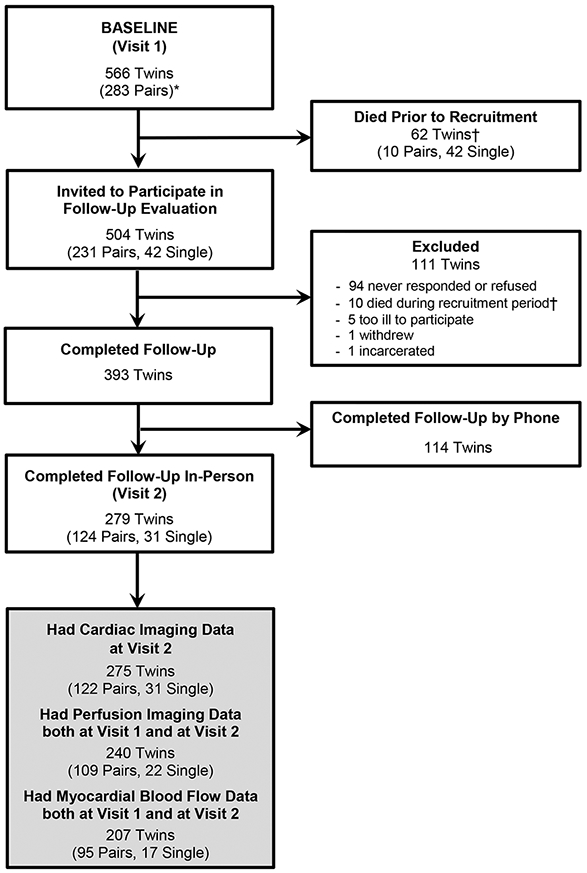
Methods: We performed positron emission tomography in 275 twins who participated in two examinations approximately 12 years apart. At both visits, we obtained a clinical diagnosis of PTSD, which was classified as long-standing (both visit 1 and visit 2), late onset (only visit 2), and no PTSD (no PTSD at both visits). With positron emission tomography, we assessed myocardial flow reserve (MFR), which, in absence of significant coronary stenoses, indexes coronary microvascular function. We compared positron emission tomography data at visit 2 across the three categories of longitudinally assessed PTSD and examined changes between the two visits.
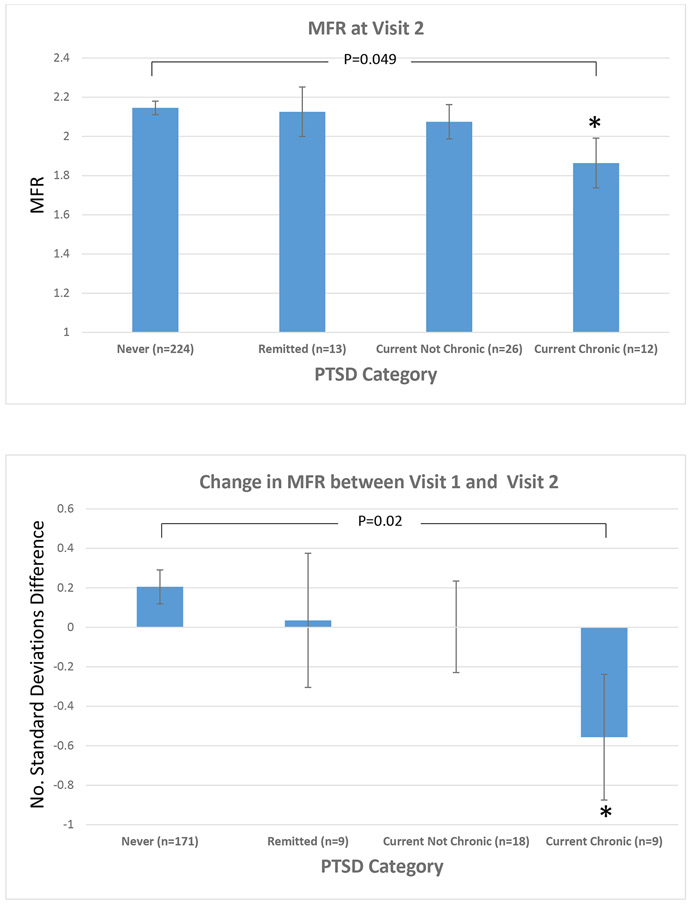
Results: Overall, 80% of the twins had no or minimal obstructive coronary disease. Yet, MFR was depressed in twins with PTSD and was progressively lower across groups with no PTSD (2.13), late-onset PTSD (1.97), and long-standing PTSD (1.93) (p = .01). A low MFR (a ratio <2.0) was present in 40% of the twins without PTSD, in 56% of those with late-onset PTSD, and in 72% of those with long-standing PTSD (p < .001). Associations persisted in multivariable analysis, when examining changes in MFR between visit 1 and visit 2, and within twin pairs. Results were similar by zygosity.
Conclusions: Longitudinally, PTSD is associated with reduced coronary microcirculatory function and greater deterioration over time. The association is especially noted among twins with chronic, long-standing PTSD and is not confounded by shared environmental or genetic factors.
Keywords: Cardiovascular disease; Epidemiology; Myocardial ischemia; Positron emission tomography; Posttraumatic stress disorder; Twins.
Copyright © 2021 Society of Biological Psychiatry. Published by Elsevier Inc. All rights reserved.
Conflict of interest statement
Disclosures
Ernest V. Garcia receives royalties from the sale of the Emory Cardiac Toolbox, used for some analyses in this study. All other authors report no biomedical financial interests or potential conflicts of interest.
Figures
Comment in
-
The Interaction of Biology and Emotion: Uncovering a New Phenotype of Nonobstructive Coronary Artery Disease.Biol Psychiatry. 2022 Apr 1;91(7):606-608. doi: 10.1016/j.biopsych.2022.01.005. Biol Psychiatry. 2022. PMID: 35272766 No abstract available.
References
-
- Yehuda R Post-traumatic stress disorder. N Engl J Med. 2002;346:108–114. - PubMed
Publication types
MeSH terms
Grants and funding
- S10 RR016917/RR/NCRR NIH HHS/United States
- I01 RX003418/RX/RRD VA/United States
- R01 MH056120/MH/NIMH NIH HHS/United States
- K24 HL077506/HL/NHLBI NIH HHS/United States
- R01 HL125246/HL/NHLBI NIH HHS/United States
- M01 RR000039/RR/NCRR NIH HHS/United States
- R01 MH120262/MH/NIMH NIH HHS/United States
- T32 HL130025/HL/NHLBI NIH HHS/United States
- K23 HL127251/HL/NHLBI NIH HHS/United States
- R01 HL068630/HL/NHLBI NIH HHS/United States
- UH3 DA048502/DA/NIDA NIH HHS/United States
- P01 HL101398/HL/NHLBI NIH HHS/United States
- UG3 DA048502/DA/NIDA NIH HHS/United States
- R01 AG026255/AG/NIA NIH HHS/United States
- R01 HL136205/HL/NHLBI NIH HHS/United States
- K24 MH076955/MH/NIMH NIH HHS/United States
- R01 HL088726/HL/NHLBI NIH HHS/United States
LinkOut - more resources
Full Text Sources
Medical
