


Phytochemical analysis of Moringa Oleifera leaves extracts by GC-MS and free radical scavenging potency for industrial applications
- PMID: 34866991
- PMCID: PMC8626243
- DOI: 10.1016/j.sjbs.2021.07.075
Phytochemical analysis of Moringa Oleifera leaves extracts by GC-MS and free radical scavenging potency for industrial applications
Abstract
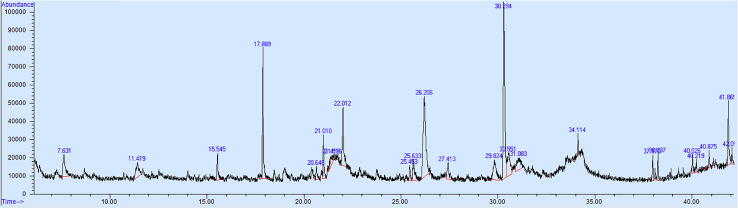
Natural extracts have been of very high interest since ancient time due to their enormous medicinal use and researcher's attention have further gone up recently to explore their phytochemical compositions, properties, potential applications in the areas such as, cosmetics, foods etc. In this present study phytochemical analysis have been done on the aqueous and methanolic Moringa leaves extracts using Gas Chromatography-Mass spectrometry (GCMS) and their free radical scavenging potency (FRSP) studied using 2, 2-diphenyl-1-picrylhydrazyl (DPPH) free radical for further applications. GCMS analysis revealed an extraction of range of phytochemicals in aqueous and methanolic extracts. In aqueous, extract constituents found with high percent peak area are Carbonic acid, butyl 2-pentyl ester (20.64%), 2-Isopropoxyethyl propionate (16.87%), Butanedioic acid, 2-hydroxy-2-methyl-, (3.14%) (also known as Citramalic acid that has been rarely detected in plant extracts) and many other phytochemicals were detected. Similarly, fifty-four bio components detected in methanolic extract of Moringa leaves, which were relatively higher than the aqueous extract. Few major compounds found with high percent peak area are 1,3-Propanediol, 2-ethyl-2- (hydroxymethyl)- (21.19%), Propionic acid, 2-methyl-, octyl ester (15.02%), Ethanamine, N-ethyl-N-nitroso- (5.21%), and 9,12,15-Octadecatrienoic acid etc. FRSP for methanolic extract was also recorded much higher than aqueous extract. The half-maximal inhibitory concentration (IC50) of Moringa aqueous extract observed is 4.65 µl/ml and for methanolic extract 1.83 µl/ml. These extracts can act as very powerful antioxidants, anti-inflammatory ingredient for various applications in diverse field of food, cosmetics, medicine etc.
Keywords: Antioxidant; Free radical scavenging; Gas chromatography-mass spectra; IC50; Moringa; Phytochemicals.
© 2021 The Author(s).
Conflict of interest statement
The authors declare that they have no known competing financial interests or personal relationships that could have appeared to influence the work reported in this paper.
Figures


References
-
- Abbas A. A. Z., Abu-Mejdad N. M. J., Atwan W. Z., Al-Masoudi A. N., 2016. Synthesis and Biological Evaluation of New Dipyridylpteridines, Lumazines, and Related Analogues. J. Heterocyclic Chem., HTTPS://DOI.ORG/10.1002/jhet.2651.
-
- Syamimi D.A.A., 2019. Phytol-Containing Seaweed Extracts as Control for Ganoderma boninense. J.O.P.R. 31(2), 238-247. HTTPS://DOI.ORG/10.21894/jopr.2019.0018.
-
- Ageel A.M., Parmar N.S., Mossa J.S., Al-Yahya M.A., Al-Said M.S., Tariq M. Anti-inflammatory activity of some Saudi Arabian medicinal plants. Agents Actions. 1986;17(3-4):383–384. - PubMed
-
- Al-Ziaydi A.G., Imran M., Al-Shammari A.M., Kadhim H.S., Jabir M., 2020. The anti-proliferative activity of D-Mannoheptulose against breast cancer cell line through glycolysis inhibition AIP Conference Proceedings 2307, 020023. HTTPS://DOI.ORG/ 10.1063/5.0032958.
-
- Aparna V., Vijayan D., Mandal P., Karthe P., 2012. Anti-Inflammatory Property of n-Hexadecanoic Acid: Structural Evidence and Kinetic Assessment. J. Chem. Bio. D. D. 80(3), 434-9. HTTPS://DOI.ORG/10.1111/j.1747-0285.2012.01418.x. - PubMed
LinkOut - more resources
Full Text Sources
Miscellaneous
