


Leisure Activities and Their Relationship With MRI Measures of Brain Structure, Functional Connectivity, and Cognition in the UK Biobank Cohort
- PMID: 34867271
- PMCID: PMC8635062
- DOI: 10.3389/fnagi.2021.734866
Leisure Activities and Their Relationship With MRI Measures of Brain Structure, Functional Connectivity, and Cognition in the UK Biobank Cohort
Abstract
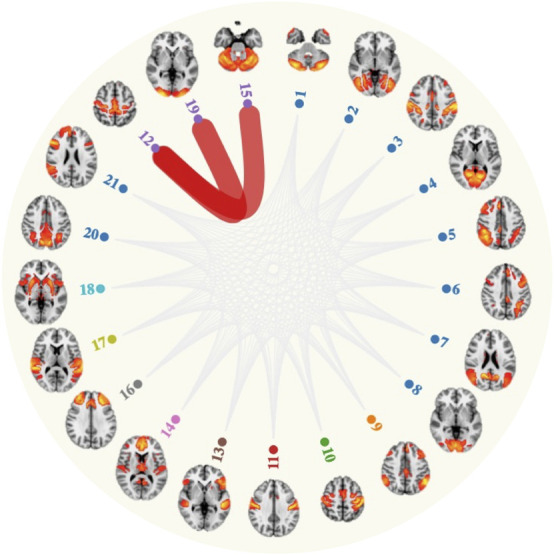
Introduction: This study aimed to evaluate whether engagement in leisure activities is linked to measures of brain structure, functional connectivity, and cognition in early old age. Methods: We examined data collected from 7,152 participants of the United Kingdom Biobank (UK Biobank) study. Weekly participation in six leisure activities was assessed twice and a cognitive battery and 3T MRI brain scan were administered at the second visit. Based on responses collected at two time points, individuals were split into one of four trajectory groups: (1) stable low engagement, (2) stable weekly engagement, (3) low to weekly engagement, and (4) weekly to low engagement. Results: Consistent weekly attendance at a sports club or gym was associated with connectivity of the sensorimotor functional network with the lateral visual (β = 0.12, 95%CI = [0.07, 0.18], FDR q = 2.48 × 10⁻³) and cerebellar (β = 0.12, 95%CI = [0.07, 0.18], FDR q = 1.23 × 10⁻⁴) networks. Visiting friends and family across the two timepoints was also associated with larger volumes of the occipital lobe (β = 0.15, 95%CI = [0.08, 0.21], FDR q = 0.03). Additionally, stable and weekly computer use was associated with global cognition (β = 0.62, 95%CI = [0.35, 0.89], FDR q = 1.16 × 10⁻⁴). No other associations were significant (FDR q > 0.05). Discussion: This study demonstrates that not all leisure activities contribute to cognitive health equally, nor is there one unifying neural signature across diverse leisure activities.
Keywords: MRI; UK Biobank; aging; brain; cognition; leisure activities.
Copyright © 2021 Anatürk, Suri, Smith, Ebmeier and Sexton.
Conflict of interest statement
This research was conducted using the UK Biobank Resource under the approved application of 45301. MA was supported by the Clarendon Trust DPhil Fellowship and HDH Wills 1965 Charitable Trust (1117747). SS reports funding from the Academy of Medical Sciences/the Wellcome Trust/the Government Department of Business, Energy and Industrial Strategy/the British Heart Foundation/Diabetes UK Springboard Award (SBF006\1078). SMS receives support from the Wellcome Trust (098369/Z/12/Z, 203139/Z/16/Z). KPE reports support from the UK Medical Research Council (G1001354, MR/K013351/), the HDH Wills 1965 Charitable Trust (1117747), Alzheimer’s Research UK (PPG2012A-5), and the European Commission (Horizon 2020 grant “Lifebrain,” 732592). SS and CES were supported by the NIHR Oxford Biomedical Research Center located at the Oxford University Hospitals NHS Trust and the University of Oxford, the NIHR Oxford Health BRC. The Wellcome Center for Integrative Neuroimaging was supported by core funding from the Wellcome Trust (203139/Z/16/Z). CES is now a full-time employee of the Alzheimer’s Association.
Figures
References
-
- Anatürk M., Demnitz N., Ebmeier K. P., Sexton C. E. (2018). A systematic review and meta-analysis of structural magnetic resonance imaging studies investigating cognitive and social activity levels in older adults. Neurosci. Biobehav. Rev. 93 71–84. 10.1016/J.NEUBIOREV.2018.06.012 - DOI - PMC - PubMed
Grants and funding
LinkOut - more resources
Full Text Sources
