


Association Between Migraine Complicated With Restless Legs Syndrome and Vitamin D
- PMID: 34867766
- PMCID: PMC8634649
- DOI: 10.3389/fneur.2021.777721
Association Between Migraine Complicated With Restless Legs Syndrome and Vitamin D
Abstract
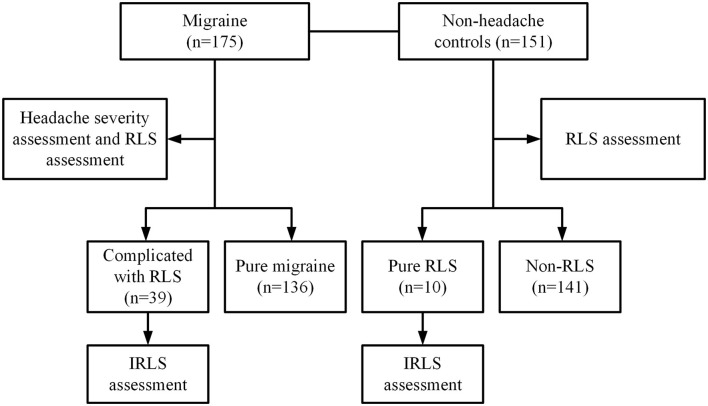
Background: This study aimed to evaluate the prevalence of restless legs syndrome (RLS) in patients with migraine and explore its association with vitamin D deficiency, aiming to provide biological support for the comorbidity of migraine with RLS, and shed new lights into clinical diagnosis and treatment. Methods: A case-control study was performed on 175 migraine patients and 151 non-headache controls. The information of all subjects concerning headache severity [visual analog scale (VAS) score], RLS, RLS severity [International Restless Legs Scale (IRLS) score], sleep quality [Pittsburgh sleep quality index (PSQI)], anxiety and depression symptoms [hospital anxiety and depression scale (HADS)], and demographic data were collected. At the same time, serum 25-(OH) D levels were also measured (concentration <20 ng/ml was defined deficiency). Afterward, the logistic regression model was adopted to explore the risk factors for RLS in patients with migraines. Results: Compared with control group, migraine group had lower vitamin D levels [(21.10 ± 6.58) vs. (16.42 ± 5.6) ng/ml, P < 0.001], a higher rate of vitamin D deficiency (45.03 vs. 72%, P <0001), higher prevalence of RLS (6.62 vs. 22.29%, P < 0.001). Compared with the pure RLS group, RLS with the migraine group had lower vitamin D levels and higher IRLS score (P < 0.05). Compared with pure migraine group, migraine with RLS group had lower vitamin D levels [(17.36 ± 5.56) vs. (13.15 ± 4.42) ng/ml, P < 0.001], higher incidence of vitamin D deficiency (66.18 vs. 92.31%, P = 0.001), higher frequency of headache attacks (P = 0.004). Thereafter, the multivariate logistic regression model was employed to adjust confounding factors such as age, gender, season, frequency of headache attacks, PSQI score, and HADS scores. According to the results vitamin D deficiency in patients with migraines was an independent risk factor for RLS (OR = 5.03, 95%CI: 1.2-21.16, P = 0.027). Conclusions: The prevalence of RLS in migraine patients was significantly higher than that in the non-headache population. Besides, vitamin D levels decreased, while the incidence of vitamin D deficiency increased in the migraine patients complicated with RLS. Finally, the occurrence of RLS in migraine patients was significantly related to vitamin D deficiency.
Keywords: case-control study; migraine; prevalence; restless legs syndrome; vitamin D.
Copyright © 2021 Sun, Liu, Jia, Wu, Li, Li and Zhao.
Conflict of interest statement
The authors declare that the research was conducted in the absence of any commercial or financial relationships that could be construed as a potential conflict of interest.
Figures
References
LinkOut - more resources
Full Text Sources
