Review
. 2021 Dec;8(4):041317.
doi: 10.1063/5.0052666.

Considerations and recent advances in nanoscale interfaces with neuronal and cardiac networks

Affiliations
Review

Considerations and recent advances in nanoscale interfaces with neuronal and cardiac networks

Youngbin Tchoe et al. Appl Phys Rev. 2021 Dec.

Abstract

Nanoscale interfaces with biological tissue, principally made with nanowires (NWs), are envisioned as minimally destructive to the tissue and as scalable tools to directly transduce the electrochemical activity of a neuron at its finest resolution. This review lays the foundations for understanding the material and device considerations required to interrogate neuronal activity at the nanoscale. We first discuss the electrochemical nanoelectrode-neuron interfaces and then present new results concerning the electrochemical impedance and charge injection capacities of millimeter, micrometer, and nanometer scale wires with Pt, PEDOT:PSS, Si, Ti, ITO, IrO x , Ag, and AgCl materials. Using established circuit models for NW-neuron interfaces, we discuss the impact of having multiple NWs interfacing with a single neuron on the amplitude and temporal characteristics of the recorded potentials. We review state of the art advances in nanoelectrode-neuron interfaces, the standard control experiments to investigate their electrophysiological behavior, and present recent high fidelity recordings of intracellular potentials obtained with ultrasharp NWs developed in our laboratory that naturally permeate neuronal cell bodies. Recordings from arrays and individually addressable electrically shorted NWs are presented, and the long-term stability of intracellular recording is discussed and put in the context of established techniques. Finally, a perspective on future research directions and applications is presented.


Figures

FIG. 1.
FIG. 1.
The human brain and its constituents at multiple length scales interact electrochemically with interrogating electrophysiological probes. Schematic illustrations of (a) human brain, (b) cortical column, (c) neuron, (d) neuronal membrane with channel proteins and lipid bilayers, and (e) interrogating electrode surface. Edited and reprinted with permission from Florio et al., Curr. Opin. Neurobiol. 42, 33 (2017). Copyright 2017 Elsevier. Edited and reprinted with permission from D. R. Merrill, Implantable Neural Prostheses (Springer, 2010), Vol. 2, pp. 85–138. Copyright 2010 Springer.
FIG. 2.
FIG. 2.
Comparison of (a) patch clamp, (b) extracellular, and (c) NW recording methods in terms of (left) simplified circuit models, (center) microscope images of electrode-neuron interface, and (right) typical recording results. Edited and reprinted with permission from Akita et al., “Patch-clamp techniques: General remarks,” in Patch Clamp Techniques (Springer, 2012), pp. 21–41. Copyright 2012 Springer Nature. Reprinted with permission from Steriade et al., J. Neurophys. 85(5), 1969 (2001). Copyright 2001 American Physiological Society. Reprinted with permission from Fong et al., Nat. Comm. 6(1), 1 (2015). Copyright 2015 Macmillan Publishers Ltd. Edited and reprinted with permission from Seidel et al., Analyst 142(11), 1929 (2017). Copyright 2017 the Royal Society of Chemistry. Edited and reprinted with permission from Liu et al., Nano Lett. 17(5), 2757 (2017). Copyright 2017 American Chemical Society. Edited and reprinted with permission from Liu et al., Adv. Func. Mat. 2108378 (2021). Copyright 2021 IEBL.
FIG. 3.
FIG. 3.
Electrochemical characteristics of the NWs, μWs, and MWs for different materials. (a) Optical and electron microscope images of the electrodes. Electrochemical impedance spectroscopy of (b) Pt, (c) PEDOT:PSS, (d) Si, (e) ITO, (f) Ag/AgCl, (g) Ag, (i) IrOx, and (j) Ti NW, μW, and MW, showing the magnitude and phase of the impedance spectra. (h) 1 kHz impedance magnitude and (k) CIC of wires with different materials.
FIG. 4.
FIG. 4.
Modeling NW-neuron junction. Circuit diagram of (a) single NW penetrating a cell and (b) multiple NWs which are partially engulfed in a cell. Nodes used for *intracellular and measured potential are indicated in red color. (c) Simulated action potential at the input of the amplifier plotted for various numbers of extracellular NWs on a single pad. Coupling and temporal spreading coefficients with (d) increasing number of extracellular NWs and (e) parasitic capacitance. (f) Sealing resistance dependent peak amplitude and pulse width of action potential inside the cell and at the input of the amplifier. Reprinted with permission from Liu et al., Adv. Func. Mat. 2108378 (2021). Copyright 2021 IEBL.
FIG. 5.
FIG. 5.
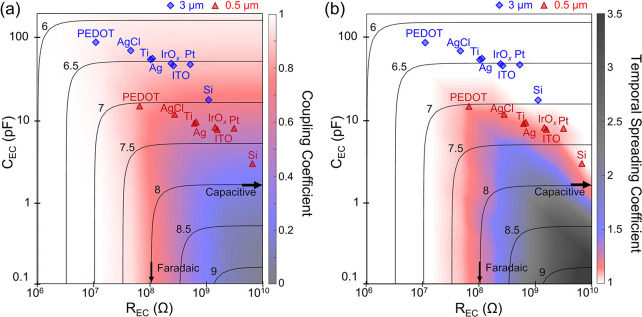
Mapping of the (a) coupling and (b) temporal spreading coefficients depending on the REC and CEC of the NW electrode. REC and CEC values of NWs with different materials were estimated from the electrochemical impedance spectroscopy and plotted on top of the mapping plot. NWs with tip exposure length of 3 μm (blue) and 0.5 μm (red) are plotted in different colors and symbols.
FIG. 6.
FIG. 6.
Structures, specifications, fabrication methods, and recording capabilities of current state of the art nano- and microelectrodes. Reprinted with permission from Spira et al., Front. Neurosci. 12, 212 (2018). Copyright 2018 Frontiers Media S.A. Reprinted with permission from Xie et al., Nat. Nanotechnol. 7, 185 (2012). Copyright 2012 Macmillan Publishers. Edited and reprinted with permission from Abbott et al., Nat. Nanotechnol. 12, 460 (2017). Copyright 2017 Macmillan Publishers. Edited and reprinted with permission from Abbott et al., Nat. Biomed. Eng. 4, 232 (2020). Copyright 2020 Macmillan Publishers. Reprinted with permission from Dipalo et al., Nano Lett. 17, 3932 (2017). Copyright 2017 American Chemical Society. Edited and reprinted with permission from Dipalo et al., Sci. Adv. 7, eabd5175 (2021). Copyright 2021 AAAS. Reprinted with permission from Duan et al., Nat. Nanotechnol. 7, 174 (2012). Copyright 2012 Macmillan Publishers. Reprinted with permission from Zhao et al., Nat. Nanotechnol. 14, 783 (2019). Copyright 2012 Macmillan Publishers. Reprinted with permission from Desbiolles et al., Nano Lett. 19, 6173 (2019). Copyright 2019 American Chemical Society. Edited and reprinted with permission from Liu et al., Adv. Func. Mat. 2108378 (2021). Copyright 2021 IEBL.
FIG. 7.
FIG. 7.
Fabrication approaches for intracellular nanostructures. Processes used to make NWs including (a) top-down etching, (b) direct growth, (c) focused ion beam, and (d) template-assisted methods. The substrate is colored red for the processes that require the substrate to be heated to temperatures above 400 °C. Electrical addressing methods used for intracellular NW/nanotube/nanovolcano recording which include the fabrication of (e) NWs on top of the preexisting acquisition circuits or (f) the definition of metal leads on top of the NWs pre-fabricated on a substrate.
FIG. 8.
FIG. 8.
Various types of nanostructures and their nanoelectrode-cell interface formation methods. (a) Schematic illustration of multiple NW arrays, U-shaped NW, and nano-volcano and ultrasharp NW tip that forms NW-cell interface by electroporation and optoporation, mechanical insertion, and natural internalizations, respectively. (b) Cross-sectional SEM images of the naturally internalized ultrasharp NWs-neuron interface. Sequential FIB cutting of NW-cell interface revealing NW closely engulfed by a single neuron. Recorded potential from CMs just after the electroporation for (c) Pt nanopillars on quartz and (d) Pt nanoneedles on CMOS. (e) Pseudo-current clamp potential recording of neurons using Pt black (PtB) nanowires on CMOS. (f) Optoporation-enabled spontaneous intracellular-like spike recorded from rat hippocampal neurons using gold nanotube. Amplitude of the positive phase of action potentials after the optoporation. (g) Potential recording of neurons upon the mechanical insertion of U-shaped NW. (h) Rat CMs potential recorded with the naturally internalized nanovolcano electrode. (i) Intracellular recordings of cardiac activity from USNWs with consistent spiked action potentials without amplitude decay during the 6 min recording time. (j) Consistently large intracellular-like action potentials recorded from rat cortical neurons using USNWs across 11–19 days in vitro (DIV). Edited and reprinted with permission from Liu et al., Adv. Func. Mat. 2108378 (2021). Copyright 2021 IEBL. Edited and reprinted with permission from Xie et al., Nat. Nanotechnol. 7, 185 (2012). Copyright 2012 Macmillan Publishers. Edited and reprinted with permission from Abbott et al., Nat. Nanotechnol. 12, 460 (2017). Copyright 2017 Macmillan Publishers. Edited and reprinted with permission from Dipalo et al., Nano Lett. 17, 3932 (2017). Copyright 2017 American Chemical Society. Edited and reprinted with permission from Zhao et al., Nat. Nanotechnol. 14, 783 (2019). Copyright 2019 Macmillan Publishers. Reprinted with permission from Desbiolles et al., Nano Lett. 19, 6173 (2019). Copyright 2019 American Chemical Society. Edited and reprinted with permission from Abbott et al., Nat. Biomed. Eng. 4, 232 (2020). Copyright 2020 Macmillan Publishers.
FIG. 9.
FIG. 9.
Single vs multiple NWs per electrode. SEM images and recorded spike train of action potentials of (a) and (b) single NW, (c) and (d) 16, (e) and (f) 625 multiple NWs per pad electrode arrays. (g) Histogram of peak-to-peak signal amplitude between single USNW and multi-USNWs per site. Vertical scale bars in (d) and (f) are 500 μV and 200 μV, respectively, and their lateral scale bar is 250 ms. Reprinted with permission from Liu et al., Adv. Func. Mat. 2108378 (2021). Copyright 2021 IEBL.
FIG. 10.
FIG. 10.
NW-cell electrochemical interface validation methods. (a) Schematics of the methods used to validate intracellular access of the NW into the cell. (b) Intracellular potential measured with sharp glass electrode (black) and gMμE (red). (c) Differential interference contrast image and recorded potential from kinked NW transistor probes (left; blue) and whole-cell patch clamp (right; red) recording the same cell. (d) Kinked NW transistor probes measuring the resting membrane potential upon internalization into the cell membrane. Pharmacological modulation of action potentials for (e) Pt-black-Pt nanoneedles and (f) ultrasharp Pt NWs. (g) Sequential optoporation of gold nanotubes-cell interfaces that enabled the membrane impermeable dye to be injected into the cell bodies through the nanotubes' microfluidic channel. (h) Electrical bi-phasic stimulation of CMs through the Pt nanoneedles that evoked synchronized cell movement. Movement was analyzed from optical microscope video differentials. (i) Electrical stimulation of CM networks with selected ultrasharp NWs altering the propagating pattern of action potentials. The original pacemaker foci locations are labeled with arrows. Edited and reprinted with permission from Avissar et al., Biology (OpenStax, 2013). Copyright 2013 OpenStax. Edited and reprinted with permission from Hai et al., Lab Chip 12, 2865 (2012). Copyright 2021 Royal Society of Chemistry. Edited and reprinted with permission from Shmoel et al., Sci. Rep. 6(1), 27110 (2016). Copyright 2016 Macmillan Publishers. Edited and reprinted with permission from Qing et al., Nat. Nanotechnol. 9, 142 (2014). Copyright 2014 Macmillan Publishers. Edited and reprinted with permission from Tian et al., Science 329, 830 (2010). Copyright 2010 AAAS. Edited and reprinted with permission from Abbott et al., Nat. Biomed. Eng. 4, 232 (2020). Copyright 2020 Macmillan Publishers. Edited and reprinted with permission from Messina et al., Adv. Mater. 27(44), 7145 (2015). Copyright 2015 Wiley-VCH. Reprinted with permission from Abbott et al., Nat. Nanotechnol. 12, 460 (2017). Copyright 2017 Macmillan Publishers. Reprinted with permission from Liu et al., Adv. Func. Mat. 2108378 (2021). Copyright 2021 IEBL.

References

    1. Williams R., Annu. Rev. Neurosci. 11, 423 (1988). 10.1146/annurev.ne.11.030188.002231 - DOI - PubMed
    1. Herculano-Houzel S., Front. Hum. Neurosci. 3, 31 (2009). 10.3389/neuro.09.031.2009 - DOI - PMC - PubMed
    1. Frackowiak R. S. J., Human Brain Function ( Elsevier, 2004).
    1. Buckner R. L., Sepulcre J., Talukdar T., Krienen F. M., Liu H., Hedden T., Andrews-Hanna J. R., Sperling R. A., and Johnson K. A., J. Neurosci. 29, 1860 (2009). 10.1523/JNEUROSCI.5062-08.2009 - DOI - PMC - PubMed
    1. Power J. D., Cohen A. L., Nelson S. M., Wig G. S., Barnes K. A., Church J. A., Vogel A. C., Laumann T. O., Miezin F. M., Schlaggar B. L., and Petersen S. E., Neuron 72, 665 (2011). 10.1016/j.neuron.2011.09.006 - DOI - PMC - PubMed

LinkOut - more resources