. 2021 Nov 19:9:781982.
doi: 10.3389/fbioe.2021.781982. eCollection 2021.

PEGylated Doxorubicin Prodrug-Forming Reduction-Sensitive Micelles With High Drug Loading and Improved Anticancer Therapy

Affiliations

PEGylated Doxorubicin Prodrug-Forming Reduction-Sensitive Micelles With High Drug Loading and Improved Anticancer Therapy

Dongdong Wang et al. Front Bioeng Biotechnol. .

Abstract

Significant efforts on the design and development of advanced drug delivery systems for targeted cancer chemotherapy continue to be a major challenge. Here, we reported a kind of reduction-responsive PEGylated doxorubicin (DOX) prodrug via the simple esterification and amidation reactions, which self-assembled into the biodegradable micelles in solutions. Since there was an obvious difference in the reduction potentials between the oxidizing extracellular milieu and the reducing intracellular fluids, these PEG-disulfide-DOX micelles were localized intracellularly and degraded rapidly by the stimulus to release the drugs once reaching the targeted tumors, which obviously enhanced the therapeutic efficacy with low side effects. Moreover, these reduction-sensitive micelles could also physically encapsulate the free DOX drug into the polymeric cargo, exhibiting a two-phase programmed drug release behavior. Consequently, it showed a potential to develop an intelligent and multifunctional chemotherapeutic payload transporter for the effective tumor therapy.

Keywords: biocompatible; disulfide; drug delivery; micelles; reduction-sensitive.


Conflict of interest statement

The authors declare that the research was conducted in the absence of any commercial or financial relationships that could be construed as a potential conflict of interest.

Figures

FIGURE 1
FIGURE 1
Synthetic scheme of the PEG–disulfide–DOX polymer and micelles with reduction-sensitive behavior for intracellular drug release.
FIGURE 2
FIGURE 2
1H NMR spectra of (A) PEG–SS–COOH and (B) PEG–disulfide–DOX polymers. The shift peaks and the intricate peaks of DOX components verify the polymeric preparation.
FIGURE 3
FIGURE 3
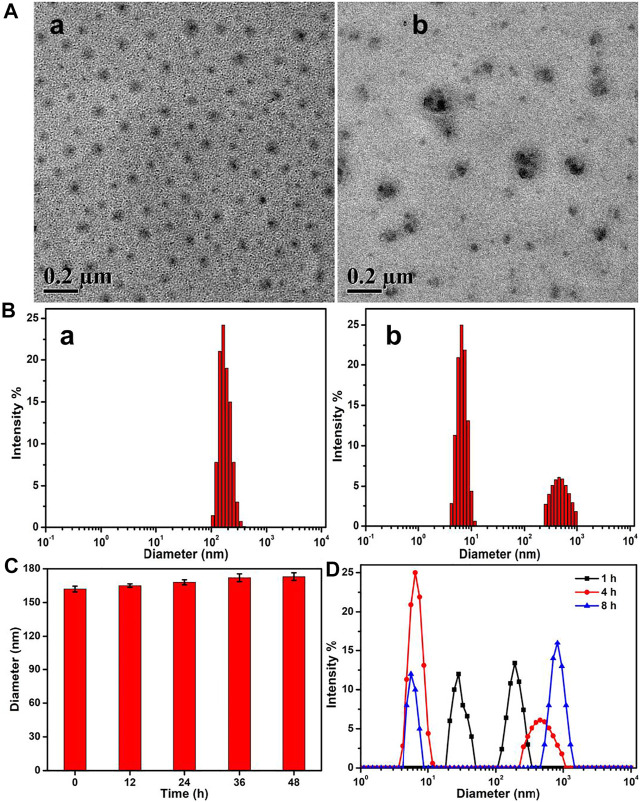
(A) TEM images and (B) size changes of the PEG–disulfide–DOX micelles before (a) and after (b) treatment of 10 mM reducing agent of DTT solutions for 4 h. (C) Size variations of the PEG–disulfide–DOX micelles after treatment in PBS (pH = 7.4) solutions. (D) Size variations of the PEG–disulfide–DOX micelles after treatment of 10 mM reducing agent of DTT solutions for various times. The PEG–disulfide–DOX micelles possessed reduction-responsive degradation in a high concentration of reductive agents, but displayed good stability at physiological conditions for a long period.
FIGURE 4
FIGURE 4
Reducing agent of DTT-triggered DOX release from PEG–disulfide–DOX micelles with or without DTT (10 mM) solutions at 37°C. The drug release profile reflects the reduction response of the micelles with good stability in neutral environment and quick dissociation in reductive agents.
FIGURE 5
FIGURE 5
(A) CLSM of MCF-7 cells after incubation with PEG–disulfide–DOX micelles for 2 h; a: bright field image, b: red fluorescence image, and c: overlap of bright field and fluorescence images. (B) Cytotoxicity of MCF-7 cells following 24-h incubation with PEG–disulfide–DOX and free drugs as a function of DOX dosages. The data are presented as the average ± standard deviation (n = 5).
FIGURE 6
FIGURE 6
(A) TEM image, (B) DLS result, and (C) in vitro drug release profile of DOX-encapsulated PEG–disulfide–DOX nanoparticles with or without 10 mM DTT solutions. (D) Cytotoxicity of MCF-7 cells following 24-h incubation with DOX-encapsulated PEG–disulfide–DOX aggregates as a function of DOX dosages. All the data are presented as the average ± standard deviation (n = 5). These DOX-encapsulated PEG–disulfide–DOX nanoparticles possessed capacities with high drug loading, sufficient drug release, and enhanced therapeutic effects of antitumor activity.

References

    1. Bao W., Lyu J., Li C., Zhang J., Sun T., Wang X., et al. (2019). Fabrication of Customized Nanogel Carriers from a UV-Triggered Dynamic Self-Assembly Strategy. Front. Chem. 7, 769. 10.3389/fchem.2019.00769 - DOI - PMC - PubMed
    1. Cao Q.-C., Wang X., Wu D.-C. (2018). Controlled Cross-Linking Strategy for Formation of Hydrogels, Microgels and Nanogels. Chin. J. Polym. Sci. 36, 8–17. 10.1007/s10118-018-2061-7 - DOI - PubMed
    1. Chao D., Jiang Y. J., Ru C., Meng F. H., Zhong Z. Y. (2012). Biodegradable Polymeric Micelles for Targeted and Controlled Anticancer Drug Delivery: Promises, Progress and Prospects. Nano Today 7, 467–480. 10.1016/j.nantod.2012.08.005 - DOI
    1. Chen W., Meng F., Cheng R., Deng C., Feijen J., Zhong Z. (2015). Facile Construction of Dual-Bioresponsive Biodegradable Micelles with superior Extracellular Stability and Activated Intracellular Drug Release. J. Controlled Release 210, 125–133. 10.1016/j.jconrel.2015.05.273 - DOI - PubMed
    1. Cheng W., Kumar J. N., Wang G., Pan X., Liu Y. (2017). Redox-responsive Polymers for Anti-cancer Drug Delivery and Bioimaging. J. Controlled Release 259, 140. 10.1016/j.jconrel.2017.03.284 - DOI

LinkOut - more resources