


Psoriasis to Psoriatic Arthritis: The Application of Proteomics Technologies
- PMID: 34869404
- PMCID: PMC8635007
- DOI: 10.3389/fmed.2021.681172
Psoriasis to Psoriatic Arthritis: The Application of Proteomics Technologies
Abstract
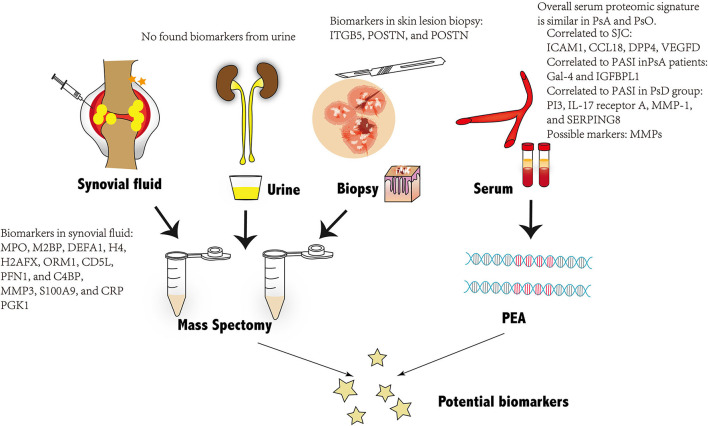
Psoriatic disease (PsD) is a spectrum of diseases that affect both skin [cutaneous psoriasis (PsC)] and musculoskeletal features [psoriatic arthritis (PsA)]. A considerable number of patients with PsC have asymptomatic synovio-entheseal inflammations, and approximately one-third of those eventually progress to PsA with an enigmatic mechanism. Published studies have shown that early interventions to the very early-stage PsA would effectively prevent substantial bone destructions or deformities, suggesting an unmet goal for exploring early PsA biomarkers. The emergence of proteomics technologies brings a complete view of all involved proteins in PsA transitions, offers a unique chance to map all potential peptides, and allows a direct head-to-head comparison of interaction pathways in PsC and PsA. This review summarized the latest development of proteomics technologies, highlighted its application in PsA biomarker discovery, and discussed the possible clinical detectable PsA risk factors in patients with PsC.
Keywords: biomarkers; proteomics; psoriasis; psoriatic arthritis; psoriatic disease.
Copyright © 2021 Qi, Tan, Yao, Yang and He.
Conflict of interest statement
The authors declare that the research was conducted in the absence of any commercial or financial relationships that could be construed as a potential conflict of interest.
Figures
References
Publication types
LinkOut - more resources
Full Text Sources
Research Materials
Miscellaneous
