. 2021 Nov 12:8:770508.
doi: 10.3389/fvets.2021.770508. eCollection 2021.

Development of a New LAMP Assay for the Detection of Ancylostoma caninum DNA (Copro-LAMPAc) in Dog Fecal Samples

Affiliations

Development of a New LAMP Assay for the Detection of Ancylostoma caninum DNA (Copro-LAMPAc) in Dog Fecal Samples

Héctor Gabriel Avila et al. Front Vet Sci. .

Abstract

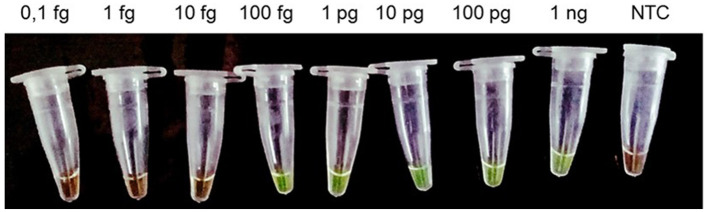
Ancylostoma caninum is a zoonotic nematode which is able to affect animals and humans. Diagnosis in the definitive host and environmental detection are key to prevent its dissemination and achieve control. Herein, a new coprological LAMP method for the detection of A. caninum (Copro-LAMPAc) DNA was developed. DNA extraction was performed using a low-cost method and a fragment of the cox-1 gene was used for primer design. The analytical sensitivity, evaluated with serial dilutions of genomic DNA from A. caninum adult worms, was 100 fg. A specificity of 100% was obtained using genomic DNA from the host and other pathogens. The Copro-LAMPAc was evaluated using environmental canine fecal samples. When compared with gold standard optical microscopy in epidemiological studies, it proved to be more sensitive. This new LAMP assay can provide an alternative protocol for screening and identification of A. caninum for epidemiological studies in endemic areas.

Keywords: Ancylostoma caninum; ancylostomiasis; copro-diagnosis; loop mediated isothermal amplification; molecular diagnosis.


Conflict of interest statement

The authors declare that the research was conducted in the absence of any commercial or financial relationships that could be construed as a potential conflict of interest.

Figures
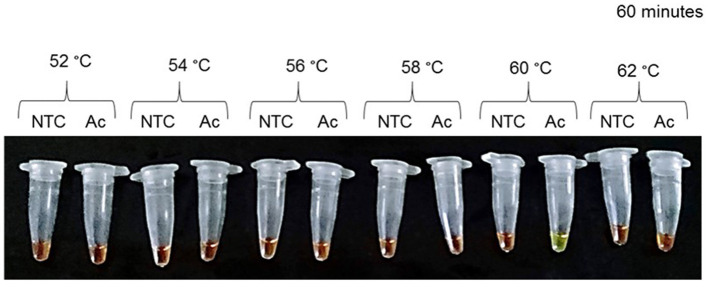
Figure 1
Figure 1
Optimal conditions for Ancylostoma caninum genomic DNA amplification. Incubation temperature optimization at a range of 52–62°C. During a 60 min incubation, a temperature of 60°C was considered optimal. Results were visualized using SYBR Green I® 1000 X. NTC, negative control; Ac, Ancylostoma caninum.
Figure 2
Figure 2
Analytical sensitivity of the Copro-LAMPAc assay. Serial dilutions of Ancylostoma caninum genomic DNA (1 fg−1 ng) were used to determine the limit of detection. One microliter of SYBR Green I® 1000 X (Thermo Fisher Scientific, Waltham, MA, United States) was used view the results. NTC, negative control.
Figure 3
Figure 3
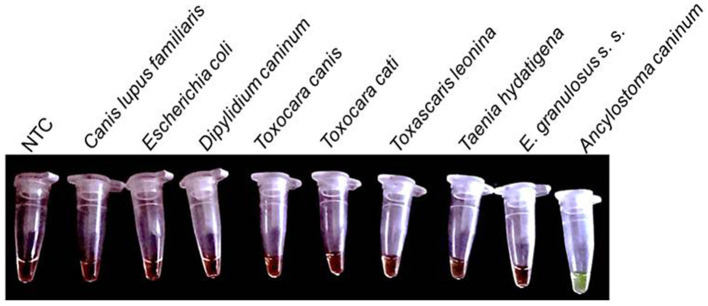
Specificity of the Copro-LAMPAc assay. Cross reaction was not observed when 10 pg of DNA from Canis lupus familiaris, Escherichia coli, Dipylidium caninum, Taenia hydatigena, Toxascaris leonina, Toxocara canis, Toxocara cati and Echinococcus granulosus sensu stricto, were used. NTC, negative control; A. caninum, 1 pg of genomic DNA.

References

    1. King CH. Health metrics for helminth infections. Acta Trop. (2015) 141:150–60. 10.1016/j.actatropica.2013.12.001 - DOI - PMC - PubMed
    1. Shepherd C, Wangchuk P, Loukas A. Of dogs and hookworms: man's best friend and his parasites as a model for translational biomedical research. Paras Vectors. (2018) 11:59. 10.1186/s13071-018-2621-2 - DOI - PMC - PubMed
    1. Morelli S, Diakou A, Di Cesare A, Colombo M, Traversa D. Canine and feline parasitology: analogies, differences, and relevance for human health. Clin Microbiol Rev. (2021) 34:e0026620. 10.1128/CMR.00266-20 - DOI - PMC - PubMed
    1. Kwon IH, Kim HS, Lee JH, Choi MH, Chai JY, Nakamura-Uchiyama F, et al. A serologically diagnosed human case of cutaneous larva migrans caused by Ancylostoma caninum. Korean J Parasitol. (2003) 41:233–237. 10.3347/kjp.2003.41.4.233 - DOI - PMC - PubMed
    1. Bowman DD, Montgomery SP, Zajac AM, Eberhard ML, Kazacos KR. Hookworms of dogs and cats as agents of cutaneous larva migrans. Trends Parasitol. (2010) 26:162–7. 10.1016/j.pt.2010.01.005 - DOI - PubMed

LinkOut - more resources