. 2021 Nov 28:8:23742895211057239.
doi: 10.1177/23742895211057239. eCollection 2021 Jan-Dec.

Educational Case: Burn Injury-Pathophysiology, Classification, and Treatment

Affiliations

Educational Case: Burn Injury-Pathophysiology, Classification, and Treatment

Seth I Noorbakhsh et al. Acad Pathol. .

Abstract

The following fictional case is intended as a learning tool within the Pathology Competencies for Medical Education (PCME), a set of national standards for teaching pathology. These are divided into three basic competencies: Disease Mechanisms and Processes, Organ System Pathology, and Diagnostic Medicine and Therapeutic Pathology. For additional information, and a full list of learning objectives for all three competencies, see http://journals.sagepub.com/doi/10.1177/2374289517715040.1.

Keywords: disease mechanism; environmental mechanisms; pathology competencies; physical injury; thermal injury.


Conflict of interest statement

Declaration of Conflicting Interests: The author(s) declared no potential conflicts of interest with respect to the research, authorship, and/or publication of this article.

Figures
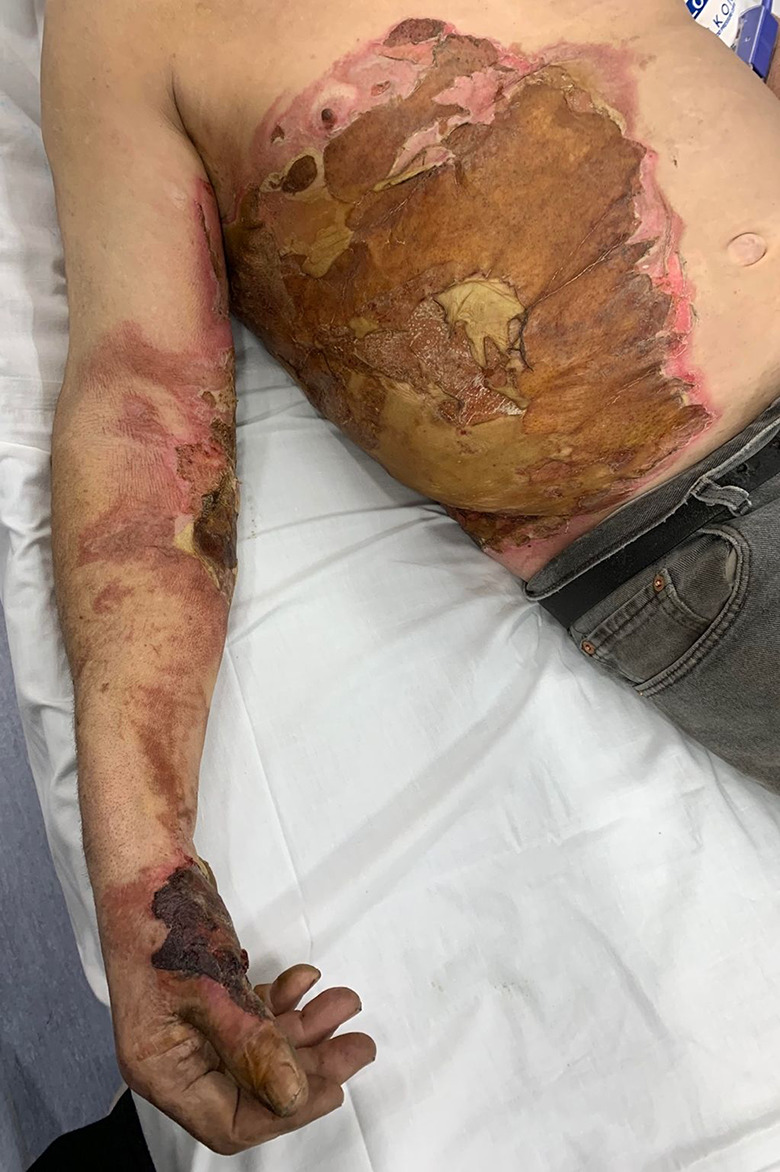
Figure 1.
Figure 1.
A 74-year-old man with severe burn injury. Note the skin sloughing on the abdomen and the necrotic eschar on the hand.
Figure 2.
Figure 2.
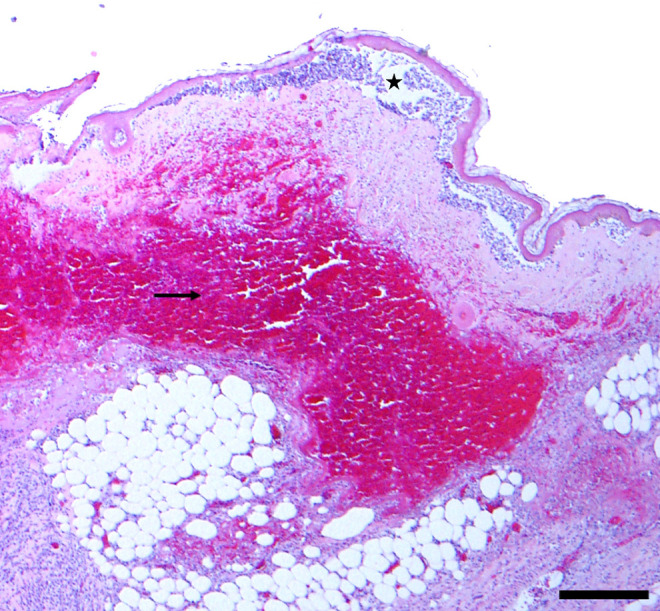
Low magnification (×40) image immediately after a burn showing separation of the epidermis from the dermis consistent with blister formation (star) and hemorrhage (arrow) in the dermis. Hematoxylin and eosin stain. Scale bar = 250 micrometer.
Figure 3.
Figure 3.
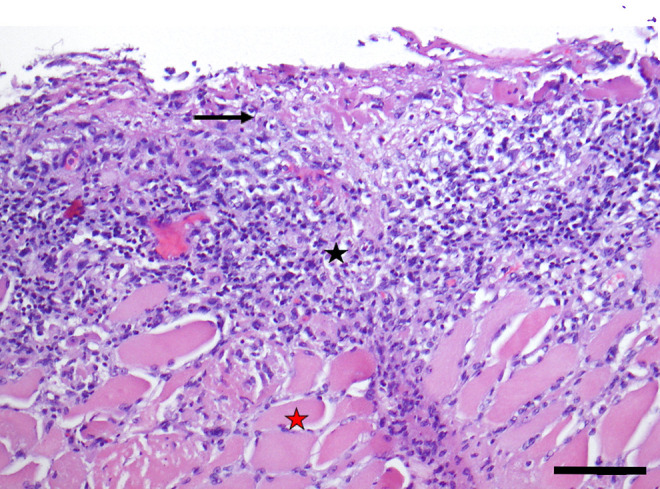
High-magnification image (×200) showing denudation and sloughing of the epidermis after burn injury (arrow). Inflammation in the dermis including neutrophils and lymphocytic infiltrate, heralding the attempts at repair, is also shown (black star). Neutrophils are seen near the sloughing epidermal surface, while the dermal infiltrate is lymphocyte-predominant. Note the underlying skeletal muscle below the dermis (red star) with minimal hypodermis, consistent with an area of the body with minimal subcutaneous adipose tissue. Hematoxylin and eosin stain. Scale bar = 100 micrometers.

References

    1. Knollmann-Ritschel BEC, Regula DP, Borowitz MJ, Conran R, Prystowsky MB. Pathology competencies for medical education and educational cases. Acad Pathol. 2017;4. doi:10.1177/2374289517715040 - PMC - PubMed
    1. Hettiaratchy S, Papini R. Initial management of a major burn: II—assessment and resuscitation. BMJ. 2004;329:101–103. doi:10.1136/bmj.329.7457.101 - PMC - PubMed
    1. Hettiaratchy S, Dziewulski P. Pathophysiology and types of burns. BMJ. 2004;328:1427–1429. doi:10.1136/bmj.328.7453.1427 - PMC - PubMed
    1. Kagan RJ, Peck MD, Ahrenholz DH, et al. Surgical management of the burn wound and use of skin substitutes: an expert panel white paper. J Burn Care Res. 2013;34:e60–79. doi:10.1097/BCR.0b013e31827039a6 - PubMed
    1. Serrano C, Boloix-Tortosa R, Gómez-Cía T, Acha B. Features identification for automatic burn classification. Burns. 2015;41:1883–1890. doi:10.1016/j.burns.2015.05.011 - PubMed