


Estimating the population at high risk for tuberculosis through household exposure in high-incidence countries: a model-based analysis
- PMID: 34870135
- PMCID: PMC8626652
- DOI: 10.1016/j.eclinm.2021.101206
Estimating the population at high risk for tuberculosis through household exposure in high-incidence countries: a model-based analysis
Abstract
Background: Household contacts of people with pulmonary tuberculosis (TB) have greater risk of developing TB. Recent guidelines conditionally recommended TB preventive treatment (TPT) for household contacts of any age living in TB high-incidence countries, expanding earlier guidance to provide TPT to household contacts under five. The all-age population of household contacts has not been estimated.
Methods: Our model-based estimation included 20 countries with >80% of incident TB globally in 2019. We developed country-specific distributions of household composition by age and sex using bootstrap resampling from health surveys and census data. We incorporated age-, sex-, year-, and location-specific estimates of pulmonary TB incidence from the Global Burden of Diseases, Injuries, and Risk Factors Study 2019 to estimate the population in each country sharing a household with someone with incident pulmonary TB, and quantified uncertainty using a Monte Carlo approach.
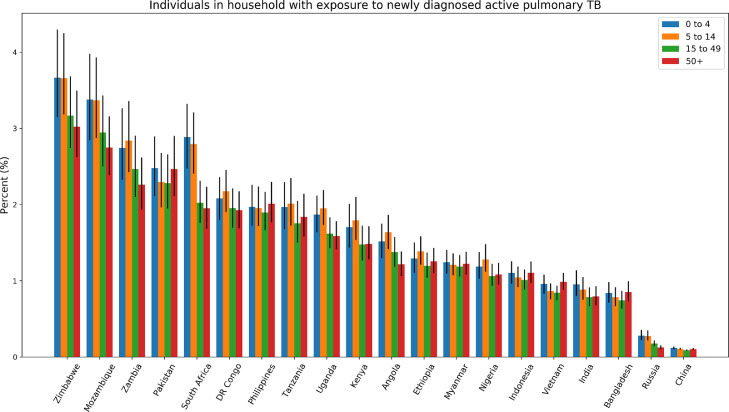
Findings: We estimate that 38 million [95% uncertainty interval (UI) 33- 43 million] individuals lived in a household with someone with incident pulmonary TB in 2019 in these 20 countries. Children under five made up 12% of the population with household exposure, while adults were 65%. Zimbabwe, Mozambique, Zambia, and Pakistan had the highest proportion of the population with household exposure, while India had the highest number of contacts (11·4 million, 95% UI 9·7-13·4 million).
Interpretation: Expanding TPT evaluation to household contacts of all ages in high-incidence countries could include a population more than 7-times larger than the under-5 contacts previously prioritized. This would substantially increase the impact of household contact investigation on reducing TB morbidity and mortality.
Funding: JMR is supported by the National Institute of Allergy and Infectious Diseases (K01 AI138620). This research was funded in part by a 2020 developmental grant from the University of Washington / Fred Hutch Center for AIDS Research, an NIH funded program under award number AI027757 which is supported by the following NIH Institutes and Centers: NIAID, NCI, NIMH, NIDA, NICHD, NHLBI, NIA, NIGMS, NIDDK. This work was funded in part by the National Science Foundation (DMS-1839116).
Conflict of interest statement
JMR reports grants from the National Institutes of Health during the conduct of the study. JBD reports other financial or non-financial interests from Sanofi. AES reports grant funding from the National Institutes of Health, Bill & Melinda Gates Foundation, and Vir Biotechnology. AES also reports serving on a data safety monitoring board. ADF reports work related to data licensing and analysis with Sanofi during the conduct of the study. ADF reports personal fees from Kaiser Permanente and NORC and other relationship with Agathos, Ltd outside of the submitted work. All other authors have nothing to declare.
Figures
References
-
- World Health Organization. Global Tuberculosis Report 2020. Geneva, Switzerland: World Health Organization, 2020.
-
- United Nations General Assembly. Transforming our world : the 2030 Agenda for Sustainable Development. 2015 https://sdgs.un.org/goals.
-
- Fox GJ, Nhung NV, Sy DN, et al. Household-Contact Investigation for Detection of Tuberculosis in Vietnam. N Engl J Med. 2018;378:221–229. - PubMed
Grants and funding
LinkOut - more resources
Full Text Sources
