


Can the application of graphene oxide contribute to the fight against COVID-19? Antiviral activity, diagnosis and prevention
- PMID: 34870157
- PMCID: PMC8491929
- DOI: 10.1016/j.crphar.2021.100062
Can the application of graphene oxide contribute to the fight against COVID-19? Antiviral activity, diagnosis and prevention
Abstract
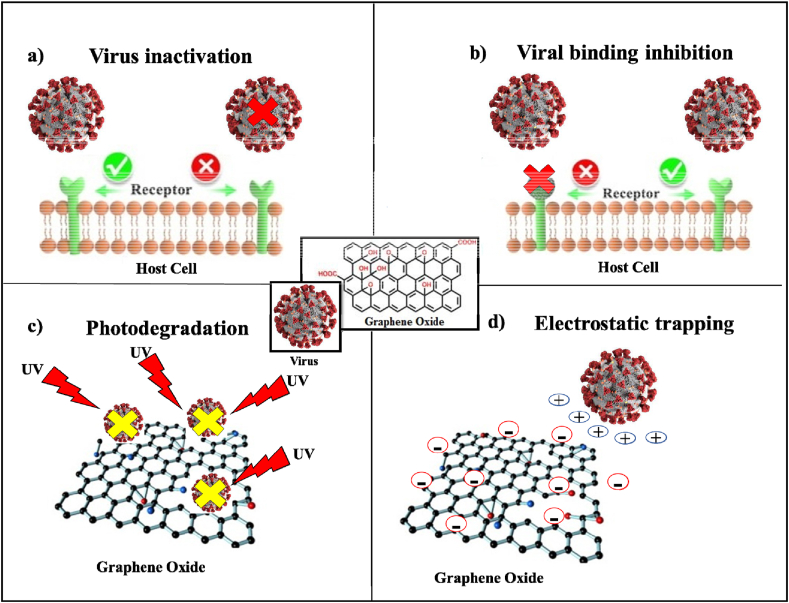
COVID-19 is an infectious disease that affects the respiratory system and is caused by the novel coronavirus SARS-CoV-2. It was first reported in Wuhan, China, on December 31, 2019, and has affected the entire world. This pandemic has caused serious health, economic and social problems. In this situation, the only solution to combat COVID-19 is to accelerate the development of antiviral drugs and vaccines to mitigate the virus and develop better antiviral methods and excellent diagnostic and prevention techniques. With the development of nanotechnology, nanoparticles are being introduced to control COVID-19. Graphene oxide (GO), an oxidized derivative of graphene, is currently used in the medical field to treat certain diseases such as cancer. It is characterized by very important antiviral properties that allow its use in treating certain infectious diseases. The GO antiviral mechanism is discussed by the virus inactivation and/or the host cell receptor or by the physicochemical destruction of viral species. Moreover, the very high surface/volume ratio of GO allows the fixation of biomolecules by simple absorption. This paper summarizes the different studies performed on GO's antiviral activities and discusses GO-based biosensors for virus detection and approaches for prevention.
Keywords: Antiviral activity; Biosensors; COVID-19; Coronavirus SARS-CoV-2; Detection; Graphene oxide; Pandemic; Prevention.
© 2021 Published by Elsevier B.V.
Conflict of interest statement
The authors declare that they have no known competing financial interests or personal relationships that could have influenced the work reported in this paper.
Figures
References
-
- Alayande A.B., Chae S., et al. Kim I.S. « Surface morphology-dependent spontaneous bacterial behaviors on graphene oxide membranes ». Separ. Purif. Technol. 2019;226:68–74.
-
- Afroj S., Tan S., Abdelkader A., Novoselov K., et al. Karim N. « highly conductive, scalable, and machine washable graphene-based E-textiles for multifunctional wearable electronic applications ». Adv. Funct. Mater. 2020;30:2000293. doi: 10.1002/adfm.202000293. avr. - DOI
-
- Akhavan O., Choobtashani M., Ghaderi et E. « protein degradation and RNA efflux of viruses photocatalyzed by graphene–tungsten oxide composite under visible light irradiation ». J. Phys. Chem. C. 2012;116(17):9653–9659. doi: 10.1021/jp301707m. mai. - DOI
Publication types
LinkOut - more resources
Full Text Sources
Miscellaneous
