Review
. 2022 Feb:19:100399.
doi: 10.1016/j.bbih.2021.100399. Epub 2021 Nov 30.

Neurological consequences of COVID-19 and brain related pathogenic mechanisms: A new challenge for neuroscience

Affiliations
Review

Neurological consequences of COVID-19 and brain related pathogenic mechanisms: A new challenge for neuroscience

Fiorella Sarubbo et al. Brain Behav Immun Health. 2022 Feb.

Abstract

Due to the infection by the SARS-CoV-2 virus (COVID-19) there were also reported neurological symptoms, being the most frequent and best cited those that affect the cerebrovascular, sensorial, cognitive and motor functions, together with the neurological diffuse symptoms as for examples headache or dizziness. Besides, some of them behave high risk of mortality. Consequently, it is crucial to elucidate the mechanisms of action in brain of SARS-CoV-2 virus in order to create new therapeutic targets to fight against this new disease. Since now the mechanisms of arrival to the brain seems to be related with the following processes: blood brain barrier (BBB) disruption together with nervous or axonal transport of the virus by the trigeminal nerve, the vagus nerve, or the brain-gut-axis. Being two the mechanisms of brain affectation most cited: a direct affectation of the virus in the brain through neuroinvasion and an indirect mechanism of action due to the effects of the systemic infection. Both processes include the triggering of inflammation, hypoxia and the increased likelihood of secondary infections. This topic supposes a major novel challenge for neuroscience. Therefore, the aim of this review is to provide summarized information about the neurological symptomatology and the brain pathogenic mechanisms involved and reported in COVID-19.

Keywords: Brain; COVID-19; Neuroinvasion; Neurological symptoms; Neuroscience; SARS-CoV-2.


Conflict of interest statement

The authors have no conflicts of interests, financial or otherwise.

Figures
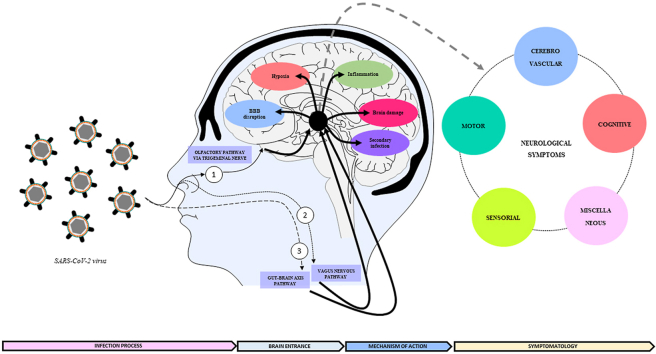
Image 1
Graphical abstract
Fig. 1
Fig. 1
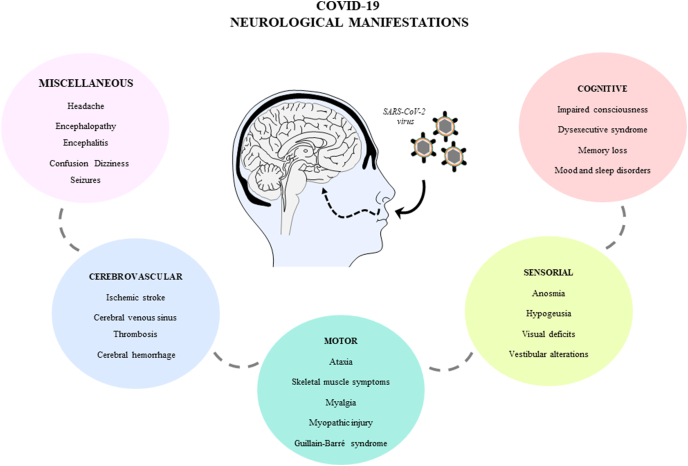
Leading neurological manifestations in COVID-19. Symptoms are classified in miscellaneous, cerebrovascular, motor, sensorial and cognitive.
Fig. 2
Fig. 2
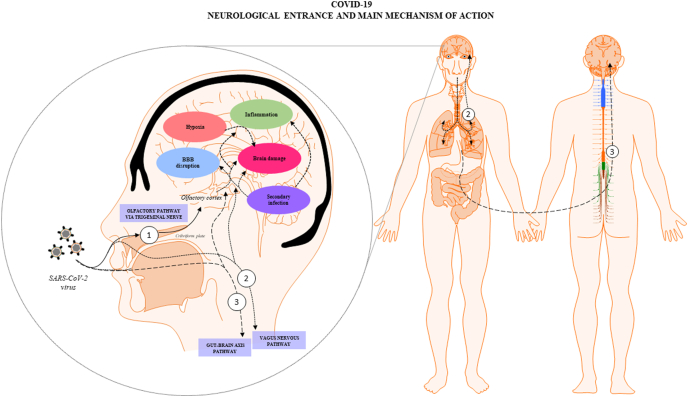
COVID-19 neurological entrance and main mechanisms of action: SARS-CoV-2 viruses could affect brain tissue and generate neurological symptomatology directly by neuroinvasion, arriving to the brain through several pathways such as: (1) the olfactory route via the trigeminal nerve, (2) the vagus nervous in connection with the lungs and (3) the gut-brain axis; or indirectly as a consequence of the effects of the systemic infection, such as hypoxia or hyperthermia. In both cases several mechanisms could be triggered such as BBB disruption, inflammation, and increased risk of secondary infections, among others, all of them being interconnected. The final result is the generation of brain dysfunction and the onset of the mentioned neurological symptomatology in COVID-19 patients.
Fig. 3
Fig. 3
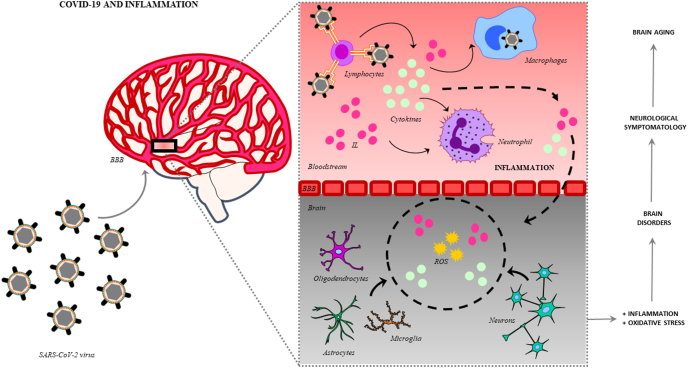
COVID-19 and inflammation: lymphocytes detect SARS-CoV-2 virus, and through triggering the production of cytokines and interleukins (IL) stimulate the immune system and the virus clearance by the activation of macrophages and neutrophils, generating also an inflammatory state. Among other factors, hyperthermia generated by the infection together with the increased of inflammation favor the disruption of the BBB. These processes become viruses able to move from the bloodstream to the brain tissue, escaping from the immune system and stimulating neural and glial cells (astrocytes, oligodendrocytes, microglial cells). Due to the whole inflammatory process at the same time, it is produced an overproduction of ROS, increasing the oxidative state. Altogether these imbalances produce brain dysfunction and damage, being observed by the onset of neurological symptomatology, generating altogether a risk factor for brain aging.

References

    1. Abbas R., El Naamani K., Sweid A., Schaefer J., Al E. Intracranial hemorrhage in COVID-19 patients: a case series. World Neurosurg. 2021:S1878–S1887. 0. - PMC - PubMed
    1. Abbatecola A.M., Antonelli-Incalzi R. COVID-19 spiraling of frailty in older Italian patients. J. Nutr. Heal. Aging. 2020 doi: 10.1007/s12603-020-1357-9. - DOI - PMC - PubMed
    1. Abboud H., Abboud F.Z., Kharbouch H., Arkha Y., El Abbadi N., El Ouahabi A. 2020. COVID-19 and SARS-cov-2 infection: pathophysiology and clinical effects on the nervous system. World neurosurg. - PMC - PubMed
    1. Abenza Abildúa M.J., Atienza S., Carvalho Monteiro G., Erro Aguirre M.E., Imaz Aguayo L., Freire Álvarez E., García-Azorín D., Gil-Olarte Montesinos I., Lara Lezama L.B., Navarro Pérez M.P., Pérez Sánchez J.R., Romero Delgado F., Serrano Serrano B., Villarreal Vitorica E., Ezpeleta Echávarri D. 2021. Encephalopathy and encephalitis during acute SARS-CoV-2 infection. Spanish Society of Neurology’s COVID-19 Registry. Neurol. English Ed. 36. - DOI - PMC - PubMed
    1. Adamzik M., Görlinger K., Peters J., Hartmann M. Whole blood impedance aggregometry as a biomarker for the diagnosis and prognosis of severe sepsis. Crit. 2012 doi: 10.1186/cc11816. Care 16. - DOI - PMC - PubMed