Cargo sorting at the trans-Golgi network at a glance
- PMID: 34870705
- PMCID: PMC8714066
- DOI: 10.1242/jcs.259110
Cargo sorting at the trans-Golgi network at a glance
Abstract
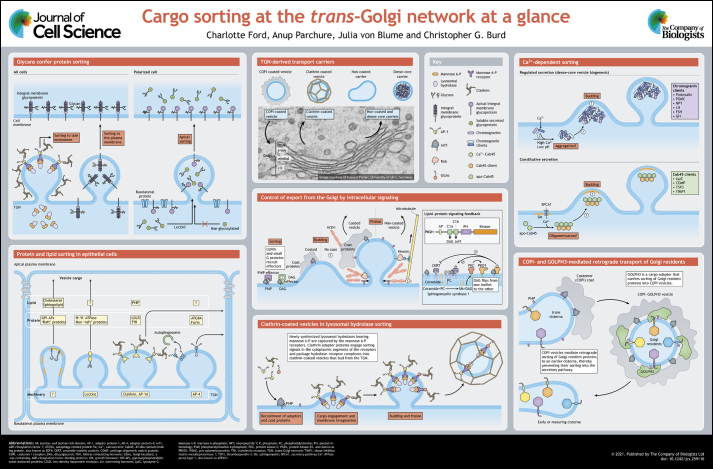
The Golgi functions principally in the biogenesis and trafficking of glycoproteins and lipids. It is compartmentalized into multiple flattened adherent membrane sacs termed cisternae, which each contain a distinct repertoire of resident proteins, principally enzymes that modify newly synthesized proteins and lipids sequentially as they traffic through the stack of Golgi cisternae. Upon reaching the final compartments of the Golgi, the trans cisterna and trans-Golgi network (TGN), processed glycoproteins and lipids are packaged into coated and non-coated transport carriers derived from the trans Golgi and TGN. The cargoes of clathrin-coated vesicles are chiefly residents of endo-lysosomal organelles, while uncoated carriers ferry cargo to the cell surface. There are outstanding questions regarding the mechanisms of protein and lipid sorting within the Golgi for export to different organelles. Nonetheless, conceptual advances have begun to define the key molecular features of cargo clients and the mechanisms underlying their sorting into distinct export pathways, which we have collated in this Cell Science at a Glance article and the accompanying poster.
Keywords: Calcium; Clathrin; Epithelial cells; Glycoprotein; Golgi; Lipids; Secretion.
© 2021. Published by The Company of Biologists Ltd.
Conflict of interest statement
Competing interests The authors declare no competing or financial interests.
References
-
- Anitei, M., Stange, C., Parshina, I., Baust, T., Schenck, A., Raposo, G., Kirchhausen, T. and Hoflack, B. (2010). Protein complexes containing CYFIP/Sra/PIR121 coordinate Arf1 and Rac1 signalling during clathrin-AP-1-coated carrier biogenesis at the TGN. Nat. Cell Biol. 12, 330-340. 10.1038/ncb2034 - DOI - PMC - PubMed
Publication types
MeSH terms
Grants and funding
LinkOut - more resources
Full Text Sources
Miscellaneous